Core definition
RTP is a long-run design percentage
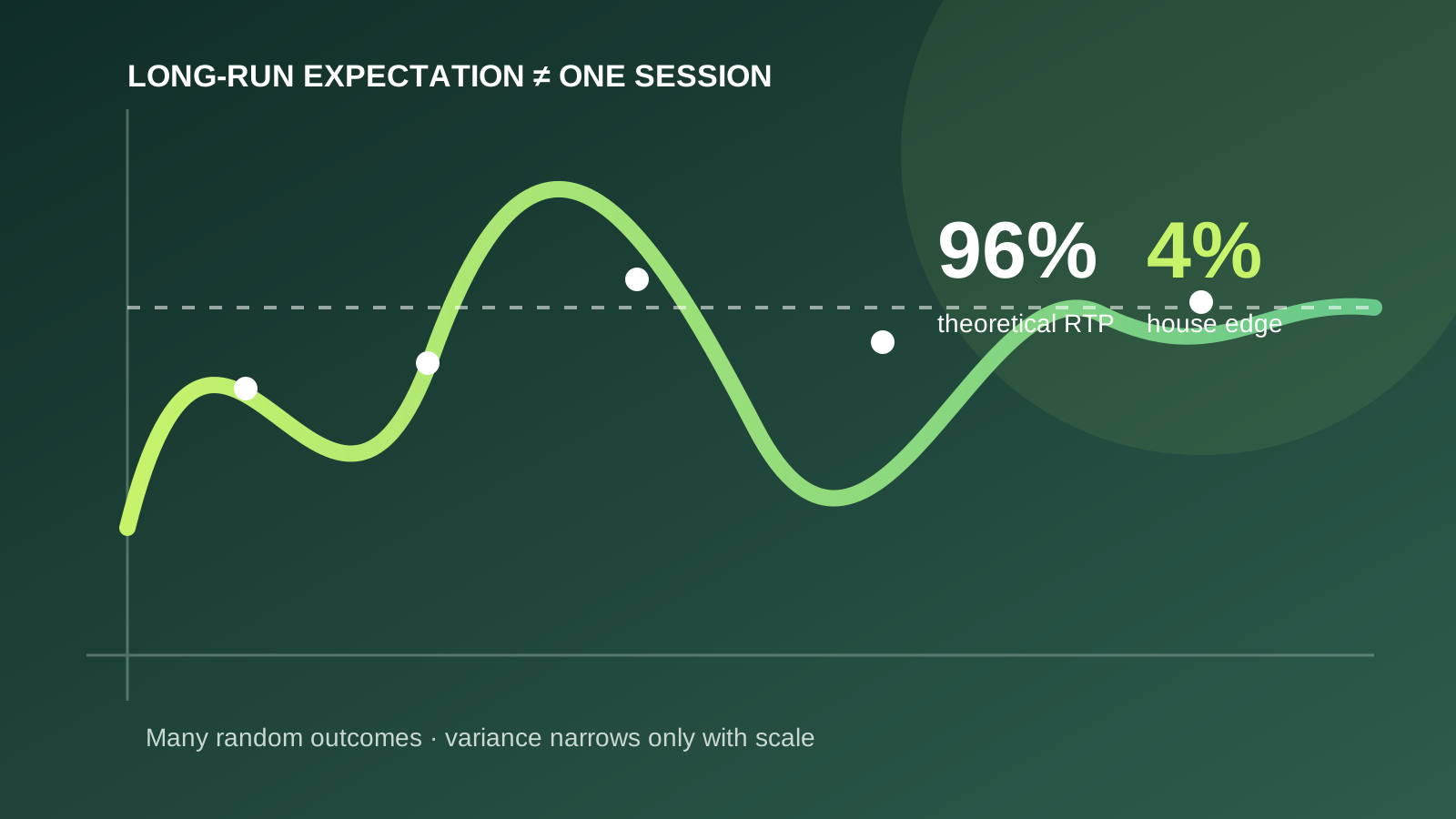
Return to Player, or RTP, expresses the proportion of all stakes that a game is designed to pay back as prizes over a sufficiently large volume of play. If a slot has a theoretical RTP of 96%, its mathematical model targets $96 in prizes for every $100 of aggregate turnover in the long run.
The words “aggregate,” “turnover” and “long run” carry most of the meaning. The percentage covers many rounds, potentially across many players. It does not allocate a personal refund to each account and it does not set a timetable for when prizes must appear.
Evolution's official slot explainer says RTP is paid back on average and is calculated over a long time and multiple players; an individual can receive more or less in the short term. The UK Gambling Commission similarly distinguishes the designed, advertised theoretical RTP from actual RTP calculated from live wins and turnover.
A useful reading is therefore: “this is the model's average return at scale.” An unhelpful reading is: “this session should give me this percentage back.” The first describes a mathematical expectation. The second invents a guarantee that the percentage does not contain.
Complement
House edge is 100% minus RTP
For an ordinary slot with all stake and prize outcomes included, the theoretical house edge is the portion of turnover not returned as prizes in the long-run model. The formula is simple:
House edge = 100% − theoretical RTPA 96% RTP corresponds to a 4% theoretical house edge. A 94.2% RTP corresponds to a 5.8% edge.
RTP and house edge describe the same model from opposite sides. RTP focuses on expected prizes returned to players; house edge focuses on the expected share retained before operating costs, promotions and other business items.
The edge is not a charge deducted evenly from every spin. A $1 round does not normally return $0.96 and remove four cents. Most rounds have discrete outcomes: zero, a small prize, a stake-returning prize, or an uncommon large prize. The average emerges only when those outcomes are combined at scale.
Comparing edges can make RTP variants easier to understand. Moving from 96.2% RTP to 84.2% RTP changes the theoretical edge from 3.8% to 15.8%. The game may look identical, but the designed long-run cost per unit of turnover is more than four times as large at the lower setting.
Money model
Expected value is not a predicted balance
Expected value translates the percentage into an average monetary result. If total turnover is $500 on a 96% theoretical RTP game, expected prizes are $480 and the expected loss is $20. The calculation is $500 × 0.96 for prizes, or $500 × 0.04 for expected loss.
That $20 is an expectation across the model, not a bill that the game settles exactly. A player might lose the full $500 of turnover, finish ahead, or land anywhere between. The expected value becomes a more stable description only as the number of independent observations grows.
Mathematically, the expected return of one round is the sum of each possible prize multiplied by its probability. Slot developers combine the full paytable, symbol distribution, feature probabilities, multipliers and maximum-win rule to calculate the certified game return.
A player cannot reconstruct that complete model from a few visible spins. Large prizes may make a meaningful contribution to RTP even though a single person is unlikely to see them. That is why a paytable without probabilities cannot prove the percentage, and why a short demo cannot audit it.
Often confused
Turnover is not the same as a deposit
Turnover, sometimes called handle, is the total amount staked across paid rounds. It can be much larger than the money originally deposited because returned prizes may be staked again.
Suppose a player deposits $100, stakes $1 per round and uses small wins to continue until 400 paid rounds have been bought. The turnover is $400 even though the starting deposit was $100. At a 4% theoretical edge, expected loss is calculated from $400, giving $16—not from the deposit alone.
This does not mean the player will lose exactly $16 or retain $84. The result distribution still applies. It means repeated recycling creates more exposure to the mathematical edge. Time and speed can therefore matter as much as the initial wallet amount.
Promotional wagering requirements are also written in turnover-like terms. A requirement of 30 times a bonus can demand far more stakes than the bonus value. Game contribution rates, maximum-bet clauses and expiry periods sit outside RTP and should be analysed separately.
When estimating an affordable session, multiply total stake by the maximum number of paid rounds, not by the number of minutes you hope the balance will last. Assume that the allocated amount can be lost and avoid treating expected loss as a stop-loss guarantee.
Variance in action
Why one session can be nowhere near RTP
A slot produces random, discrete outcomes. In a small sample, uncommon prizes may be absent or disproportionately influential. One feature can move a session from a large loss to a profit, while a long run without it can leave the result well below the designed return.
The UK Gambling Commission's monitoring guidance demonstrates the principle with tolerance ranges. A live game's actual RTP can sit meaningfully above or below the designed figure when the sample is limited; the acceptable range narrows as more games are measured.
This is the law of large numbers in practical form. More independent rounds make the sample average tend towards the expectation, but they do not force a personal balance to recover. Playing longer also exposes more money to the edge.
A common error is to calculate “personal RTP” after fifty spins and compare it with 96%. That number describes only a tiny realised sample. It may be interesting as a session record, but it is not evidence that the published theoretical setting is wrong.
The same applies to a profitable session. Finishing above 100% actual return does not turn a negative-expectation game into a positive one. It records what happened, not what the next round is expected to do.
Use the RTP sample-size simulator to see this spread across many repeat trials in a transparent two-outcome teaching model. Its chart illustrates sampling variation; it is not a certified distribution for a named game.
Distribution, not return
Volatility changes the path, not automatically the RTP
Volatility describes how prizes are distributed around the average. A lower-volatility game tends to concentrate more return in smaller, more frequent awards. A higher-volatility game tends to place more return in rarer, larger outcomes.
Two games can both have 96% RTP and deliver very different sessions. The lower-volatility title may produce more stake returns and small wins. The higher-volatility title may produce long losing stretches punctuated by a large feature.
Neither pattern changes the meaning of 96%. RTP describes the long-run mean; volatility describes dispersion. Maximum win adds another boundary, while hit frequency—when officially supplied—describes how often any defined win occurs. These metrics answer different questions. The separate slot volatility and hit-frequency guide shows why frequent small returns can coexist with a volatile tail.
Provider volatility scales are not universal. A level 7 from one studio may not match “high” at another. Use an exact first-party numeric scale where available and avoid translating it into a confident industry category without a documented mapping.
Evolution notes that slots can experience hot and cold streaks and that volatility itself is an average. A streak is therefore compatible with the model; it is not proof that the game has entered a different state.
Independent rounds
Previous wins and losses do not create a debt
In a random slot, outcomes are produced by a random number generator and are independent of previous spins. Evolution states that outcomes are random and that one round does not depend on the preceding one. The UK Gambling Commission's player guide likewise says the odds in a random machine are not affected by earlier wins or losses.
This rules out the gambler's fallacy. Ten losing spins do not make a win due. A recent jackpot does not make the machine unable to pay another. The probability distribution for the next round remains the one specified by the current game state and rules.
Some features visibly carry progress within a paid round or across documented meters. That is not the same as a hidden recovery mechanism. Use the help to determine what state persists. Do not infer that the game compensates for money lost.
Changing stake, stopping the reels, switching devices or returning later does not make an independent random outcome remember a session. Interface actions matter only where the rules explicitly give them a role, such as selecting a payline or feature choice.
For the testing standard, conditional-probability explanation and stateful exceptions, read the dedicated independent RNG outcomes guide.
Same art, different maths
One title can have several RTP configurations
Modern providers may certify several mathematical settings for the same title. The reels, animations and feature names can remain identical while symbol weights or feature probabilities change behind the interface.
Play'n GO game summaries reviewed elsewhere on this site commonly list five settings such as 96.2%, 94.2%, 91.2%, 87.2% and 84.2%. The existence of a 96.2% build does not prove that every operator uses it.
The live help is therefore the decisive consumer-facing check. Open the deployed client and find RTP, theoretical return, payout percentage or game rules. If the number is absent, unclear or different from the review, do not substitute the provider's maximum.
Record the title, provider, game ID or version if available, percentage, operator and date. That evidence is more useful than a screenshot of a search result because it ties the number to the exact build.
When comparing a public freeplay client with an operator build, use the demo versus real-money settings checklist. It keeps version, currency, stake, optional modes and maximum-win wording beside the RTP instead of treating matching artwork as proof of matching mathematics.
Whole-game total
Base game and features contribute to one RTP
A slot's headline RTP normally combines all award paths included in its mathematical model: base-game line or cluster wins, Wild substitutions, free spins, respins, multipliers, jackpots where specified, and the maximum-win rule. Our progressive versus fixed jackpots guide explains when a contribution, live prize pool and ordinary cap must be separated.
The provider may publish feature-specific returns in specialist documentation, but those figures should not be invented by subtracting a few observed outcomes. A feature that appears rarely can still contribute a substantial share of the theoretical return.
Bonus buys or ante bets, where present, may have their own cost and RTP. They should be treated as distinct modes only when the live help provides separate rules. This guide does not assume that buying a feature improves expected value.
A maximum win does not reveal RTP. One game can offer a very high cap with a lower return, while another offers a smaller cap and a higher return. The cap describes a boundary; RTP describes the weighted average of all outcomes.
Two measurements
Theoretical RTP versus actual RTP
Theoretical RTP is calculated from the game's designed probabilities and prizes. Actual RTP is calculated from real results: total wins divided by total turnover for a chosen period or sample.
The UK Gambling Commission gives the formula directly. If a game records $1,085,000 in wins from $1,200,000 in turnover, actual RTP is 90.42%. That does not by itself prove a fault if the theoretical return is higher; the sample size and volatility determine the expected tolerance.
Operators and suppliers use actual performance monitoring to detect sustained deviations. A player's short session does not have the scale or information needed for that control process. Sequential, statistically significant failures matter more than one low sample.
When reading operator reports, check the period, turnover volume, game version and whether jackpots are included. An actual RTP number without those fields can be accurate yet unsuitable for comparison with a theoretical figure.
Decision use
How to compare two slots responsibly
First match the exact deployed RTP. A 96.2% setting has a smaller theoretical edge than 94.2%, all else equal. The difference matters most across repeated turnover; it does not rank which game will pay the next session.
Second compare volatility. Choose a distribution consistent with the loss swings you can tolerate, not a label that promises excitement. Third compare maximum win and feature structure for understanding, not as a reason to chase a rare event.
Also separate return from evaluation geometry. The paylines, ways and cluster-pays guide explains why a larger ways count or smaller cluster threshold does not create a higher RTP by itself.
Fourth inspect total stake, speed and controls. A slightly higher RTP can be outweighed in practical exposure if the game encourages a much larger stake or many more rounds. RTP is one input to a budget, not a safety certificate.
Finally verify the operator separately. An accurate game percentage does not establish territorial access, withdrawal quality or regulatory status. Game mathematics and operator due diligence are parallel tasks.
Fast corrections
Six common RTP myths
- “96% means I get $96 back from $100.” It describes aggregate long-run turnover, not a personal refund.
- “The slot must repay a losing streak.” Independent rounds do not track a debt to the player.
- “A demo proves the return.” A short sample cannot measure the model, and demo access does not prove operator availability.
- “Higher RTP means I will win tonight.” It lowers theoretical cost, all else equal, but session variance remains wide.
- “Maximum win tells me the RTP.” A cap is one outcome boundary; probability weights determine the average.
- “Provider RTP is always the operator RTP.” Multiple certified settings may exist, so the deployed help must be checked.
Practical control
Turn the maths into limits
Choose a fixed entertainment budget that is affordable to lose. Divide it by the total bet to see the maximum number of full-loss rounds it represents. Set a time limit too, because returned prizes can extend turnover beyond the initial cash amount.
Avoid loss-chasing. Increasing stake after a bad sequence raises the amount exposed but does not improve the random probability of the next round. Do not treat an expected-loss calculation as permission to exceed the budget.
An optional post-win decision needs its own probability check. Our double-or-nothing gamble guide shows why an apparently neutral colour or suit choice can preserve expected value while sharply increasing the chance of losing the award already won.
Use deposit, spend and time controls where available. Stop when the pre-set boundary is reached, regardless of whether a feature meter looks close. A visible progress bar can define a game mechanic without making continued spending affordable.
If gambling is no longer recreational, use the support and exclusion links on our responsible gambling page. Mathematical understanding helps identify cost, but it cannot make a negative-expectation game a source of income.
Local context
What New Zealand readers still need to verify
This guide explains a mathematical concept and does not recommend an operator. Before any real-money play, verify current New Zealand guidance, the operator's identity and territorial terms, age controls, payments, withdrawals, complaints and safer-gambling tools.
The Department of Internal Affairs information was checked on 6 October 2026. The regulatory environment is time-sensitive, so use its current player guidance and our dated legal-status page rather than relying on an old general statement.
An NZD wallet, New Zealand flag or localised advert does not prove authorisation. Equally, a correct 96% RTP does not prove that the operator is suitable or that the exact game is available in New Zealand.
Keep evidence layers separate: official regulator guidance for status, operator terms for access and account rules, and the live game help for RTP and mechanics. That separation prevents one accurate percentage from lending credibility to unrelated claims.
Worked examples
Three calculations—and their limits
Example 1: convert RTP to edge
A game displays 96.2% RTP. The theoretical house edge is 100 − 96.2 = 3.8%. At $1,000 turnover, the expected loss is $38. The actual result can still be a profit or a much larger loss.
Example 2: compare configurations
The same title is available at 96.2% and 84.2%. Their theoretical edges are 3.8% and 15.8%. Across $1,000 turnover, expected losses are $38 and $158 respectively—a $120 difference in expectation, not a guaranteed difference in two sessions.
Example 3: separate deposit from turnover
A $100 balance is recycled through $500 of paid stakes. At a 4% edge, expected loss is $20 because $500 is the turnover. The player did not deposit $500; repeated staking created $500 of exposure.
To apply the same arithmetic without hiding the assumptions, use our slot session expected-cost calculator. It shows turnover, theoretical prizes and expected cost together, while keeping the output explicitly separate from a one-session forecast.
These examples deliberately ignore promotions, taxes, fees, currency conversion and market rules. They show the mathematical relationship only. Real operator terms must be assessed separately.
Two-minute audit
RTP verification checklist
- Open the exact game at the intended operator.
- Find the information, rules or help panel.
- Record title, provider, Game ID or version where shown.
- Write down the displayed theoretical RTP.
- Calculate house edge as 100% minus RTP.
- Confirm whether a bonus buy or alternate mode has separate maths.
- Check volatility and maximum win as separate measures.
- Use total turnover—not only the deposit—for expected-loss examples.
- Do not use a short demo or session to “test” the percentage.
- Verify operator and New Zealand status through current primary guidance.
If a review conflicts with the live help, the deployed percentage is the relevant figure for that build. Save the date and evidence, and use our corrections process to report the mismatch.
Questions answered
Frequently asked questions
What does 96% RTP mean?
It means the game is designed to return 96% of total stakes as prizes on average over a very large number of rounds. It does not promise $96 back from one $100 deposit or session.
What is the house edge on a 96% RTP slot?
For a standard slot, the theoretical house edge is 100% minus RTP, so 96% RTP corresponds to a 4% theoretical edge.
Can a slot return more than its RTP in one session?
Yes. A short session can finish far above or below the theoretical return. RTP is a long-run design value, and volatility describes how widely outcomes are distributed.
Does a losing streak make a win more likely?
No. In a random game, the probability of the current round is not changed by wins or losses in previous rounds. A streak does not create a debt the game must repay.
Where should I check a slot’s RTP?
Use the information, rules or help panel inside the exact deployed game. Provider documents can list multiple configurations, so a review’s headline percentage may not match the operator build.
Evidence record
Primary sources
Facts and configurations were checked against the following first-party records. A public product page is not proof that a game is available through a New Zealand operator.
- Evolution — Slots: RNG, RTP and volatility overviewChecked 6 October 2026
- UK Gambling Commission — calculating actual RTPChecked 6 October 2026
- UK Gambling Commission — theoretical and actual RTP definitionsChecked 6 October 2026
- UK Gambling Commission — player guide to RTP and random machinesChecked 6 October 2026
- New Zealand Department of Internal Affairs — online gambling for playersChecked 6 October 2026