Short answer
Compare the charged route, not the button name
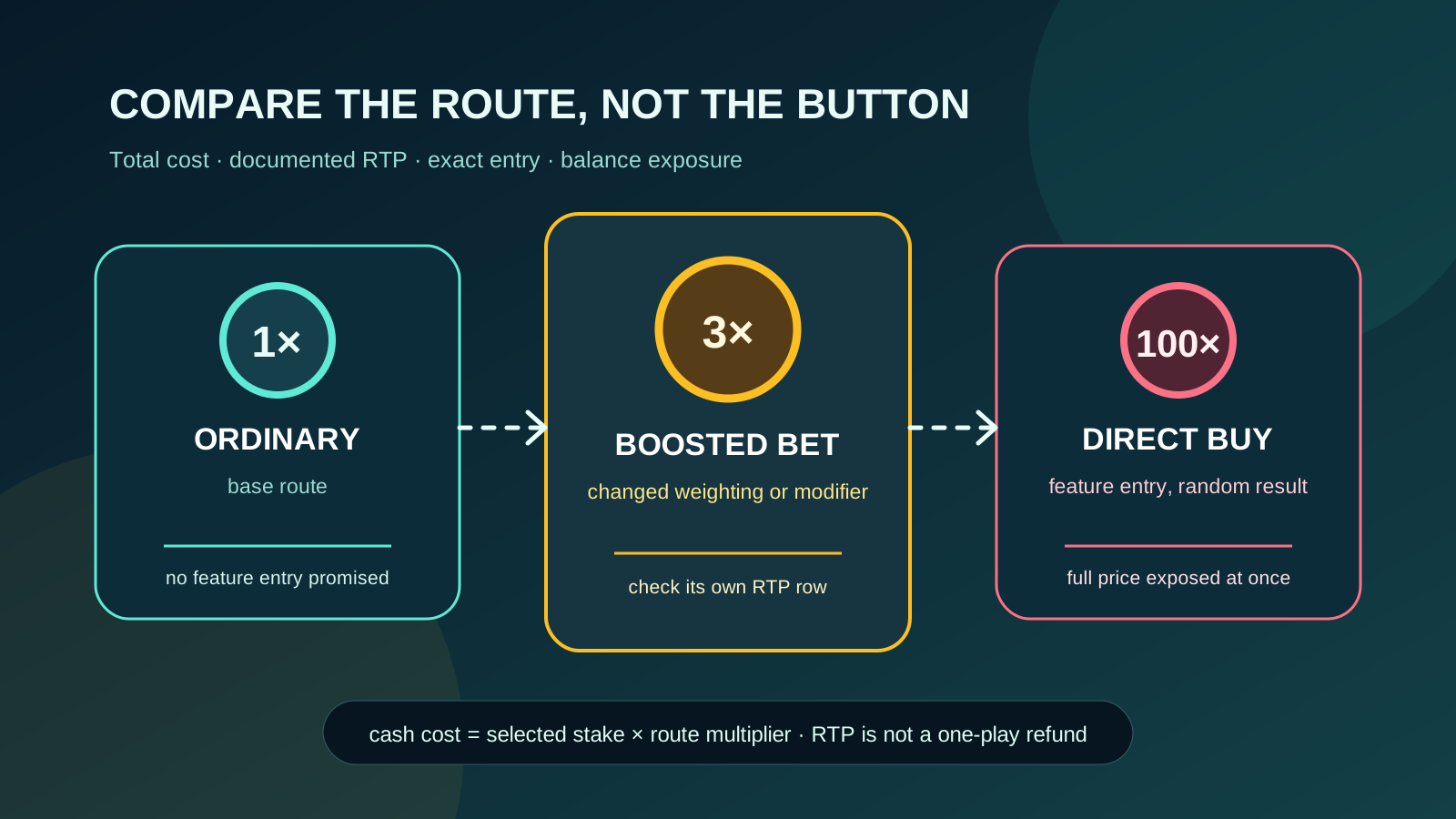
A feature purchase is a priced route inside a game. The interface might call it Buy Bonus, Buy Feature, FeatureSpins, BonusHunt, enhanced bet, ante bet or another branded name. The label is not the mathematics. Before comparing two controls, identify the base stake, the multiplier used to calculate the price, the resulting cash charge, the exact outcome or entry promised, the theoretical RTP for that route and the maximum-win wording in the same build.
Suppose the base stake is a hypothetical $0.20. A 3× boosted spin charges $0.60; a 50× purchase charges $10; a 100× purchase charges $20; and a 500× purchase charges $100. The same multipliers at a $1 stake expose $3, $50, $100 and $500. Expressing the price as “one click” hides that difference.
RTP is a long-run model average, not a refund. A paid route showing 96.50% does not mean 96.50% of its price comes back after one purchase. It can produce zero or a small award, and an uncommon large result can support the model average. Compare affordability and distribution separately from the percentage.
This guide covers controls purchased inside a game. It does not cover a casino welcome bonus, free-spin promotion, cashback, wagering requirement or withdrawal condition. Those are operator terms and need a different evidence chain.
- Price formula
- Stake × displayed multiplier
- RTP evidence
- Exact route in live help
- Guarantee
- Only what rules specify
- Session result
- Never guaranteed
Name the mechanism
Ordinary spins, boosted bets and direct purchases are different controls
An ordinary spin charges the selected total bet and uses the base-game route. It can still trigger a feature naturally, but no trigger is promised. Its published RTP belongs to repeated base-game play under that configuration, including any naturally reached features specified by the rules.
A boosted bet normally charges a multiple of the ordinary stake while play remains on the base grid. Depending on the title, it may increase a Bonus-symbol chance, add a special reel, activate a modifier or change the weighting of an event. “Better chance” is not “guaranteed entry”, and the boost can have its own RTP.
A direct feature purchase charges a much larger multiple and then supplies the condition described in help: for example, a minimum number of Bonus symbols, direct entry to Free Spins or a particular enhanced feature. It does not purchase a fixed prize unless the rules explicitly say so. The feature's random outcomes begin after the charge.
A post-feature purchase or gamble is a fourth practical category. It appears only after a state has been created, and its cost can depend on stored multipliers, collected symbols or the previous award. Joker Split's Buy Extra Spin and Sloth Tumble's progressive-multiplier price are examples. They cannot be compared with a fixed 100× entry without recording the state used to price them.
Controls can be disabled by jurisdiction, operator or account settings. An official product page saying that a feature is “available where permitted” establishes conditional support, not universal access. If the live operator client omits the button, do not assume the same route is hidden elsewhere.
Use one unit
Convert every option into the amount removed from the balance
The cleanest comparison uses total cash exposure. If the help says a purchase costs m times total bet and the selected total bet is b, the charged amount is m × b. If a game instead defines the multiplier against a base denomination before lines, levels or an ante are added, use that stated base. Never assume the word “bet” uses the same unit across games.
| Displayed route | At $0.20 reference stake | At $1 reference stake | What the number means |
|---|---|---|---|
| 3× boosted spin | $0.60 | $3 | Three ordinary stake units charged for that round |
| 50× purchase | $10 | $50 | Fifty stake units charged before the feature |
| 100× purchase | $20 | $100 | One hundred stake units exposed at once |
| 250× purchase | $50 | $250 | Two hundred and fifty stake units exposed |
| 500× purchase | $100 | $500 | Five hundred stake units exposed |
The dollar figures are arithmetic illustrations, not claims that any route is offered in NZD. Their purpose is to expose scale. At the same nominal stake, a 500× control risks the amount of five hundred ordinary spins in one confirmation.
Price should also be compared with a pre-set money limit. Divide that limit by the full purchase cost and round down. A $75 limit covers three hypothetical $20 purchases with $15 left, not 375 “$0.20 spins”. The number of clicks that fit within a limit can collapse rapidly when the multiplier rises.
If the interface changes the total bet after selecting a boost, take the final amount next to the confirm control. Do not calculate from an earlier screen. A useful evidence capture shows the stake, multiplier, cash price, active route name and balance together.
Separate models
A feature purchase can have its own documented RTP
Theoretical RTP is the long-run ratio of modelled awards to stakes for a defined route and configuration. If the base game says 96.10% and Buy Feature says 96.50%, those values describe two routes. It is inaccurate to average them unless the proportion of money placed through each route is known and the calculation is explicitly weighted by stake.
The corresponding theoretical house edges are 3.90% and 3.50%. That 0.40 percentage-point difference is not a promise that a purchase loses less cash in one attempt. Because the purchase exposes many stake units at once, the expected monetary loss per click can still be larger.
For a simplified 100× purchase at a $1 stake with 96.50% RTP, the price is $100 and the long-run expected award is $96.50; the mathematical difference is $3.50 per purchase across the model horizon. One $1 base spin at 96.10% has a $0.039 theoretical difference. This comparison explains exposure per action, not a forecast for either result.
Some product records list several RTP builds for the same title. Hacksaw's official Drop ’em page, for example, lists 96.21%, 94.19%, 92.26% and 88.10% alongside a 3× BonusHunt control. That record proves multiple product returns exist, but it does not, by itself, map each percentage to the boost in every deployed client. Current help must make the mapping.
Never transfer a route percentage from a review of another build. Matching artwork, title and purchase price can coexist with a lower certified return. The active information screen is stronger evidence than a search snippet or a launch announcement.
First-party records
Official examples show why button names are insufficient
Hacksaw Gaming's public catalogue and exact product pages illustrate the variety of costs. Divine Drop lists BonusHunt FeatureSpins at 3×, Wild Divinity at 50×, Tricks of Hades at 100× and Triple Tricks at 250×, with availability qualified by market conditions. Wishbringer lists BonusHunt at 5× and direct options at 50×, 200× and 110×. These are different price points and entry promises within each product, not a universal menu shared by all slots.
The official pages are useful discovery evidence, but route-specific mathematics must still be read in current help. A product card may list overall RTP versions without spelling out which optional route uses which return. We do not manufacture that relationship from the visual order of numbers.
Relax Gaming's current help supplies explicit comparisons. Joker Split v1.0.5 states 96.10% base RTP and 96.50% for its 100× Buy Feature and state-priced Buy Extra Spin. Torii Tumble v1.0.5 states 96.10% base and 96.50% for a 70× purchase. Sloth Tumble v1.0.9 states 96.11% base and 96.50% for 100× Free Spins, 500× Super Free Spins and its post-feature extra spin.
Even when those paid routes share 96.50%, they do not share the same feature, price or outcome distribution. A 500× Super purchase concentrates far more balance exposure into one event than a 70× entry. Equal RTP answers only the long-run return ratio, not which option is affordable or how often an award above cost occurs.
The evidence also shows why a current version matters. A feature price can be updated, an extra tier can be added, or a market client can remove the control. Record the help date and version with the numerical claim.
Long-run arithmetic
Expected value scales with price, while a single outcome stays random
For a route with price C and theoretical RTP r written as a decimal, the long-run expected award is C × r. The corresponding theoretical cost is C × (1 − r). These equations summarise the certified model over a very large horizon. They do not tell you which award the next feature will produce.
Consider a hypothetical 70× purchase at a $0.40 stake. The charge is $28. At 96.50% RTP, its modelled average award is $27.02 and the theoretical difference is $0.98. A result can nevertheless be $2, $60 or another permitted amount. The expected value is not a floor.
A higher RTP route can have a higher expected cash loss per action if it costs much more. A hypothetical $100 purchase at 96.50% has a $3.50 theoretical difference; a $1 ordinary spin at 94% has a $0.06 difference. Comparing only 96.50% versus 94% hides the 100-fold stake difference.
Rounding, currency steps and limits can affect the displayed cash amount. Use the exact amount in the confirmation panel rather than a hand-converted supplier euro example. If the game charges from winnings already accumulated in the round, record both the nominal multiplier cost and the source of funds; value remains at risk even if it is not taken from the opening balance.
Expected value is not a strategy for recovering losses. Buying another feature after a poor one creates new exposure under the same random rules. Previous results do not increase the next purchase's expected return or make a rare award due.
RTP is not frequency
Price, hit rate and volatility answer different questions
RTP describes the average share of stakes returned across the mathematical model. Hit frequency describes how often a defined result occurs. Volatility describes how unevenly return is distributed. A feature route can have a slightly higher RTP while producing fewer awards that exceed its purchase price.
Direct entry removes the waiting time needed to trigger a feature naturally, but it does not remove randomness inside the feature. The purchase can settle below cost on the first spin, and repeated purchases can create long loss sequences. A faster route can therefore increase the rate at which money is exposed.
A boosted bet may increase a trigger chance without guaranteeing one. To evaluate it, the help must state the price and what probability or weighting changes. Marketing words such as “enhanced”, “supercharged” or “more chance” do not provide enough information to calculate value.
Feature frequency should not be inferred by watching a short demo. Rare events make small samples unstable, and automated spins can hide the amount wagered while the sample is collected. If the supplier does not publish a frequency, preserve the gap.
Formal volatility labels should also remain title-specific. An expensive buy or high cap may suggest concentrated risk, but it does not establish a provider's Low, Medium or High classification. Use the exact first-party wording or say that no formal label was found.
Keep units separate
Maximum win, purchase price and jackpot are not the same number
A maximum game win is normally expressed as a multiple of the initiating total bet. A 20,000× cap and a 100× purchase price use multiples for different purposes: the first limits settlement, while the second calculates the charge. Dividing one by the other may describe a theoretical ratio, but it does not give the probability of reaching the cap.
Check whether the cap uses base bet, total bet, feature bet or a reference stake. A review can be wrong by orders of magnitude if it treats a coin value as the full paid amount. The live help's unit controls.
Progressive jackpots require another separation. A connected prize pool can sit outside the ordinary fixed cap, as current Pinata Popper Dream Drop help expressly states. The jackpot contribution and eligibility rules do not turn the ordinary feature-buy price into a claim on a personal share of the pool.
Operator withdrawal conditions are different again. A game can settle an award under its cap while the account remains subject to identity checks, payment processing and contractual limits. Do not replace a game rule with an operator term or imply that a theoretical maximum is immediately withdrawable.
If help does not state a cap, do not copy a launch headline such as “wins up to” and silently convert it into a hard settlement rule. Preserve the gap and explain what the source actually says.
One-row-per-route
Build a comparison worksheet before judging value
| Field | Question to answer | Evidence |
|---|---|---|
| Exact build | What title, game ID, help date and version loaded? | Live information panel |
| Price basis | Base bet or total bet? Fixed or state-dependent? | Help plus confirmation screen |
| Cash charge | How much leaves the balance for this action? | Final displayed total |
| Guaranteed entry | Feature, symbols, boosted chance or one extra spin? | Current rules |
| Route RTP | Does help state a percentage for this exact option? | Current rules |
| Cap | What maximum and unit apply to the route? | Current rules |
| Availability | Is the control enabled in this market and operator? | Deployed client and terms |
Create a separate row for every route. Do not combine “Buy Bonus 1” and “Buy Bonus 2” because they share a screen. If a post-feature price changes with a multiplier, record the formula and the state used for the observed quote.
Mark an unknown as unknown. A blank route RTP is not evidence that it equals the base percentage. A missing frequency is not zero. An unavailable button is not proof the game lacks the route globally.
For comparisons across games, use the same cash reference stake only as an illustration. Real denominational ranges can differ, and one title can cap total bet when another caps a feature bet. Preserve the supplier's unit beside every number.
Two-minute evidence audit
What to read in the live information panel
Open the menu after the game has fully loaded. Record the full title, provider, game ID where shown, help date, version and jurisdiction or market identifier. Then find the RTP section and read every row, not only the first percentage.
Open the feature rules and identify the price, entry condition, number of spins, retained state, retrigger rules, cap and any line saying the option is unavailable in some markets. If a product page and help conflict, current deployed help is stronger for operational details, but the conflict should be preserved for review.
Return to the game screen and select the lowest intended stake without confirming a purchase. Check whether the total bet changes when the option is enabled and whether the purchase price is shown in cash, multiples or both. Cancel and verify that no value was charged.
On mobile, expand clipped help and confirm the same percentages. A responsive layout can hide a table column or put the purchase disclosure behind an additional tab. Screenshots should include the route label and units rather than a cropped number.
If the information panel cannot be accessed before a deposit or paid action, treat the configuration as unverified. A search result, streamer overlay or casino lobby card is not a substitute for the deployed rules.
Configuration boundary
A demo can teach the control but cannot prove the real-money build
An official demo is useful for locating the menu, observing how a purchase confirmation works and reading supplier help without staking money. It can show whether a route is supported by the checked global client and how feature state is displayed.
It cannot establish that an operator offers the same game ID, return model, stake range or optional control. The operator can deploy another certified RTP, remove the buy button or use a different currency step. Compare the demo and real-money help field by field.
Demo outcomes do not validate RTP. Valueless credits can produce a large win or a long dry sequence without saying anything reliable about the certified long-run average. Do not use a short demo to estimate feature frequency or profit probability.
If the demo and paid client disagree, stop and capture both help panels. The mismatch can indicate an update, cache, jurisdictional build or different game ID. The correct article response is to document the conflict, not blend the highest numbers into one attractive specification.
Different contract layer
In-game purchases are not welcome bonuses or wagering terms
A feature purchase is settled by the game engine as a paid route. A casino bonus is a promotion governed by operator terms. A promotion can restrict maximum stake, excluded games, contribution rates, purchase features or withdrawal while leaving the slot's theoretical RTP unchanged.
Using bonus funds on a feature buy can be prohibited even when cash play allows the button. Conversely, a game can disable purchases while an operator offers unrelated free spins. Check promotion eligibility and game mathematics separately.
Do not call the purchase price a wagering requirement. The price is the stake charged for the route; a wagering requirement is the amount promotional funds must be played through under a contract. Combining them creates misleading “cost” calculations.
Likewise, a casino cash-out limit is not the game's maximum win. One belongs to account terms, the other to settlement rules. Verify each source and date independently.
Market evidence
New Zealand availability requires an operator-level check
Official global catalogues show that suppliers publish games and support certain controls. They do not prove that a named operator offers the same route to a person in New Zealand. Territory, age, operator status, account location and product configuration are separate claims.
New Zealand's online-gambling position is time-sensitive. Check the Department of Internal Affairs player guidance and our dated legal-status guide at the point of use. This mathematics page is not legal advice and makes no blanket availability claim.
Before real-money use, verify operator identity, current New Zealand terms, age and location controls, payment and withdrawal rules, complaints, self-exclusion and account limits. A New Zealand flag or NZD balance does not prove authorisation, and a supplier demo does not prove an operator relationship.
After the operator check, repeat the game-help audit. A valid operator relationship does not guarantee the highest RTP, and a high RTP does not validate the operator. Both evidence chains must pass.
No recovery strategy
Set limits around full-price exposure
Decide a total money limit before opening the purchase panel and assume each price can be lost. Translate the limit into a maximum number of whole purchases. If one purchase exceeds the limit, the arithmetic decision is complete: the route does not fit.
Set a time boundary as well. Direct entry shortens the wait for a feature and can compress many stake units into minutes. A clock limit helps counter the misleading impression that fewer clicks mean less exposure.
Do not raise the base stake after a poor feature, switch to a more expensive route to recover a loss, or treat a nearly completed collection as value already earned. Random future outcomes do not compensate for earlier results.
Use operator deposit, loss and time tools where available, and take a break before deciding on a post-feature continuation. A countdown or colourful confirmation is interface pressure, not mathematical evidence.
Verification checklist
Record these fields before relying on a feature-purchase claim
- Match the exact title, provider and game ID.
- Record the live help date, version and market client.
- Identify whether the control is a boost, direct buy or post-feature continuation.
- Read whether the multiplier uses base bet or total bet.
- Convert the displayed price into the cash amount charged.
- Record exactly what the price guarantees and what remains random.
- Capture the route-specific RTP; do not substitute the base percentage.
- Check the cap and its unit in the same build.
- Keep jackpots, casino bonuses and withdrawal terms separate.
- Verify operator identity and New Zealand access independently.
- Assume the full charge can be lost and compare it with a pre-set limit.
- Preserve missing facts and conflicts instead of inventing a precise answer.
For the long-run percentage itself, see slot RTP and house edge explained. For configuration differences, use demo versus real-money settings. For the distinction between game and operator caps, see maximum game win versus cash-out limits.
Questions answered
Frequently asked questions
Does a 100× bonus buy cost one normal spin?
No. It costs one hundred times the selected base stake. At a hypothetical $0.20 stake the charge is $20; at $1 it is $100. Check whether the interface defines the multiplier against base bet or total bet.
Is bonus-buy RTP always higher than base-game RTP?
No. Some documented routes have a higher theoretical RTP, some can be equal or lower, and a game may offer several certified builds. Read the exact route and percentage in the active help.
Does buying a feature guarantee the advertised bonus result?
It guarantees only the entry or condition described in the rules. The feature remains random and can settle below the purchase cost unless the help states a minimum award.
Are boosted spins the same as a feature buy?
Not necessarily. A boosted bet may change symbol frequency, add a modifier or improve the chance of a trigger while keeping play in the base game. A feature buy usually enters a named feature directly.
Can a demo prove the real-money purchase settings?
No. A demo can show controls and current supplier help, but the operator may use another game ID, RTP build, currency range or market configuration. Compare both clients directly.
Is a game feature purchase the same as a welcome bonus?
No. A game purchase is a paid action inside the slot. A welcome bonus is an operator promotion governed by separate eligibility, wagering, contribution and withdrawal terms.
Evidence record
Primary sources
Facts and configurations were checked against the following first-party records. A public product page is not proof that a game is available through a New Zealand operator.
- Hacksaw Gaming — official games catalogueChecked 6 October 2026
- Hacksaw Gaming — Divine Drop product recordChecked 6 October 2026
- Hacksaw Gaming — Drop ’em product recordChecked 6 October 2026
- Hacksaw Gaming — Wishbringer product recordChecked 6 October 2026
- Relax Gaming — official Joker Split help v1.0.5Checked 6 October 2026
- Relax Gaming — official Torii Tumble help v1.0.5Checked 6 October 2026
- Relax Gaming — official Sloth Tumble help v1.0.9Checked 6 October 2026
- New Zealand Department of Internal Affairs — online gambling for playersChecked 6 October 2026