Short answer
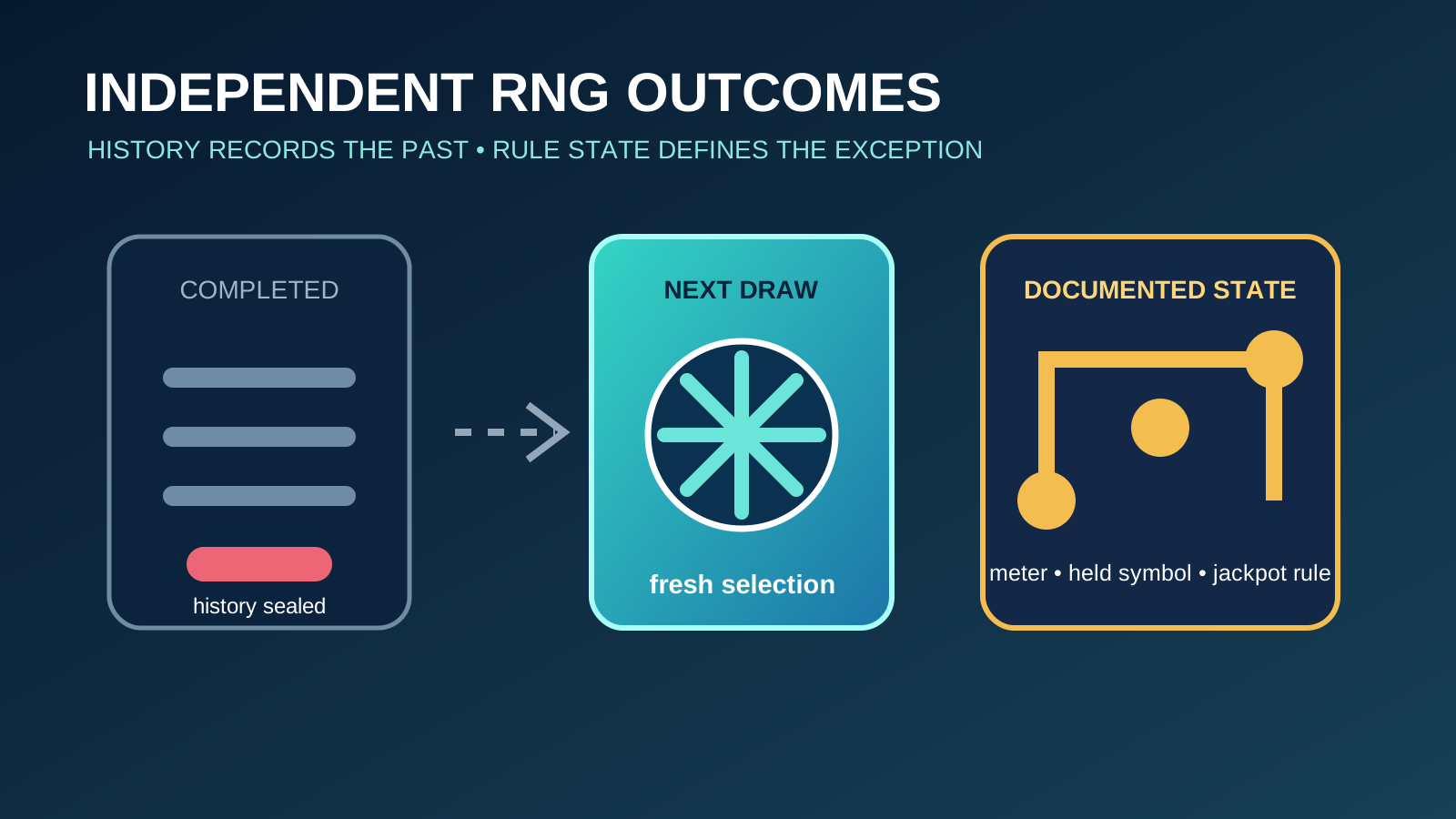
A completed spin is evidence about the past, not a lever on the next result
A slot can produce ten non-winning rounds and still assign the same probabilities to round eleven that it assigned to round one, provided the game is in the same documented state. The losses are real and the balance is lower, but the random selection has no mathematical debt to repay.
Independence is narrower than saying “anything can happen.” It means knowledge of earlier completed outcomes does not change the probability distribution for the next eligible random draw. If event A is a feature trigger and H is the visible history, an independent model has the relationship P(A given H) = P(A) while the governing state stays unchanged.
This principle does not erase rules. A free-spin counter, collected symbol, must-hit-by threshold or held reel can alter the next round because the game explicitly carries state forward. The distinction is whether the rule changes the conditions, not whether the player has recently won or lost.
The UK Gambling Commission's remote technical standard requires random outcomes to follow the designed probabilities, prevents adaptive compensation and requires the next output to resist prediction. GLI-11 separately tests for independence between draws. These are implementation and testing controls, not a promise that a short session will look balanced.
- Previous result
- Completed event
- Next draw
- Fresh random selection
- Explicit state
- Rule-defined exception
- “Due” claim
- Not evidence
Core definition
What independent outcomes mean in a slot
Two outcomes are independent when observing one does not supply information that changes the probability of the other. For successive base-game rounds, that means the win or loss already shown does not alter the random distribution used for the next round merely because it happened.
Independence is not the same as equal probability. A high-value symbol combination may remain extremely rare while a zero award remains common. The probabilities can be unequal and the draws can still be independent.
Independence is also not the same as identical visible results. A game can use the same probability model on every ordinary spin and still produce different reel stops, win sizes and features. Conversely, repeated identical-looking stops do not prove dependence; repetition is allowed by a random model.
The exact unit matters. A bonus can contain linked events within one initiated round, such as cascades or sticky symbols. It may be wrong to call every animation an independent spin. Read the help to identify where a paid game cycle begins, which states persist and when the complete round ends.
A useful test
Ask whether the conditional probability changed
Suppose a feature has a hypothetical 2% chance on each independent base-game round. After fifty misses, its chance on the next comparable round remains 2%, not 52% and not “almost guaranteed.” The history changes the probability that fifty misses would have occurred, but it does not rewrite the next draw.
The confusion often comes from asking a different question: what is the chance of seeing at least one feature somewhere in a block of many future rounds? More opportunities increase the block probability. That does not raise the probability on any single independent round and it requires paying for every opportunity.
Conditional reasoning is legitimate when the condition is part of the game. If collecting four tokens moves a meter into a fifth-token state, the next round can have different feature possibilities. The condition is the documented meter, not the emotional impression that the game has taken enough money.
When a review says a game is “due,” ask for the exact rule that changes P(A given the current state). A run of losses, a nearby player's jackpot or the time of day is not such a rule unless current first-party documentation explicitly makes it one.
Original probability worksheet
One future draw and a block of future draws are different questions
Consider an invented model in which a defined event has a 2% probability on each independent round. This is not a published trigger rate for any casino game, and it tells us nothing about the event's prize, RTP or affordability. Assume the same eligible state throughout and define the event before observing the results. The purpose is to show exactly which probability changes when you add opportunities.
A single next round has a 98% probability of not producing the event. For ten independent rounds, all ten must miss for the whole block to miss: 0.98 raised to the power ten. Subtract that number from one to obtain the probability of at least one event somewhere in the block. “At least one” includes two or more events; it is not the chance of exactly one, and it is not the chance of a net profit.
| Future rounds fixed in advance | No event anywhere in the block | At least one event in the block | Next individual round |
|---|---|---|---|
| 1 | 98.00% | 2.00% | 2.00% |
| 10 | 81.71% | 18.29% | 2.00% |
| 50 | 36.42% | 63.58% | 2.00% |
| 100 | 13.26% | 86.74% | 2.00% |
The table is calculated before those future rounds occur. Now suppose you have already observed fifty misses. They are no longer fifty unknown opportunities: their result is known. The next round still has a 2% event probability. A new block of fifty future rounds has the same 63.58% probability shown for a fifty-round block, not the 86.74% probability of a hundred unknown rounds. Combining fifty known misses with fifty future rounds does not recreate a fresh hundred-round forecast.
This distinction also prevents a misleading interpretation of “one in fifty”. The reciprocal of 2% describes a mean waiting count under the model, not a deadline. Even before play, a fifty-round block has a substantial 36.42% probability of containing no event. After a miss, the model does not shorten an outstanding countdown. It has no outstanding countdown at all.
Nothing here recommends buying more rounds to increase the block percentage. Each additional paid opportunity is additional exposure. To analyse money, you would need the complete award distribution, the actual stake and any extra feature charge. A 2% trigger followed by an unknown prize cannot establish a profitable strategy. If a persistent meter changes the conditions, discard this constant-probability worksheet and use the documented state-specific model instead.
Selection engine
What an RNG does—and what the reels show
A random number generator produces values that the game maps to outcomes according to its approved mathematical design. In an online slot, the result is normally selected by software; the reel animation presents that result rather than physically determining it.
The mapping can be complex. Virtual reel positions, symbol weights, feature tables and mode rules can make some combinations far more likely than others. Visual reels alone therefore do not reveal the probability of a particular prize.
A compliant implementation must not quietly change probabilities to compensate for a player's recent results. The UKGC standard expressly rejects adaptive or compensated behaviour that changes the probability distribution during play, except for features whose changing rules are disclosed.
Randomness does not mean unpredictability to the human eye alone. A simple repeating pattern might look irregular for a while but remain predictable. Technical standards examine the generator, mapping and statistical behaviour rather than judging a handful of attractive animations.
From value to award
Random generation and outcome mapping are separate checks
The RNG can produce a valid stream while an incorrect mapping still biases the game. That is why technical standards address both generated values and the conversion of those values into reel stops, cards, wheel sectors or other game events.
Imagine a generator that selects integers uniformly from 1 to 100. If numbers 1–90 map to one outcome and 91–100 map to another, the visible outcomes are not equally likely even though the underlying integers are. The mapping defines the consumer-facing probabilities.
Paytables and feature rules then determine the awards attached to mapped outcomes. RTP is calculated from the probability-weighted values across that model. It does not require every prize to occur at a tidy interval.
For readers, the practical conclusion is to trust neither reel counting nor a short screen recording as a probability table. Use current help for rules and certified or supplier documentation for mathematical claims. If an exact hit rate is absent, leave it unknown.
Original mapping model
Uniform numbers can legitimately produce unequal awards
Here is a second invented model, separate from the 2% event worksheet. Assume a generator selects one of the integers from 1 to 100 with equal probability, and a round costs one unit. The mapping assigns those integers to four gross-award categories. Every integer has a 1% probability, but the categories contain different numbers of integers. Uniform generation is therefore compatible with a frequent zero award and a rare large award.
| Random integers | Count | Gross award | Category probability | Contribution to mean award |
|---|---|---|---|---|
| 1–70 | 70 | 0 units | 70% | 0 units |
| 71–95 | 25 | 1 unit | 25% | 0.25 units |
| 96–99 | 4 | 5 units | 4% | 0.20 units |
| 100 | 1 | 50 units | 1% | 0.50 units |
The probabilities sum to 100%. The expected gross award is 0.25 + 0.20 + 0.50 = 0.95 units per one-unit stake. The model's theoretical return is therefore 95%. A positive award occurs on 30% of rounds, but only 5% of rounds return more than the stake: the one-unit award breaks even. These are three different quantities derived from one mapping, not three inconsistent descriptions of the generator.
The large award's probability remains 1% after a zero award, after a break-even award and after another large award, provided the next integer is drawn independently using the same mapping. Changing an animation or the order in which symbols are revealed would not change this calculation. Changing the mapping would. That is why an assessment must examine outcome conversion as well as the numerical stream.
For example, an implementation accidentally routing integer 95 into the five-unit category would no longer have the table's 25/4 split. Its numerical generator could still be uniform while its visible awards failed the specified model. Conversely, counting only the four award categories and demanding equal frequency would reject a correct implementation for the wrong reason. The reference is the approved weighted design, not an assumption that every pictured prize should occur equally often.
This miniature model is fully specified so its arithmetic can be checked. A commercial game's reel art is not such a specification. Do not assign these weights to a named game, estimate proprietary probabilities from the number of icons, or infer a payout rate from a vendor's claim that an RNG is random. To connect random selection to return, the award mapping and complete eligible state must also be known.
No memory of losses
Why spin history does not predict the next independent draw
A history screen is an accounting record. It can confirm stakes, awards and completed rounds, but it does not expose the next RNG value. Reading ten losses from that record tells you what happened to the balance, not which number will be generated next.
The same applies after a large win. The game does not become “used up” merely because a rare result appeared. If the next round uses the same state and probabilities, a second rare result is still possible immediately afterwards.
Changing devices, closing the browser or waiting a particular number of seconds does not transform the mathematics documented for the next game cycle. Such actions may reconnect a session or reload a client, but they are not evidence of a more favourable random draw.
A provider may use secure server-side generation, client-side components or a certified combination. The architecture can differ while the consumer principle remains the same: completed outcomes do not provide a timing signal for the next independent selection.
Cognitive trap
The gambler’s fallacy turns balance over time into a false deadline
The gambler's fallacy is the belief that a deviation in an independent sequence must soon be corrected. Five losses feel as though they create pressure for a win; five bonuses can feel as though a cold run must follow. Neither conclusion is supported by independence.
Long-run proportions can approach their mathematical values without short sequences alternating neatly. A future sample does not need to compensate for a past sample. As the total number of trials grows, the existing imbalance becomes a smaller fraction of the whole even if no special correction occurs.
This distinction is easy to miss because everyday systems often do have balancing mechanisms. A queue moves faster after staff are added; a depleted inventory changes what remains. An independent RNG slot has no comparable rule unless the game help states one.
The financial danger is behavioural. A player who raises the stake because a feature feels due increases the amount at risk while the underlying next-spin probability remains unchanged. The belief does not create value; it only changes exposure.
Random does not mean tidy
Why clusters, repeats and long gaps are expected
People often imagine randomness as regular alternation. Genuine random sequences are messier: they contain runs, repeated symbols and clusters of events. A six-heads run in fair coin tosses is unusual, but it is not evidence that the seventh toss is forced to be tails.
A slot has many possible event definitions, so visible streaks are easy to find after the fact. One observer counts non-winning spins, another counts feature symbols and another notices a particular icon. Selecting the pattern after seeing it makes coincidence look more informative than it is.
Large outcome spaces make exact visual repeats less common, yet broad categories such as “loss” can repeat often because they cover many underlying RNG results. The category frequency, not the emotional force of the run, determines how surprising it is.
A streak can be evidence worth investigating only when it is analysed against the documented model with an appropriate sample and method. Personal memory and a few screenshots cannot distinguish normal variation from a technical fault.
Mean is not a schedule
Long-run RTP does not make the next spin self-correct
Theoretical RTP is the average award divided by stake across the complete probability model. A 96% design corresponds to a 4% theoretical house edge, but it does not reserve four units from every hundred for the operator in each session.
One player can finish far above 100% and another at zero over the same number of rounds. Both results can arise from the same independent model. Volatility and rare features determine how widely short samples spread around the long-run mean.
The law of large numbers describes convergence of averages as observations grow. It does not say that the next outcome moves against the recent sequence. The average can drift toward the model simply because later independent results add more data.
Chasing RTP is therefore a category error. More paid rounds may make the sample average more representative, but they also add turnover. With a negative theoretical expectation, extra turnover increases expected loss rather than guaranteeing recovery.
Legitimate exception
Documented game state can change future conditions
Some slots carry visible state between rounds. Examples include collection meters, persistent wilds inside a feature, an accumulating multiplier or a fixed number of free spins remaining. Those variables can change what the next action can produce.
The correct statement is then conditional: outcomes are random under the current state and according to its rules. A level-five spin can differ from a level-zero spin because the game says so. The earlier sequence matters only through the state it legitimately created.
A stateful mechanic is not evidence that the software monitors losses and increases a hidden chance. Verify what advances the state, whether it persists after closing, what resets it and whether extra payment is required. Marketing phrases such as “building momentum” are not enough.
Features can also contain dependent events within the same game cycle. A first cascade removes symbols and changes the grid for the next cascade. That relationship does not imply that the next separately purchased base-game round remembers the player's earlier losses.
Different probability object
Progressive values and must-hit conditions need their own rules
A progressive jackpot value can increase as eligible stakes contribute to a shared pool. The displayed amount changes, but the trigger probability may or may not change. Do not infer a higher chance merely from a larger counter.
A documented must-hit-by jackpot is different because its rules guarantee settlement before or at a stated boundary. The current position relative to that boundary can be relevant state. It is not an example of ordinary independent spins becoming due after losses.
Network jackpots can also use a separate server and contribution. Current help should state eligibility, contribution, currency treatment, fun-mode exclusions and any guaranteed intervals. A base game's ordinary cap should not be confused with a progressive prize.
When the help omits the trigger probability, the counter cannot reveal it. A large prize and an approaching deadline can be visible while the exact conditional chance remains proprietary. Describe only the rule that is actually documented.
Independent testing
How standards test randomness and independence
GLI-11 requires statistical testing of final game outcomes for independence between draws and within a draw where appropriate. It also expects every possible outcome to remain available with the correct likelihood, except where the approved game design explicitly changes state.
The UKGC testing strategy requires relevant remote games and RNGs to be tested by an approved test house before release. Material updates can require further assessment, and operators must retain game test reports under the applicable procedure.
Tests can include source review, statistical simulation, mapping checks, seeding analysis and verification that prohibited adaptive behaviour is absent. The exact programme depends on the product and jurisdiction; one consumer badge cannot summarise the whole process.
Certification is evidence about conformance at the tested version. It is not permission to assume every operator uses the same build forever. Record the game ID, help version, RTP and date so that a later client can be compared to the tested or published configuration.
Investigation, not prediction
A flagged sample needs a question defined before the sample
Suppose an invented statistical procedure is calibrated to flag 5% of samples from a correctly operating reference model. A flag is a reason to investigate, not a statement that the game has a 95% probability of being faulty. The flag rate describes results under the reference model. To judge a fault claim, an investigator also needs the alternative explanation, the data quality and the test's ability to detect the relevant fault.
Now imagine applying that procedure to ten independent samples and reporting whichever flags. Under those deliberately simplified assumptions, the probability of at least one flag is 1 − 0.95 to the power ten, approximately 40.13%. With twenty independent samples it is approximately 64.15%. A collection of nominal 5% tests is not a single 5% decision. Overlapping samples or correlated checks require a different analysis; these numbers must not be applied as though those observations were independent.
Searching a history for the most striking run creates a related selection problem. The chosen pattern was not necessarily the question you intended to test before seeing the data. Reporting a rare-looking cluster while ignoring all the other symbols, windows and definitions examined exaggerates the evidence. A proper investigation records the event definition, sample boundary, game version, state, reference probabilities and planned decision rule.
For a customer, the useful response to a suspicious settlement is a precise record: round identifier, stake, award, time, game edition and what the help said should happen. It is not a demand for more spins to make a pattern clearer. Preserve the operator's response and use the applicable complaint process. A discrepancy in one settled award can be investigated as an accounting issue without claiming that the next round is predictable or encouraging more paid exposure.
Player-facing evidence
What current game help can and cannot establish
Current help can identify the title, version, theoretical RTP, evaluation model, feature state, optional costs and maximum-win wording. It is the strongest public source for interpreting what the deployed client says it does.
Help rarely publishes the complete probability table. A trigger count, multiplier maximum or prize cap is not a hit rate. Do not calculate a next-spin chance from screenshots when the required symbol weights are absent.
Alternative RTP builds can share art and rules. A provider's catalogue value should not override the percentage shown after the operator client loads. Match the exact mode because bonus buys, enhanced spins or jackpot editions can use different returns.
If the help describes a persistent state, use that wording to define the exception to simple spin independence. If it does not describe a compensation rule, recent losses should not be presented as one.
Records are for control
Use session history for budgeting, not prediction
A history log is useful for reconciling stakes, identifying an interrupted round and measuring total turnover. It can also reveal how quickly a chosen stake and speed are consuming a budget.
It cannot tell you that the next spin is favourable. A chart that colours recent results red and green may encourage pattern recognition, but the colours do not create dependence.
Set a monetary and time limit before the first paid round. Treat the maximum acceptable loss as fixed rather than expanding it after a streak. Stop rules control exposure; they do not change expected value.
If a result appears to settle incorrectly, record the exact round ID, time, stake and displayed outcome and use the operator's dispute process. That is an accounting question, separate from trying to forecast the next result.
Stake patterns
Why progressions do not defeat independent negative expectation
Martingale-style systems increase the stake after losses in an attempt to recover earlier exposure. Independence means the next event does not become more favourable, so the system exchanges many small apparent recoveries for the risk of a large loss, table limit or exhausted balance.
Flat betting avoids that escalation but does not remove the house edge. Lowering stake can reduce money exposed per round; it does not create a positive expectation.
Changing games after a win or loss also does not transfer probability between unrelated RNGs. The new game may have different RTP, volatility and rules, but the previous title's sequence is not a signal about it.
The only reliable mathematical comparisons are documented differences: active RTP, stake, feature costs, cap and distribution information. None can guarantee profit, but they are more useful than a narrative built from recent spins.
Unpredictable is not mystical
Prediction resistance, seeds and implementation security
Technical RNGs are algorithms, not supernatural sources of chance. A compliant system uses an approved design and seed management so that the next value is not computationally feasible for a player to predict from observed outputs.
That security requirement is distinct from statistical independence, although both matter. A sequence might pass simple frequency checks yet be predictable if the generator or seed is weak. Conversely, strong cryptography cannot rescue incorrect outcome mapping.
Players should not trust software that claims to predict a named slot from screenshots, timing or earlier results. Such tools cannot access the protected server state and can introduce malware, account theft or false betting confidence.
Verification belongs with licensed testing processes, current help and operator records—not a downloadable “RNG analyser.” Never provide account credentials, remote access or payment information to a prediction service.
Local evidence boundary
What New Zealand readers must verify separately
This page explains a mathematical concept, not operator legality or suitability. New Zealand's online-gambling position is time-sensitive. Consult the Department of Internal Affairs player guidance and the site's dated legal-status guide at the point of use.
An RNG certificate or supplier name does not establish that a particular operator may serve a New Zealand account. Verify operator identity, territorial terms, age controls, withdrawals, complaints, limits and self-exclusion separately.
Likewise, an operator check does not prove that its game client uses the highest RTP. Open the live information panel and record the exact percentage and version. Legal, operator and game-math claims require separate sources.
If gambling stops being recreational, use the support routes in the site's responsible gambling guide. Understanding independence should reduce chasing, not provide a reason to continue a session.
Two-minute audit
How to test an RNG claim before repeating it
- Identify the exact game, edition, provider and mode.
- Open current help and define one complete game cycle.
- List any state that the rules explicitly carry forward.
- Separate a changing jackpot or meter from recent win/loss history.
- Do not convert RTP, volatility or a cap into a next-spin chance.
- Reject claims based only on timing, streaks or nearby players.
- Check whether an approved testing record or technical standard supports the implementation.
- Record the version and date because clients can change.
- Use history to control spend, never to increase stake.
- Verify New Zealand operator access independently.
For the long-run mean, see slot RTP and house edge explained. For spread and event-rate differences, use the volatility versus hit-frequency guide. Together the pages separate average, dispersion and independence without pretending to forecast a result.
Questions answered
Frequently asked questions
Is a slot more likely to pay after a long losing run?
No, not when the next paid round is an independent RNG trial under the same game state. Earlier losses affect the balance and total turnover, not the probability assigned to the next outcome.
Can a slot be hot or cold?
A completed sequence can be described as hot or cold after the fact, but that label does not predict the next independent round. Random sequences naturally include clusters, repeats and long gaps.
Do persistent meters break independence?
A documented meter can change the state used by later rounds. The correct comparison is then between rounds in the same state. The meter does not imply that unrelated losses create a hidden obligation to pay.
Does RNG certification guarantee a player will receive the stated RTP?
No. Testing supports the implementation and statistical model. Theoretical RTP is a long-run property and individual sessions can finish far above or below it.
Can changing stake after losses improve the next result?
A higher stake increases the amount exposed and may change prize values or an explicitly documented eligibility condition. It does not make an independent outcome more likely merely because earlier spins lost.
Evidence record
Primary sources
Facts and configurations were checked against the following first-party records. A public product page is not proof that a game is available through a New Zealand operator.
- UK Gambling Commission — RTS 7 generation of random outcomesChecked 7 October 2026
- Gaming Laboratories International — GLI-11 gaming devices standardChecked 6 October 2026
- UK Gambling Commission — procedure for testingChecked 6 October 2026
- UK Gambling Commission — games test reportsChecked 6 October 2026
- Evolution — slots catalogue and conceptsChecked 6 October 2026
- New Zealand Department of Internal Affairs — online gambling for playersChecked 6 October 2026