Short answer
The prize label is only the beginning
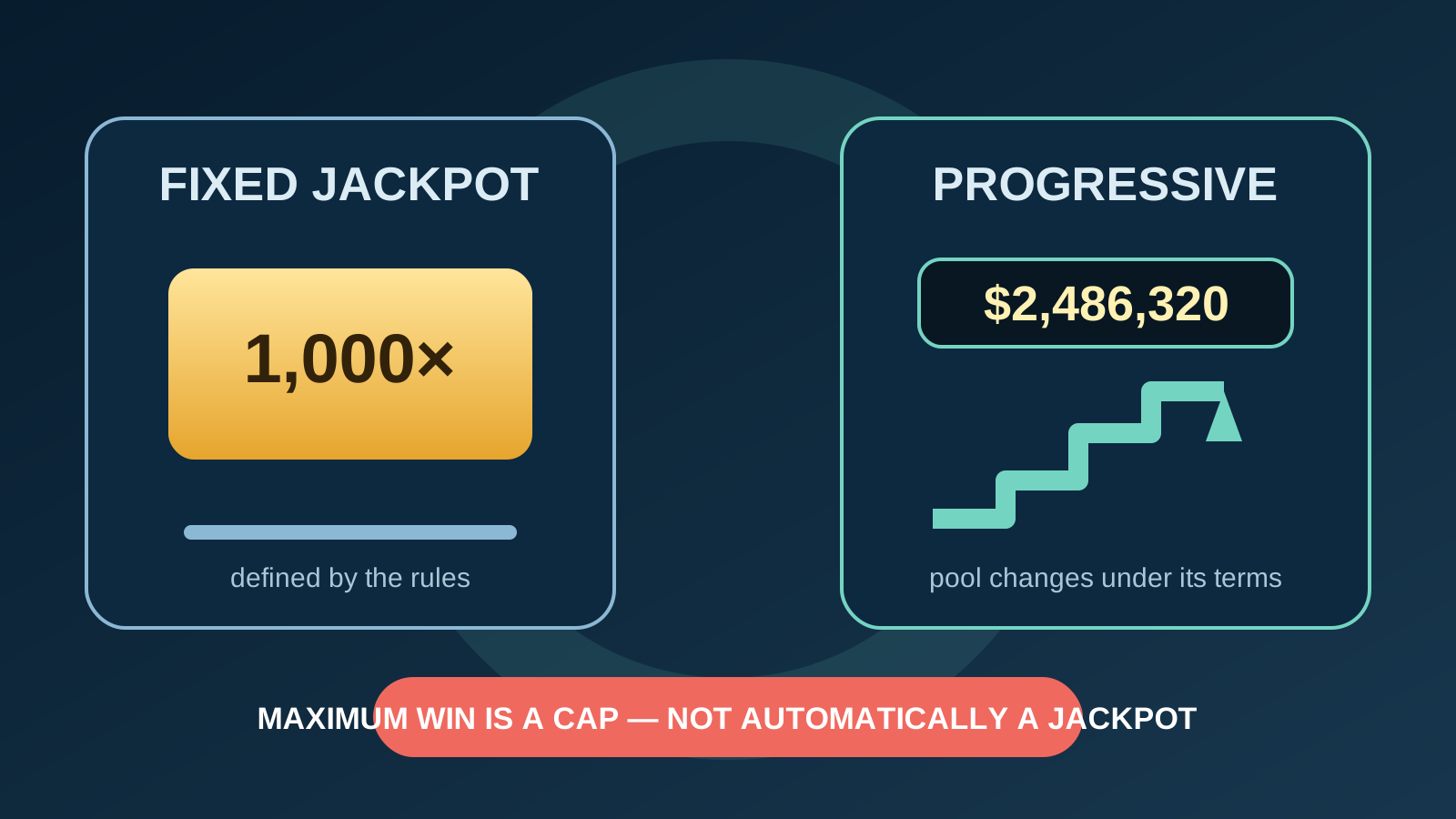
A fixed jackpot is a named prize whose amount is fixed by the rules for the relevant stake or configuration. A progressive jackpot has a current value that can grow as qualifying play contributes to a pool. Evolution's official slots glossary makes the same core distinction: the fixed amount is shown in the paytable and does not change, while a progressive amount varies and is commonly built from a small part of eligible stakes.
Those definitions do not reveal how the jackpot is won. Either type can use reel symbols, a bonus wheel, a mystery event or another certified trigger. A progressive can also carry a must-hit condition, but many do not. Read the exact rules before treating a visible meter as a countdown.
Most confusion comes from a third number: the maximum win. A cap such as “10,000x bet” limits the total paid for a game round. It is not automatically a fixed jackpot. A jackpot is a distinct award; a cap is a settlement boundary. They can coexist, differ or apply to separate parts of the product.
- Fixed jackpot
- Defined prize amount
- Progressive
- Changing pool
- Maximum win
- Settlement ceiling
- Timing
- Never infer it
Build a clean vocabulary
Jackpot, top prize and cap are not synonyms
A jackpot is a specially named prize with a rule defining eligibility and award. A top paytable win is the largest ordinary symbol combination before other modifiers. A maximum win or cap is the most the game will settle for the round after the documented features and multipliers resolve.
A game can advertise a fixed “Grand” of 1,000x and still cap the whole round at 5,000x. Another can have no named jackpot at all yet permit a 10,000x feature result. A network progressive can display a seven-figure live pool while the underlying slot keeps a lower ordinary-game cap. The numbers answer different questions.
“Maximum payout” is especially ambiguous in marketing copy. It may refer to a mathematical cap, the highest paytable row, a simulated record or a currently displayed jackpot. Preserve the provider's exact unit and label. Do not convert every large number into a jackpot for a headline.
The practical test is structural: does the help name a prize, explain how it is funded or fixed, state who is eligible and define its trigger? If not, treat the number as a cap or paytable value until stronger evidence appears.
Stable amount, separate trigger
What “fixed jackpot” actually fixes
A fixed jackpot keeps its defined amount rather than increasing with later wagers. The amount may be a cash figure, a credit value or a multiple of the qualifying bet. If stake level changes the award, the formula can still be fixed: the rules determine the prize instead of a live pooled balance.
Fixed does not mean frequent, predictable or easy. The trigger can remain rare and random. It also does not mean the amount is permanent across every build. A provider can certify another paytable, an operator can use another denomination, or the game can have separate fixed tiers.
Read whether the prize is awarded in addition to the underlying line win or replaces it. Check whether a Wild can substitute, whether the qualifying combination must appear on a named line, and whether a bonus feature has to be active. “Land five Jackpot symbols” is incomplete without reel, line and stake conditions.
A fixed jackpot can be useful for comparison because its award unit is knowable before the spin. It still supplies no schedule. Dividing the prize by stake does not reveal its probability or make the expected value visible without the hit rate.
A live prize state
What makes a jackpot progressive
A progressive has a changing pool. The displayed value usually rises while eligible play is recorded and falls or resets after a valid award or another rule-defined event. The game rules should explain where the pool begins, what contributes, who can win it and what happens after settlement.
The meter is part of the product state, not necessarily a direct view of cash contributed by one player. Contributions can be aggregated across many players, games, operators or markets. The pool can also contain a seed value funded before the current cycle and a reserve used under the product's accounting rules.
The displayed amount should not be read as the game's ordinary maximum. It is a current prize value subject to eligibility and settlement conditions. A player who is not eligible for the progressive may be playing a different return profile even when the base artwork looks identical.
A progressive can contain several tiers. Small tiers may award more often or reset on a different schedule, while a top tier spans a wider network. Never assume that one contribution rate, trigger or cap applies to every named tier.
Funding rules
How a prize pool can grow
The common model takes a stated portion of eligible stakes and adds it to a pool. If one dollar of an eligible spin contributes twelve cents, the contribution rate is 12% of that stake. This does not mean the player owns the contribution or can withdraw it; it is part of the certified game model.
Some products allocate contributions across several tiers. Others use a combined progressive controller and a reserve or seed arrangement. The visible meter may increase at a rate different from the total amount allocated because funding can be split between current prize, reset funding and administration permitted by the rules.
A contribution can be embedded in the displayed total bet or charged as a distinct optional amount. The help must say which. If a toggle raises a $1 ordinary stake to $1.12, the extra twelve cents is transparent. If the displayed stake remains $1 and 12% is allocated inside it, the base-game return can differ from a non-jackpot edition.
Do not estimate a contribution by watching the meter. Network activity, rounding, currency conversion, pooled play and delayed display updates make a short visual sample unreliable. Use the written percentage and the total charged amount.
Who shares the pool?
Local, linked and network progressives
A local progressive can be confined to one game instance, one operator or another narrow group defined by the product. A linked progressive shares eligible play across several terminals, games or sites. A wide network can collect contributions from many participating operators and jurisdictions.
A wider pool can grow faster because more eligible stakes enter it. That observation does not say any one player is more likely to trigger it. The trigger probability per qualifying action and the number of competing actions are separate facts.
Scope also affects evidence. An operator lobby can show a live meter for its deployed network, while a provider demo may show a sample value or no jackpot at all. A screenshot from another operator is not proof of the current pool in the reader's client.
When several games feed one pool, the jackpot product and the base slot remain distinct entities. Each game can have different base rules while sharing the same progressive controller. The exact edition name tells you whether the jackpot layer is attached.
Award mechanism
Reel, feature and mystery triggers
A reel-based jackpot requires a documented symbol arrangement, often under a qualifying bet. The result is visibly tied to the base game's reels or bonus board. A feature trigger can require entry to a wheel, hold-and-win round or another subgame before the jackpot outcome is determined.
A mystery trigger is awarded by the jackpot system without a visible jackpot-symbol combination. The animation can appear over an ordinary spin, but the rules still define eligible actions and settlement. “Random” does not mean unregulated or selected by an operator employee.
Some products combine methods across tiers. A lower prize may appear through symbols while a top progressive uses a mystery event. Others award several tiers from one wheel. Do not import the Mega trigger into the Mini description because the names share a panel.
Eligibility can depend on stake, side bet, game mode, real-money status and market. A trigger observed in fun mode may be simulated rather than connected to a live prize pool. Read the demo notice before treating it as operational evidence.
A condition, not a prediction
Must-hit-by amount and time rules
A must-hit-by amount means the product's rules guarantee settlement before or at a stated pool ceiling. A must-hit-by time or scheduled tier uses a deadline or time window. These conditions distinguish the product from an open-ended progressive, but they do not reveal the next exact spin.
The trigger can still occur anywhere within the permitted range. If a prize must hit before $10,000 and currently shows $9,900, the remaining range is smaller; that is not evidence that the reader's next bet will win or that one operator session controls the final hundred dollars.
Time-based tiers need their official timezone, window and eligibility rules. A “Daily” label may guarantee an award within a product day, not within twenty-four hours of one player's first spin. The pool can also have a minimum displayed seed after a prior award.
Never write “due soon,” “hot” or “guaranteed today” unless the exact help supports the precise condition—and even then, describe the product's settlement window rather than promising a particular player the prize.
After an award
Seeds, reset values and reserve funding
Many progressives do not reset to zero. They return to a seed or start-up value so the next cycle immediately has a funded prize. The seed may be financed from a reserve, the operator, the provider or another arrangement stated in the rules.
A visible fall in the meter therefore does not show that all contributions disappeared. It shows that the settled prize and next-cycle rules have been applied. The following pool can start at a material value even before new eligible play arrives.
If two eligible events appear to occur at nearly the same time, network rules need a settlement process. The UK Gambling Commission's technical standards require jackpot rules to explain how prizes are determined and awarded, including simultaneous or apparently simultaneous triggers caused by network latency.
Readers do not need to reverse-engineer the reserve. They need the current displayed pool, reset condition and dispute rule. If those are unavailable, a precise explanation would be speculation.
Return allocation
How jackpots change the RTP question
Theoretical RTP is the probability-weighted average award divided by stake across the model's long horizon. A jackpot contribution can be part of that average, shown beside it or excluded for ineligible play. The label “96% RTP” is incomplete until the help says which components and route it includes.
Suppose a documented configuration shows 84% base-game RTP and a 12% jackpot contribution. The combined theoretical allocation is 96% for eligible real-money play, but the 12% does not behave like frequent base awards. It enters rare jackpot outcomes. A short session can therefore experience only the base distribution while the combined long-run figure remains mathematically correct.
If fun money cannot win the jackpots, its effective demo behaviour is not a valid measurement of the eligible real-money model. Likewise, a player using a stake or mode that does not qualify may have a different stated RTP. The UK technical standard specifically expects ineligibility and the corresponding theoretical return to be clear.
Do not add a headline RTP and contribution unless the rules say they are separate components. Some help files already present a combined total. Adding twice would overstate return. Use the theoretical RTP and house-edge guide for the mean calculation and keep each jackpot route in its own row.
A checked rules example
How to read one Dream Drop edition
The checked Groovy Knights Dream Drop guide shows why the full edition matters. Its official v1.0.6 help identifies six jackpot tiers, a 12% jackpot contribution and a 94.00% return for the documented routes. Fun-money play is excluded from jackpot awards.
The same help separates scheduled Daily tiers, a Major tier with an amount condition and a staged Mega rule. Those names do not create one universal trigger. Each tier has its own product terms even though all appear under Dream Drop branding.
The ordinary game also has a 10,000x maximum. That limit is not the displayed Mega pool. Treating both as “the max win” would merge a fixed settlement ceiling with a progressive prize and produce a misleading comparison.
This example is not a template for every progressive. It demonstrates the audit method: exact edition, tier list, contribution, eligibility, return, ordinary cap and demo limitation all need separate fields. Another provider or Dream Drop title can use different base-game rules.
Do not merge the numbers
Maximum win versus available jackpot
A maximum win answers: how much can this game round settle under its ordinary cap? A current progressive meter answers: what prize pool is available to an eligible jackpot trigger now? One can exceed the other because they may be governed by separate settlement systems.
A fixed jackpot also is not automatically identical to the cap. The game might award a 1,000x fixed jackpot and allow ordinary features to reach 5,000x. Or the jackpot might be the largest possible single component while the cap stops combined awards above another amount.
Marketing pages often choose whichever number looks largest. A useful comparison table instead carries four columns: ordinary maximum, fixed named prizes, current progressive tiers and the stake basis for each. Empty fields should remain empty rather than being filled from a similar edition.
When a help file says “maximum recorded win,” preserve the word recorded. A simulation record is evidence of an observed test maximum, not necessarily a hard settlement cap. Exact wording prevents a precise-looking factual error.
Qualifying action
Bet size, side bets and jackpot eligibility
Some jackpots are available at any permitted stake; others require a minimum denomination, maximum coins, all paylines, a side bet or a dedicated jackpot mode. The displayed meter can remain visible even when the current bet is ineligible, so look for an eligibility indicator.
Increasing the stake can increase a cash prize that is calculated as a fixed multiple, but it does not automatically improve jackpot probability per dollar. The rules may use equal probability per qualifying spin, probability scaled by stake or another certified method. Do not infer the formula from the payout size.
If a side bet adds a percentage, confirm whether ordinary line awards still use the base stake or total charged amount. A $1 base bet plus $0.12 contribution can cap ordinary awards against $1 while using $1.12 as the wallet debit. The help must define the denominator.
Promotional funds can have separate contribution or eligibility rules. Wagering requirements, excluded jackpot games, maximum-bet clauses and cash-out limits belong to the operator terms rather than the jackpot paytable.
What fun mode cannot prove
Demo jackpots, sample meters and availability
A demo is useful for learning controls, finding the help panel and observing the base game's feature order. It may use valueless credits, a sample meter or a disconnected jackpot service. A provider can explicitly exclude fun-money actions from jackpot awards.
Demo spins therefore cannot estimate a live progressive's hit rate or confirm that the meter corresponds to funded real-money play. A jackpot animation in demo mode can be an instructional simulation. Its amount is not a claim that cash is available.
Global demo access also does not prove that an operator offers the exact edition to a New Zealand account. Provider publication, operator inventory, geographic eligibility and current game configuration are separate facts.
Use the demo to record title, game ID, help version, base rules and declared RTP components. Use the operator client to verify real-money eligibility, live pool, currency, stake qualification and settlement terms.
No countdown without a rule
Why a growing meter does not forecast the next win
A progressive meter records prize state. It is not evidence that the RNG remembers how many non-winning spins one person has made. Independent eligible actions do not become “owed” a prize because the pool is large.
Without a published must-hit condition, the current amount supplies no deadline. Even with a must-hit ceiling, it defines a range for the product, not the winning account. Thousands of eligible actions across a network can occur while one reader watches the meter.
A recent jackpot does not make the next one impossible. After reset, the product begins a new cycle under its rules. Nor does a long gap prove that the controller is broken. Probability and elapsed time must not be replaced by narrative.
Do not chase a rising pool by increasing stake or extending a session. Set the maximum acceptable loss before play and treat every paid action as capable of losing. The jackpot's size does not change personal affordability.
One-screen reference
Fixed, progressive and cap side by side
| Number | What changes | Funding question | Timing claim |
|---|---|---|---|
| Fixed jackpot | Prize follows a defined fixed amount or formula | Part of the certified paytable/model | No timing unless separately stated |
| Progressive jackpot | Current pool can grow under contribution rules | Check stake allocation, seed and eligibility | Only a published must-hit rule creates a boundary |
| Maximum win | Settlement cannot exceed the stated cap | Not a pooled fund | Never a countdown |
| Simulation record | Largest result observed in the stated sample | Not a prize pool | No frequency or guarantee |
The correct comparison unit is the exact edition and qualifying stake. Two games with the same headline “Mega” can use different networks, contributions and trigger rules. Two 10,000x labels can describe a cap in one title and a named fixed prize in another.
Two-minute live-help audit
Questions to answer before relying on the meter
- Match the full title, provider, edition and game ID.
- Identify each named jackpot tier.
- Classify each tier as fixed, progressive or scheduled.
- Record the current pool and currency from the live operator client.
- Find the seed or reset rule where published.
- Read the contribution and whether it is inside or added to total stake.
- Confirm the qualifying stakes, modes and real-money requirement.
- Copy the exact trigger for each tier.
- Check any must-hit amount, time window and timezone.
- Separate ordinary maximum win from jackpot prizes.
- Record base RTP, jackpot contribution and combined RTP exactly as labelled.
- Read simultaneous-trigger, interruption and malfunction settlement terms.
If one field is absent, preserve the gap. Do not borrow a contribution from another game in the same series or a current meter from another operator. Jackpot systems are configuration-sensitive and time-sensitive by design.
Separate market evidence
New Zealand access and player checks
This guide explains jackpot mechanics and does not recommend an operator. A global provider page or fun-mode demo does not establish that a named operator accepts New Zealand players, offers the exact jackpot network or uses the same return configuration.
New Zealand's online-gambling position is time-sensitive. Check the Department of Internal Affairs player guidance and the site's dated legal-status guide at the point of use. A New Zealand flag, NZD wallet or localised landing page is not on its own proof of authorisation.
Then verify the live game's jackpot eligibility. Territorial rules can exclude a progressive even when the base slot loads. The operator should make ineligibility and the applicable RTP clear before a paid action.
If gambling stops being recreational, use account limits and the contacts in the responsible gambling guide. Understanding a jackpot does not create an advantage over its random trigger.
Questions answered
Frequently asked questions
What is the main difference between a progressive and fixed jackpot?
A fixed jackpot has a defined prize amount that does not grow with later eligible play. A progressive jackpot has a current pool that can increase under its contribution rules until a trigger or other settlement event.
Is a 10,000x maximum win a fixed jackpot?
Not automatically. A maximum-win cap limits total settlement. A jackpot is a named prize with its own award rule. A game can have a 10,000x cap and no jackpot, or a progressive jackpot plus a separate ordinary-game cap.
Does a larger progressive pool mean it is about to pay?
No, unless the exact rules publish a must-hit-by amount or time condition. A rising meter alone is not a countdown and past non-winning spins do not prove that a trigger is due.
Is the jackpot contribution included in RTP?
It depends on the game and configuration. Some help files separate base-game RTP and jackpot contribution; others present a combined return or distinguish eligible and ineligible play. The current deployed help must say which figure applies.
Can a demo prove a progressive jackpot is available in New Zealand?
No. A demo can show controls and rules, but fun-money clients may exclude jackpot awards and do not prove operator inventory, territorial eligibility, real-money funding or a current live pool.
Evidence record
Primary sources
Facts and configurations were checked against the following first-party records. A public product page is not proof that a game is available through a New Zealand operator.
- Evolution — official slots catalogue and slot conceptsChecked 6 October 2026
- UK Gambling Commission — Remote Technical Standards, RTS 9 progressive jackpot systemsChecked 6 October 2026
- Relax Gaming — Dream Drop product pageChecked 6 October 2026
- Relax Gaming — Groovy Knights Dream Drop official demo help v1.0.6Checked 6 October 2026
- New Zealand Department of Internal Affairs — online gambling for playersChecked 6 October 2026