Short answer
Three different tests for one result screen
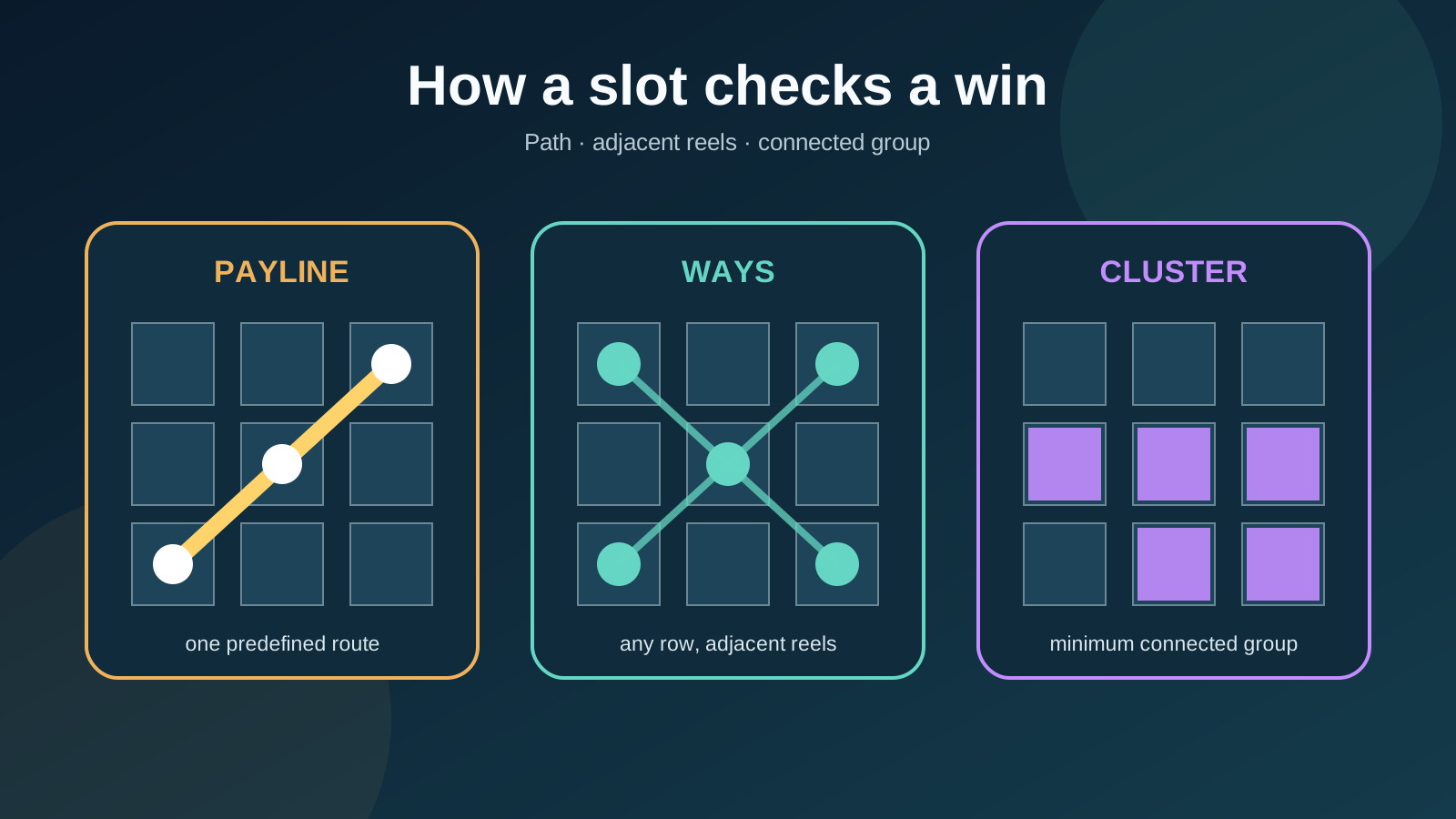
A slot first generates a final symbol arrangement, then applies its documented qualification rule. In a payline game, matching symbols must occupy positions belonging to one of the active drawn paths. In a ways game, their row positions can vary, but the matches normally have to continue through consecutive reels from a stated side. In a cluster game, reel-to-reel paths disappear and a sufficiently large connected group qualifies.
The system answers where symbols must be. It does not by itself answer how much the win pays, how often it occurs, how volatile the game is or what its theoretical return will be. Those properties come from symbol weights, the paytable, feature rules, stake definition, caps and the complete mathematical model.
Labels are shortcuts. “Ways,” “all ways,” “cluster” and “pays anywhere” can hide important differences. One ways game may pay from the left only, another from either edge. One cluster may require five symbols joined side-to-side, another may count a broader shape. Read the exact live help before applying a generic definition.
- Payline
- Predefined path
- Ways
- Adjacent reels
- Cluster
- Connected group
- Best evidence
- Current game help
From RNG to award
The evaluation sequence in plain language
A random-number generator selects an outcome according to the certified game model. The client displays that outcome as stops, symbols, blocks or feature objects. The rules then inspect the visible state for qualifying combinations. The paytable assigns an amount, special modifiers are applied in their documented order, and the result is settled subject to any maximum-win rule.
That order matters. A Wild may substitute before a multiplier is applied; a Collector may resolve after row multipliers; a cascade may create another board without charging another base bet. Two games can show similar fruit symbols while evaluating them in a different sequence.
Do not infer the algorithm from animation alone. Highlight lines and exploding groups are a visual explanation of an already selected outcome. They are useful for checking which rule fired, but they are not evidence that stopping the reels, tapping a symbol or changing screen orientation changed the mathematical draw.
A useful audit separates four questions: what arrangement was generated, what qualifies as a win, what value the paytable assigns, and which later modifiers or caps alter settlement. Paylines, ways and clusters answer only the second question.
Predefined geometry
How fixed paylines work
A payline is a named path through reel positions. The simplest path crosses the middle row; other paths can zig-zag, rise or fall. A game with 20 lines stores twenty such patterns, and a combination qualifies only when the required symbols occupy one path according to the direction rule.
Most modern fixed-line games keep every line active and quote one total bet. Older or selectable-line games can let the player choose how many lines to cover. In that model, an otherwise correct combination on an inactive line may not pay. The bet panel and help must state whether lines are fixed, adjustable or evaluated under a total-bet paytable.
Direction is separate from shape. A line can pay left-to-right, right-to-left or both ways. Many games require the first matching symbol on the leftmost reel; a Scatter often ignores that restriction. “Twenty lines” therefore does not fully define the result without start and direction rules.
When the same symbols fill more than one active line, each qualifying line can pay. A rule such as “only the highest win per line” prevents a five-of-a-kind from also paying its shorter three- and four-symbol versions on that same path.
Worked line check
A five-reel example without implying real odds
Imagine a five-reel, three-row game with a payline that runs top, middle, bottom, middle, top. The visible symbol A lands in the first four positions of that path but a B lands in the fifth. If the paytable requires three A symbols from the left, the result qualifies for four A symbols on that line. It does not need the fifth A.
If a second active line also contains four A symbols, the two line awards are added. An A elsewhere on the grid contributes nothing unless it belongs to another qualifying line. This is the quickest way to distinguish line logic from ways: a visually adjacent matching symbol can be irrelevant when it sits off the active paths.
Suppose the total stake is $1 across 20 selectable lines and the paytable uses per-line units. The line stake could be $0.05, and a 10x line award would return $0.50. But some newer games quote paytable values against total bet instead. Never assume the denominator from the line count; read the unit beside the paytable.
This example teaches evaluation only. It supplies no probability, RTP or recommendation and does not represent a specific New Zealand product.
Positions, not paths
How ways-to-win systems work
A standard ways model removes drawn line shapes. A matching symbol can occupy any row on the first reel and continue from any row on the next adjacent reel. The usual rule requires at least three consecutive reels from the left, although the exact help can specify another start or “both ways” evaluation.
The nominal ways count is often the product of active positions on every reel. Five reels with three positions each produce 3⁵, or 243 paths. Six reels with four positions produce 4⁶, or 4,096. A six-by-six grid produces 46,656.
That product describes possible position paths across the full grid, not the number of winning combinations in a spin. Blocks, variable reel heights and inactive cells can reduce what is usable. A game may also advertise “up to” a number because rows expand only after cascades.
When several copies of one symbol appear on a reel, they multiply the ways for that connection. Two matching copies on reel one, three on reel two and two on reel three produce 2×3×2 = 12 three-reel ways, assuming the other qualification rules are met.
Count matching copies
Why 46,656 ways does not mean 46,656 payouts
The checked Aura God help describes six reels, six rows and 46,656 ways. A symbol matching once on each of the first three reels produces one three-reel way, not 46,656 awards. If the symbol appears twice, three times and twice across those reels, the same displayed board creates twelve ways for that symbol.
Copies on reel four can extend the same combination. If two matching symbols land there, twelve three-reel paths extend into twenty-four four-reel paths, and the rule pays only the longest combination for that symbol. It does not add the shorter twelve again.
Aura God starts with stone blocks in up to 24 positions. The nominal grid still defines the model, but blocked cells cannot act as ordinary symbol copies until cleared. This is why a lobby count should be read alongside the actual board rules.
Conquer Babylon shows the dynamic version. It starts at 4,096 ways on six reels and four rows. Winning avalanches can add rows until six reels and eight rows create 262,144. “Up to” is a state-dependent maximum, not an ordinary starting count.
Connected positions
How cluster-pays systems work
A cluster game replaces reel-spanning paths with a neighbourhood test. A minimum number of matching symbols must form one connected group on the grid. The group can take an irregular shape and can begin away from the left edge.
Connection is game-specific. Many titles count horizontal and vertical neighbours but not diagonal contact. Others define hexagonal, orthogonal-plus-diagonal or proprietary arrangements. A generic cluster definition is not permission to add diagonal symbols when the help excludes them.
The paytable usually has thresholds rather than reel lengths: five, eight, eleven or sixteen matching positions, for example. One larger connected group receives the row for its total size. Separate clusters of the same symbol may be paid independently or combined under a special removal rule; the help decides.
Grid size does not tell the minimum. A six-by-six title can require five symbols, while another grid game may require eight. Likewise, “pays anywhere” can refer to scatter counts rather than true clusters. Look for the provider's formal qualification sentence.
Jumbo Juicy example
Trigger group versus all-symbol removal
Jumbo Juicy's checked v1.0.7 help defines a winning cluster as at least five matching symbols. Its paytable then increases at 8+, 11+, 14, 15 and 16+ copies. This differs from a ways table, which normally pays according to consecutive reel length and matching copies on each reel.
Once a Jumbo Juicy cluster qualifies, the game removes the winning group and every other instance of that same symbol on the board. Isolated copies can therefore affect the later multiplier collection even though they did not make the initial cluster. That is a title-specific rule, not a universal cluster behaviour.
Oversized 2×2, 3×3 and 4×4 fruit symbols can arrive after the initial grid. Their occupied cells count as symbol copies when connected, so one 4×4 object can supply sixteen positions. The visual “one symbol” and mathematical “sixteen copies” are reconciled by the help.
This example shows why a short label is insufficient. “Cluster Pays” identifies the broad family, while minimum size, connectivity, large-symbol treatment, removal and multiplier sequence determine the actual evaluation.
One-screen reference
Paylines, ways and clusters side by side
| System | What qualifies | What to verify | Common misread |
|---|---|---|---|
| Paylines | Matches on a predefined path | Active lines, start side, line/total-bet unit | Counting an off-line match |
| Ways | Matches on consecutive reels in any row | Start direction, active heights, longest-win rule | Treating ways count as payout count |
| Clusters | Minimum connected group on a grid | Adjacency, minimum size, separate-group rule | Assuming diagonal contact |
The systems can coexist with features that resemble another family. A ways game may place large blocks across several cells; a line game may contain Scatter awards anywhere; a cluster game may have columns and reels in its technical implementation. Use the award rule, not the artwork, to classify it.
All three can support Wilds, multipliers, Free Spins, expanding grids and feature purchases. Those additions change the outcome distribution or settlement but do not automatically replace the core evaluation method.
What happens next
Cascades, tumbles and avalanches are not ways
After a qualifying win, many games remove its symbols and let replacements fall. Providers call the sequence tumbles, cascades, reactions or avalanches. The replacement board is then checked again using the same stated line, ways or cluster rule.
A single paid round can therefore contain several evaluations. Unless the help says otherwise, a cascade does not deduct another base stake. Multipliers can reset after each cascade, increase through the sequence or remain sticky in a feature.
Grid expansion is another separate dimension. Conquer Babylon adds a row after wins, increasing its available ways. A cluster title might keep the same dimensions while changing a multiplier. The animation is similar, but the mathematics is not interchangeable.
When comparing games, record both fields: “ways with avalanches” or “clusters with cascades.” Collapsing them into one label hides whether the qualifying geometry or only the follow-up sequence differs.
Exceptions to the base test
Wilds, Scatters, Coins and feature objects
A Wild substitutes for specified paying symbols. Its permitted reels, exclusions and multiplier behaviour matter. It may help a line, a way or a cluster, but it does not automatically replace a Scatter, Bonus, Collector or jackpot symbol.
Scatters commonly pay or trigger from a count anywhere on the screen. That is a separate evaluation layered over the base system. A five-line game can award three Scatters without those symbols occupying a line; that does not turn the ordinary symbols into “pays anywhere.”
Cash Coins often need a Collector, while Mystery symbols transform before another evaluation. Blockers can occupy positions without belonging to the paytable. Read the resolution order to learn whether the special event happens before ordinary wins, after cascades or at the end of a feature.
Do not add incompatible awards by intuition. If a Wild substitutes in a ways win and later becomes a Coin, the help should state whether both events are possible and in which order.
The denominator controls meaning
Total bet, line bet and multiplier units
A paytable value such as 10 can mean ten times the line bet, ten times total bet, ten credits or a displayed cash amount. The interface must identify the unit. Comparing two “10x” awards without matching their stake basis can be off by the number of lines.
Ways and cluster games often quote values against total bet, but that convention is not universal. Feature purchases may use a “reference bet” while enhanced modes charge 2x, 10x or 25x that reference. The balance deduction immediately before the action is the practical amount at risk.
Maximum-win wording has the same issue. “10,000x bet” normally refers to the full paid regular stake defined by the rules, not each way or cluster. If an enhanced round costs 10x, the cap can still be expressed against the underlying regular bet. Preserve the provider's exact phrase.
Currency does not change the mathematical multiplier, but operator denominations can. A product page's euro range does not prove the same NZD controls or New Zealand availability.
Mean, not geometry
Why evaluation style does not determine RTP
Theoretical RTP is the probability-weighted average award divided by stake across the model's long horizon. The UK Gambling Commission distinguishes that designed percentage from actual RTP observed as wins divided by turnover.
A designer can assign lower individual awards to a game with many qualifying paths or higher awards to a game with fewer paths and still reach the same mean. Symbol weights and features can make a 20-line game, a 4,096-way game and a cluster game all publish 96% RTP.
More ways therefore do not create free return. If the model evaluates more combinations, its paytable and symbol distribution account for them. Similarly, lowering the minimum cluster size does not prove a higher RTP; average cluster awards can be smaller.
Optional routes can have separate returns. Aura God v1.0.10 states 96.10% for ordinary and enhanced spins but 96.50% for direct feature purchases. Jumbo Juicy v1.0.7 states 96.06%, 96.14%, 96.17% and 96.51% across four routes. Those differences come from route-specific models, not simply ways versus clusters.
For the full mean-and-edge calculation, use the theoretical slot RTP guide. It explains why a 96% model corresponds to a 4% theoretical edge but does not return $96 from each $100 session.
Count and spread remain separate
Win frequency and volatility cannot be read from the label
A cluster screen can feel busy because several groups explode, while a ways game can highlight many paths at once. That visual activity does not reveal how often paid rounds return more than the stake or how much of RTP sits in rare features.
Hit frequency requires a definition: any positive payout, a return at least equal to stake, or a feature trigger. Volatility describes the spread of monetary results. Neither is fixed by choosing paylines, ways or clusters.
Large nominal counts can coexist with high volatility if most ordinary awards are small and the tail contains rare multipliers. A small line count can be lower volatility when prizes are more evenly distributed. Use the supplier's stated measure where available; do not reverse-engineer one from a demo.
The separate volatility and hit-frequency guide shows how two games can share RTP while distributing it very differently.
Display is not memory
RNG outcomes, near misses and sequence history
A symbol one position away from a payline or a cluster missing one neighbour is a non-winning outcome unless a separate feature applies. Visual closeness does not mean the RNG was mathematically close to selecting the prize.
Likewise, several non-winning spins do not make a line, way or cluster due. Independent paid rounds do not accumulate a debt. Persistent meters and cascade states are exceptions only when the written rules say their values carry over.
The ways count does not cycle through every path, and a cluster game does not “fill” missing group positions because they were nearly complete. The next draw follows its probability model.
Read independent RNG outcomes explained for the boundary between random new rounds and legitimate within-feature state.
Two-minute verification
How to classify the live game correctly
- Open the game's current paytable or Info panel.
- Copy the exact title, provider, game ID, date and version.
- Find the sentence defining a winning combination.
- Record start direction, minimum length or minimum cluster size.
- Check whether row positions, drawn lines or adjacency matter.
- Identify what Wilds may substitute for.
- Separate Scatter, Coin and bonus triggers from the base rule.
- Read the stake unit attached to paytable values.
- Record cascade, expansion and multiplier order.
- Check RTP, optional-route returns and the maximum-win wording.
If a lobby says “ways” but the help displays fixed lines, the deployed help controls that client. A marketing card can be stale, abbreviated or attached to another configuration.
If the help is unavailable, do not fill the gap from a similarly named game. Preserve the uncertainty and avoid publishing exact counts or payouts until the current rules can be inspected.
Fast corrections
Eight common evaluation myths
- “243 ways means 243 paylines.” The count can match while the geometry differs.
- “More ways means better RTP.” The complete model determines return.
- “Any touching symbols make a cluster.” Minimum size and adjacency are rule-specific.
- “Cascades are a win system.” They are a post-win replacement process.
- “Every visible Wild substitutes.” Reel and symbol exclusions can apply.
- “A near miss is almost a win.” Qualification is binary under the rule.
- “10x always means total bet.” The unit may be line bet or credits.
- “A demo proves local availability.” It proves only the checked client and rules.
Local evidence boundary
What New Zealand readers must verify separately
This guide explains game mathematics and does not recommend an operator. A global provider catalogue or demo does not prove that a named site accepts a New Zealand account, uses the same RTP or meets current territorial requirements.
New Zealand's online-gambling position is time-sensitive. Check current Department of Internal Affairs guidance and the site's dated legal-status guide before making an operator decision.
Then open the operator's live game help. A legitimate platform can deploy an alternative mathematical build, and an accurate demo can sit on an unsuitable platform. Operator status and game configuration are independent checks.
If gambling stops being recreational, use the controls and contacts in the responsible gambling guide. Understanding evaluation prevents rule errors; it does not create an advantage.
Comparison sheet
Fields to record before comparing two slots
For the base system, record line count and activation, ways count and reel heights, or cluster minimum and adjacency. Add direction, longest-win rule, Wild exclusions and Scatter behaviour.
For settlement, record paytable unit, total stake, multiplier order, cascades, maximum win and whether features share the same cap. For risk, record active RTP, provider volatility wording and any properly defined hit frequency.
For optional routes, list each price and return separately. Do not average a base game and purchase mode into one percentage. Finally date the help and note the game ID so a later configuration can be distinguished.
This produces a useful comparison without claiming that one geometry is universally better. The deciding facts are the exact model, cost and evidence—not the largest number in the lobby badge.
Questions answered
Frequently asked questions
Are 243 ways the same as 243 paylines?
No. A payline is a predefined path. A 243-way model usually evaluates any matching positions across consecutive reels on a 3×3×3×3×3 layout. The number can match while the qualification rule is different.
Do more ways mean a higher RTP?
No. Ways count describes how many position paths can be evaluated. RTP comes from the complete probability and prize model. A game with 46,656 ways can have a lower, equal or higher RTP than a 20-line game.
Do diagonal symbols count in a cluster?
Only if that exact game’s help says they do. Many cluster games use horizontal and vertical contact, but the provider can define another neighbourhood. Never import a generic adjacency rule into a specific paytable.
Are cascades a fourth win system?
No. A cascade, tumble or avalanche describes what happens after a win: symbols are removed and replacements fall. The next board is still evaluated by paylines, ways, clusters or another stated rule.
Which system is best for players?
None is inherently best. Compare active RTP, stake, volatility evidence, paytable, feature concentration and limits. Evaluation style changes how the screen is read, not the house edge by itself.
Evidence record
Primary sources
Facts and configurations were checked against the following first-party records. A public product page is not proof that a game is available through a New Zealand operator.
- Evolution — official slots catalogue and game conceptsChecked 6 October 2026
- Relax Gaming — Aura God product pageChecked 6 October 2026
- Relax Gaming — Aura God official demo help v1.0.10Checked 6 October 2026
- Relax Gaming — Jumbo Juicy product pageChecked 6 October 2026
- Relax Gaming — Jumbo Juicy official demo help v1.0.7Checked 6 October 2026
- UK Gambling Commission — how to calculate return to playerChecked 6 October 2026
- New Zealand Department of Internal Affairs — online gambling for playersChecked 6 October 2026