Working calculator
Estimate turnover and long-run expected cost
Use the total amount charged for one ordinary paid spin, the number of paid spins and the theoretical RTP displayed in the exact game help. The default example uses NZ$1, 1,000 spins and 96.00% RTP. It produces NZ$1,000 turnover and NZ$40 expected cost because the corresponding theoretical house edge is 4%.
Do not read the output as a forecast. Expected cost is an average from the theoretical model over a very large number of comparable paid rounds. It does not say that a 1,000-spin session will lose NZ$40, that losses stop at NZ$40 or that any prizes will arrive on schedule.
Interpretation first
What every output means—and does not mean
Total turnover is the sum of all stakes entered into paid rounds. A NZ$1 stake repeated 1,000 times creates NZ$1,000 turnover even if the account began with a much smaller deposit and reused earlier returns. The number is exposure, not necessarily new money deposited.
Theoretical house edge is the complement of RTP. At 96% RTP, the edge is 4%. RTP and edge describe the same long-run relationship from opposite sides; they are not two separate fees added to a spin.
Expected prizes are turnover multiplied by the entered RTP. In the default example the model allocates NZ$960 of awards across NZ$1,000 turnover on average. That does not mean NZ$960 appears as one balance, because returns can be restaked and individual rounds can pay zero or more than the stake.
Expected cost is turnover minus expected prizes, equivalently turnover multiplied by house edge. The per-spin and per-100-spin figures simply rescale the same mean. None is a stop-loss, a likely result interval or the most a player can lose.
Transparent arithmetic
The formula and its assumptions
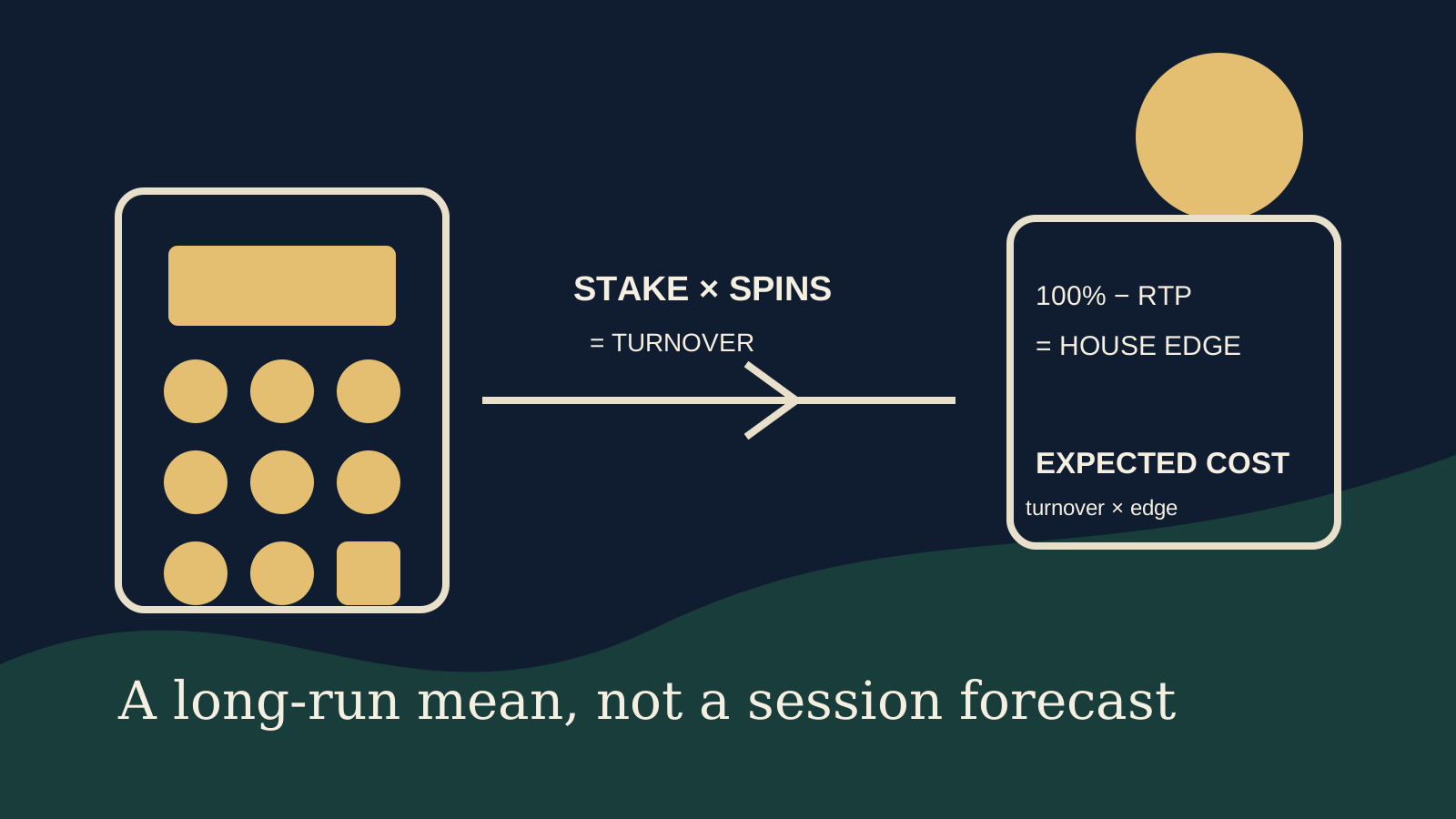
The tool uses three steps: turnover = stake × paid spins; house edge = 100% − RTP; and expected cost = turnover × house edge. Percentage values are divided by 100 in the multiplication. A 4% edge therefore enters the formula as 0.04.
The calculation assumes every counted round uses the same total stake and the same RTP configuration. If the stake changes, split the session into groups and add the expected costs. For example, calculate 200 spins at NZ$0.50 separately from 300 spins at NZ$1 rather than entering an average that hides optional feature prices.
It also assumes that “spins” means paid rounds. Free Spins awarded within a game are part of the return distribution generated by the paid trigger round; counting them again as newly staked rounds would overstate turnover unless an additional charge is actually made.
The model does not know volatility, hit frequency, maximum win, feature frequency or the full probability distribution. RTP alone supplies a mean, not the spread around that mean. A useful range for one session would require substantially more certified mathematical information than most public help provides.
Items deliberately left outside the formula
The calculator does not subtract deposit fees, currency-conversion charges, withdrawal fees, taxes or promotional value. Those items are not part of the slot RTP. If they apply, assess them separately and do not alter the game percentage to make unrelated operator costs look like part of the certified return.
It also does not model a progressive jackpot balance. A network prize can change continuously, and its contribution or trigger rules may sit inside the published RTP in a way that only the current help explains. Entering a larger jackpot number as expected prizes would create a false personal forecast.
Finally, the calculation assumes a completed, correctly settled round. Interrupted games, void rules, disconnected sessions and operator adjustments belong to the game and account terms. They can affect an individual record without changing the algebra used for a normal paid round.
Exposure is repeated
Why turnover is not the same as a deposit
A deposit is the amount transferred into an account. Turnover is the sum of stakes placed after that transfer. If a NZ$100 balance funds a NZ$1 spin, receives NZ$0.80 and the returned amount is staked again, each paid spin adds another NZ$1 to turnover even though no new deposit occurred.
This distinction explains why expected cost can accumulate over a long session while the visible balance moves up and down. Recycled prizes permit further paid rounds, and those later stakes create more exposure to the same theoretical edge.
Do not multiply the deposit by the edge unless the deposit will be staked exactly once. If a NZ$100 deposit supports NZ$800 in total paid spins, NZ$800—not NZ$100—is the relevant input for an expected-cost calculation.
Conversely, do not assume turnover must be lost. RTP includes prize value returned across rounds, and the same units can form part of both prizes and later stakes. Expected cost captures the average difference, while the actual balance path remains random.
Configuration-specific input
Which RTP percentage belongs in the calculator
Use the percentage displayed in the help or information panel of the exact game at the intended operator. Match the full title, developer, game ID or version where visible, and the selected mode. A provider’s product page or an editorial review can identify possible settings but cannot prove which one was deployed.
Many slots exist in several certified RTP builds. A page may discuss 96% because that was the public demo, while an operator uses 94%, 92% or another value under the same artwork. At NZ$10,000 turnover, changing the input from 96% to 92% changes expected cost from NZ$400 to NZ$800.
Enhanced bets, feature purchases and jackpot-connected editions can use their own RTP. Enter the return for the paid route actually being assessed. If the help provides no separate percentage, do not invent one or assume that a higher price automatically receives a higher return.
A percentage from a demo is evidence for that demo build only. Our demo versus real-money settings guide explains how to compare identifiers, stake controls and help panels without assuming the two modes are mathematically identical.
Mean without a timetable
Why an actual session can be far from the estimate
RTP is designed over a very large number of rounds, commonly across simulations or mathematical evaluation far beyond an ordinary session. The calculator applies that long-run mean directly, but it cannot remove short-run randomness.
A volatile game may place a large share of theoretical return in rare features or high awards. Many sessions can finish below the expected line while a few large results lift the long-run average. A lower-volatility game can still lose and a high-volatility game can still win; the label concerns distribution, not direction.
Independent random outcomes also mean a prior loss does not make the next spin more likely to recover the average. RTP does not operate as a personal balance that must settle after a fixed number of rounds. See our independent RNG outcomes guide for the distinction between a stable model and an unsettled session.
The expected-cost line is therefore best used to compare exposure choices before play: stake, number of paid rounds and active return. It is not useful for deciding that continued play is “due” to move a balance toward the average.
Use the full charged price
Enhanced bets, feature buys and free rounds
If an enhanced-spin option costs 1.5x or 2x the regular amount, enter the enhanced total shown beside the spin button—not the unmodified base stake. One hundred NZ$2 rounds create NZ$200 turnover even if the interface describes the original unit as NZ$1.
A feature purchase is one paid decision at its full displayed price. A buy costing 100x a NZ$1 regular bet contributes NZ$100 turnover when purchased. Do not enter “one spin at NZ$1”; that would understate the charged exposure by a factor of 100.
If the feature buy has a separately documented RTP, use it for that purchase. If it shares the ordinary RTP, the expected-cost formula is unchanged but the one-decision exposure is much larger. Our feature-purchase mathematics guide covers route pricing and return comparisons in more detail.
Free Spins won from a paid round are not new turnover unless the rules charge for them. Their awards are already part of the paid round’s mathematical return. Optional extra spins purchased after a feature, by contrast, add their actual displayed price to turnover.
Change one input at a time
How to compare stakes, spin counts and RTP settings
Holding spins and RTP constant, doubling the stake doubles turnover and expected cost. Holding stake and RTP constant, doubling the paid-spin count does the same. The relationship is linear because the formula multiplies those inputs.
Changing RTP alters the edge. At NZ$1 for 1,000 spins, 96% RTP produces NZ$40 expected cost, 94% produces NZ$60 and 90% produces NZ$100. The gaps are long-run differences in expectation, not guaranteed differences between three short sessions.
Spin speed is not a formula input, yet it can affect how quickly the chosen number of rounds occurs. Faster play can turn the same per-spin exposure into a larger hourly turnover if it leads to more paid decisions.
For a fair comparison, keep the definition of one paid round consistent. Do not compare ordinary spins in one game with a 100x feature purchase in another as though both were one unit of equal exposure.
| NZD example | Turnover | RTP | Expected cost |
|---|---|---|---|
| NZ$0.50 × 500 spins | NZ$250 | 96% | NZ$10 |
| NZ$1 × 1,000 spins | NZ$1,000 | 96% | NZ$40 |
| NZ$1 × 1,000 spins | NZ$1,000 | 92% | NZ$80 |
| One 100x buy from NZ$1 base | NZ$100 | 96.5% | NZ$3.50 |
Expected cost is not a loss ceiling
Using the estimate alongside a real limit
The maximum session loss can be much larger than expected cost. With NZ$1,000 turnover, it is mathematically possible to lose most or all of that amount depending on the game and sequence, even when the expected cost is NZ$40.
A budget must therefore be chosen independently of the average. Decide how much money can be lost without affecting bills, savings or debt, and make that amount smaller than the funds available—not equal to a favourable calculator result.
Use operator deposit, spend and time controls where available. A paid-spin target is not protection if stake size is increased after losses, and an expected-cost figure is not permission to continue after the chosen boundary is reached.
If gambling is no longer recreational, stop and use the contacts on our responsible gambling page. Mathematical transparency can show exposure, but it cannot turn a negative-expectation product into income or a recovery strategy.
Manual cross-checks
Three worked examples
Example 1: ordinary spins
Stake is NZ$0.80, planned paid spins are 600 and RTP is 96.20%. Turnover is 0.80 × 600 = NZ$480. Edge is 100% − 96.20% = 3.80%. Expected cost is 480 × 0.038 = NZ$18.24. The actual result is not bounded by NZ$18.24.
Example 2: lower-return configuration
Stake is NZ$1, spins are 2,000 and RTP is 90%. Turnover is NZ$2,000, edge is 10% and expected cost is NZ$200. Entering 96% instead would produce NZ$80, showing why the deployed percentage matters.
Example 3: mixed stakes
A session contains 200 spins at NZ$0.50 and 100 spins at NZ$2, all at 96% RTP. The first block has NZ$100 turnover and NZ$4 expected cost; the second has NZ$200 turnover and NZ$8 expected cost. The combined expected cost is NZ$12 across NZ$300 turnover.
Mixed modes with different RTPs should also be calculated separately. Add their expected costs only after applying each route’s own stake, count and return.
Two-minute input audit
Checklist before relying on the output
- Open the exact game in the intended client.
- Match the full title, provider, edition and game ID where shown.
- Record the RTP from current help, including the selected mode.
- Use the total charged stake after enhanced-bet options.
- Count only paid rounds as new turnover.
- Enter feature purchases at their full displayed price.
- Calculate different stakes or RTP routes separately.
- Do not interpret expected cost as likely loss or maximum loss.
- Keep jackpots, promotions, fees and withdrawal terms outside the slot formula unless modelling them separately.
- Set an independent money and time limit before any paid play.
If a live client conflicts with an editorial page, use the deployed help for that configuration and send the title, game ID, date and screenshot through our corrections process.
New Zealand readers
What the calculator cannot verify
This tool performs arithmetic in NZD for readability. It does not assert that a supplier’s euro-denominated reference game is available with NZD stakes or through an operator accessible from New Zealand.
Operator identity, territorial terms, age controls, deposits, withdrawals, complaints, self-exclusion and promotional conditions require separate checks. A correct RTP input does not validate any of those claims.
New Zealand’s online-gambling position is time-sensitive. Use current Department of Internal Affairs player guidance and our dated legal-status guide at the point of use.
The tool stores nothing and sends no entered value to an operator. Its output is an on-page educational calculation; refreshing the page returns the example inputs.
Questions answered
Frequently asked questions
What does the slot expected-cost calculator calculate?
It calculates turnover as stake per paid spin multiplied by paid spins, then applies the theoretical house edge, which is 100% minus the entered RTP. Expected cost equals turnover multiplied by that edge.
Does an expected cost predict my actual loss?
No. It is the mean of the mathematical model over a very large number of comparable rounds. One session can lose the full turnover, finish ahead or land anywhere between, subject to the game rules.
Should I enter my deposit or my stake?
Enter the full price of one paid round after any enhanced-bet option. The calculator derives turnover from that price and the number of paid rounds. A deposit is a funding amount, not automatically the turnover.
Which RTP should I use?
Use the percentage shown in the information or help panel of the exact operator client and mode you intend to assess. Do not assume the highest percentage found in a review applies to a lower-return build.
Can I use the result as a safe gambling budget?
No. Expected cost is not a maximum loss. If budgeting, assume the amount you make available can be lost and use deposit, spend and time controls that are acceptable without any win.
Evidence record
Primary sources
Facts and configurations were checked against the following first-party records. A public product page is not proof that a game is available through a New Zealand operator.
- Evolution — Slots product informationChecked 6 October 2026
- Relax Gaming — official Book of Power help exampleChecked 6 October 2026
- Relax Gaming — official Money Cart 3 help exampleChecked 6 October 2026
- New Zealand Department of Internal Affairs — online gambling for playersChecked 6 October 2026