Short answer
The gamble starts with money already won
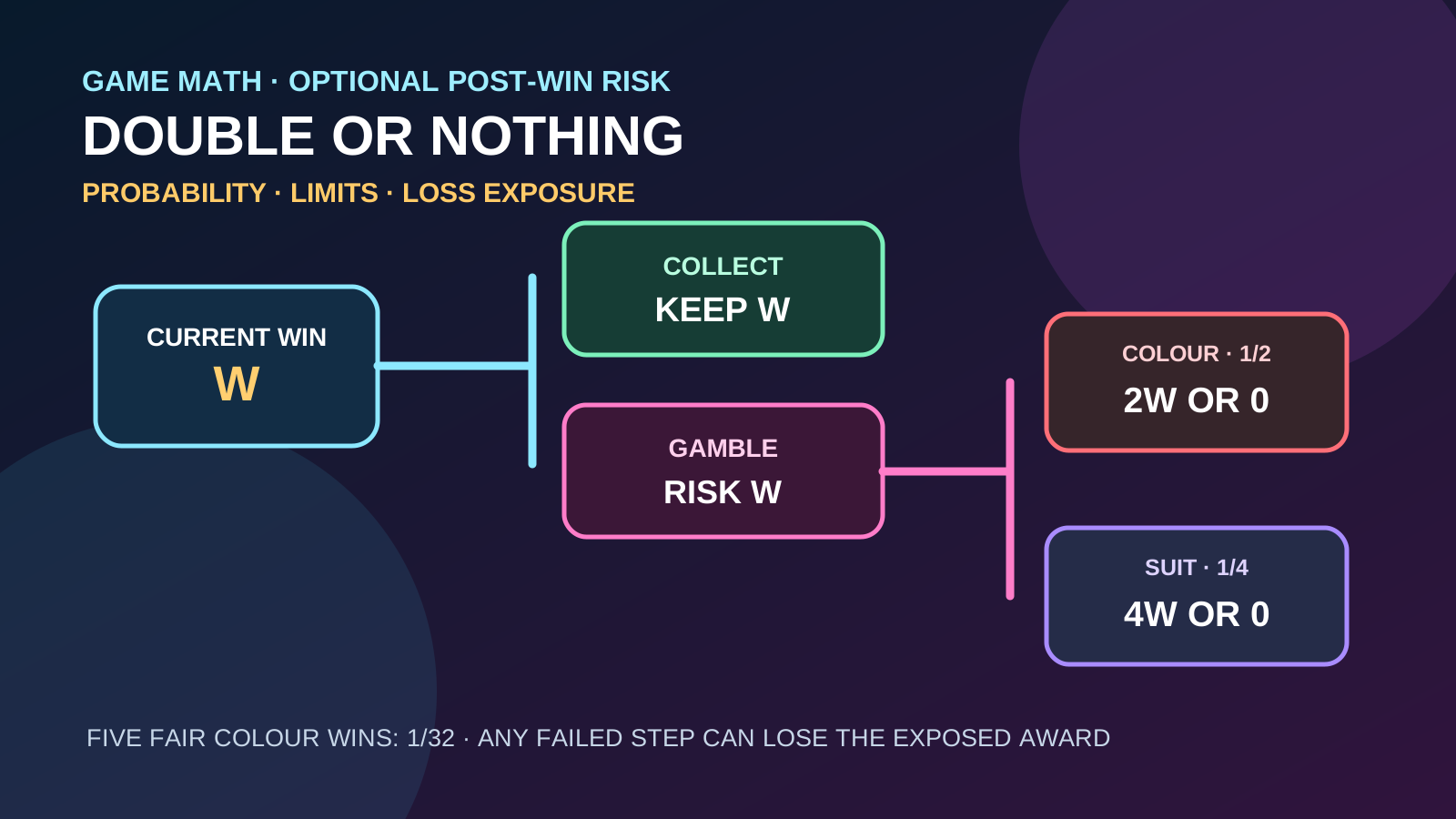
A post-win gamble is not another ordinary reel spin. The slot has already calculated an award, and the player chooses whether to collect it or expose it to a separate random event. A successful outcome replaces the current amount with a larger one; a failed outcome commonly reduces the exposed amount to zero.
The familiar card version offers red or black for a displayed 2× return and sometimes one of four suits for 4×. If colours are equally likely, the colour chance is 1/2. If four suits are equally likely, the suit chance is 1/4. Those probabilities are conditional on the documented model. A themed wheel, unequal segments, special cards or market-specific rules can produce a different calculation.
Play’n GO’s current public pages for Oasis of Dead, Myth and Ninja Fruits document the colour-to-double and suit-to-quadruple structure. They also document title-specific limits, including no more than five successive attempts in those examples. That evidence supports a comparison of those named games, not a claim that every Play’n GO title—or every slot—uses the same feature.
The practical decision is therefore simpler than the animation: collect the known win, or accept a stated probability of losing it for a larger conditional payout. The feature does not repair earlier losses, make the next reel spin more favourable or create a timetable for winning.
- Colour model
- Nominally 1/2 for 2×
- Suit model
- Nominally 1/4 for 4×
- Five colour wins
- 1/32 · 3.125%
- Amount at risk
- The current award
Define the stake correctly
The exposed amount is the current win, not a free extra
Suppose a paid spin returns a $4 award. Pressing Collect preserves $4. Pressing a fair colour gamble instead makes that $4 the feature stake: a correct answer produces $8 and an incorrect answer normally produces $0. The original paid spin is not refunded after a failed guess because its settled award was deliberately placed into the gamble.
If the first gamble succeeds and the player continues, the next decision exposes $8, not the original $4. After another success the exposed amount becomes $16. This is why a sequence that looks like several small button presses can become a large change in risk: every continuation places the entire accumulated award on the next outcome unless the rules provide a partial-gamble option.
“Optional” matters. A proper description should show a Collect route and should not imply that refusing the gamble forfeits the base award. If the interface offers several stake fractions, the selected fraction—not necessarily the whole win—becomes the amount at risk. The help must define that behaviour; do not infer it from a slider or an animation alone.
Some awards may be excluded. Jackpot prizes, bonus-round settlements, very small amounts or wins above the game’s gamble ceiling can go straight to the balance. That does not mean the feature malfunctioned. It means eligibility is part of the rule set and should be checked for the exact award type.
Count outcomes before using labels
When colour is 50% and suit is 25%
With a standard 52-card deck containing 26 red and 26 black cards, and with every card equally likely, the probability of a correct colour choice is 26/52 = 1/2 = 50%. With 13 cards in each of four suits, the probability of one named suit is 13/52 = 1/4 = 25%.
That calculation requires more than a picture of a card. The game might sample from a virtual deck that is reshuffled after every attempt, remove the previous card, include non-standard outcomes or simply use an independent random colour event. Each can look similar while producing different conditional probabilities. Only the formal help can identify the model.
The words “double or nothing” describe the payout consequence, not proof of the chance. A game could theoretically offer 2× against a probability lower than 50%, creating a negative expected value, or attach a fee or ceiling that changes the result. Conversely, a game may document a fair even-money choice without showing a literal deck.
Do not estimate probability from a short demo sample. Seeing six red cards in ten attempts neither proves a 60% red chance nor makes black “due.” Under an independent model, the next outcome retains its documented probability regardless of the recent sequence.
| Documented choice | Ideal equal-outcome probability | Displayed successful result | Failure consequence |
|---|---|---|---|
| Red or black | 1/2 · 50% | 2× current exposed award | Exposed award lost |
| One of four suits | 1/4 · 25% | 4× current exposed award | Exposed award lost |
| Themed wheel or pick | Count documented weighted outcomes | Use the paytable | Use the feature rules |
Payout times probability
A fair gamble can be neutral while still being highly risky
Let W be the current award. In an ideal fair colour gamble, the expected value after one attempt is 0.5 × 2W + 0.5 × 0 = W. In an ideal fair suit gamble, it is 0.25 × 4W + 0.75 × 0 = W. The mathematical average is unchanged even though the possible personal outcomes become much more extreme.
Neutral expected value is not a recommendation. Collecting keeps W with certainty; gambling converts that certainty into a chance of a larger amount and a chance of zero. A person who needs or values the existing award can rationally prefer certainty even when the theoretical average is identical.
Real implementations can depart from the ideal. Amount rounding, currency precision, maximum-gamble thresholds, forced collection at a ceiling, unequal probabilities or a payout schedule that is not exactly the reciprocal of probability can change expected value. The current help and paytable are needed before calling the step fair.
The game’s published RTP can also treat the feature in different ways. Some certification models incorporate optimal or assumed gamble use; others describe the base game separately or present a dedicated feature return. A general formula cannot determine which convention a particular client uses.
Probability compounds
Why consecutive attempts make survival unlikely
When independent colour gambles each have a 1/2 success probability, winning n attempts in a row has probability (1/2)n. One success is 50%; two are 25%; three are 12.5%; four are 6.25%; and five are 3.125%, or one successful full sequence in 32 on average over a very large number of trials.
The payout grows at the inverse rate: five successful doubles turn W into 32W. That symmetry is why the ideal expected value can remain W. It does not make 32W likely. There is a 31/32, or 96.875%, probability that at least one failure occurs before completing five colour guesses.
For independent suit guesses at 1/4 each, five consecutive successes have probability (1/4)5 = 1/1,024, about 0.0977%. The successful endpoint is 45W = 1,024W before any game ceiling. The rare large endpoint and the common zero endpoint offset only in the long-run ideal calculation.
A mixed sequence is calculated by multiplying the stated conditional probabilities. Colour, colour, suit has success probability 1/2 × 1/2 × 1/4 = 1/16, while the successful award is 2 × 2 × 4 = 16 times the starting award. If the game uses dependent cards without replacement, that simple product may need adjustment.
Stopping after a win changes how much remains exposed, but it does not retroactively improve the earlier chance. Nor does a series of failures create a higher next-step probability. The relevant information at each point is the current award, the documented next probability and the player’s willingness to lose the exposed amount.
Limits belong to the exact title
Round count, award ceiling and eligibility can all stop the feature
The official Play’n GO pages checked for Myth and Ninja Fruits say the gamble can be used up to five times successively and up to a limit of 2,500 coins. The current Oasis of Dead page also describes up to five consecutive rounds but expresses its promotional ceiling as up to 2,500× maximum bet. Those are not interchangeable units.
A coin limit can depend on denomination, coin value or the game’s definition of a credit. A times-bet figure depends on the named stake unit. Before calculating a cash amount, identify whether “bet” means total stake, line bet or another base. Converting the wrong unit creates a precise but false ceiling.
The interface may force collection when the next successful multiple would exceed the ceiling. Another implementation may hide the feature once the initial win is above the threshold. A third may cap the successful result. These produce different expected values near the limit and cannot be treated as one rule.
Jurisdiction and operator configuration can remove the feature even if the global provider page describes it. The public catalogue establishes that a studio documents the mechanism; only the loaded real-money help establishes that the option exists for a particular account and build.
Confirmed examples, not universal rules
What current Play’n GO pages actually document
Oasis of Dead describes an optional Gamble Feature in which predicting the colour doubles the win and predicting the suit quadruples it. Its page states up to five consecutive guesses and a potential bounty up to 2,500× max bet. That is a named 2024 game example, not the default for the whole Dead series.
Myth, released in 2012, documents the same colour and suit choices and a maximum of five consecutive rounds, but states a 2,500-coin limit. Ninja Fruits repeats that older rule pattern. The matching language supports comparison while the unit difference remains important.
Some modern slots use “gamble” for a different decision, such as accepting a displayed number of free spins or risking them for a larger package. That mechanism may have named probabilities or a visual meter unrelated to red/black cards. It should be reviewed under its own help rather than forced into the card formula.
Provider pages are useful discovery evidence, but deployed help is stronger for a current configuration. Record the game title, provider, version, help date, award type, attempt count and limit unit. If any field differs, keep the builds separate.
Do not count the same return twice
How the feature can interact with published RTP
RTP is a long-run ratio between total stakes and awards under the game’s mathematical model. A post-win gamble moves the distribution of an existing award. It does not automatically add a second percentage on top of the slot’s published return.
If a fair gamble is neutral and fully included in certification, using or declining it may change variance without changing theoretical return. If the gamble has a house edge, rounding effect or ceiling, the route can have a different return. The help must specify the treatment before a review assigns a number.
Do not calculate “96% slot RTP plus 100% gamble RTP.” The gamble amount came from the slot award; it is not a new external contribution that can be added as another return. Follow the full flow of stake, award, optional exposure and final settlement.
Our theoretical slot RTP guide explains the long-run percentage, while the independent-outcomes guide explains why recent reel or card results do not make a future outcome due.
Read before pressing
What the live help should disclose
First identify the amount displayed as the gamble stake. It should reconcile with the settled win or the selected fraction. Then record the available choices, successful payout, failure result and whether a Collect button remains available.
Next look for the probability model. “Guess red or black” can support a 50% calculation only when the rules establish equally likely colours. For suit, confirm four equally likely outcomes. If the help provides explicit probability instead, use it rather than assuming a physical deck.
Check the maximum number of attempts, maximum award, excluded prize types, rounding rule and what happens near the ceiling. Determine whether the client reshuffles or treats attempts independently if that detail is relevant to probability.
Finally, check the RTP statement and market availability. A feature visible in an official fun-money demo may be unavailable in an operator build. A search snippet, screenshot or another title’s page is not a substitute for the exact deployed help.
No recovery system
The feature changes exposure, not the past
A win that is still inside the gamble screen can feel like “house money,” but it has a real opportunity cost: Collect would preserve it. The correct comparison is not zero versus a possible double. It is a known current award versus a risky distribution with a possible zero.
Previous slot losses do not improve the gamble odds. A player who is down $100 and has a $10 award still faces the same documented probability on that $10. Continuing until the balance recovers is a target based on history, not a change in the random mechanism.
Martingale-style escalation is especially mismatched because the exposed amount usually grows automatically after each success and disappears after a failure. A finite attempt ceiling, game cap and finite bankroll prevent the idealised recovery story even before considering any house edge.
Decide before the result whether the award will be collected. If any amount would be needed for essentials, debt or another commitment, it should not be exposed. Use account limits, breaks and self-exclusion tools where gambling is no longer staying within a pre-set entertainment budget.
Keep concepts separate
Card gamble, feature gamble and bonus pick are different
A card gamble occurs after a monetary award and risks that award. A free-spins gamble may risk a package of spins for a different package. A bonus pick reveals a prize from a set but may not expose a settled award. A double-up symbol inside the reel game is part of normal evaluation, not necessarily an optional post-win action.
Risk labels alone are not enough. Document the object being risked, the timing, the possible outcomes and the settlement unit. This prevents a review from applying 50/50 language to a weighted free-spins ladder or calling a random bonus choice “double or nothing.”
The maximum game win is also separate. A gamble ceiling can be lower than the slot’s round cap, and the round cap can include or exclude different awards. Read both rules and do not promise that a theoretical series can continue beyond the game’s enforced limit.
New Zealand evidence
A global demo does not prove local availability
Play’n GO’s catalogue and global game pages establish provider documentation. They do not establish that a named operator makes the same title or gamble configuration available to a New Zealand account. Operator identity, territorial access and current client settings require separate checks.
New Zealand’s online-gambling environment is time-sensitive. Use the Department of Internal Affairs player guidance and our dated New Zealand legal-status guide at the point of action. This mathematical explanation is not legal advice or an operator recommendation.
Age gates, responsible-gambling controls and operator terms still apply. Demo access does not create cash eligibility, and a local currency display does not prove regulatory status. Keep the source chain for game rules separate from the source chain for an operator.
Arithmetic only
Three worked examples without a betting strategy
One colour choice: a hypothetical $6 win is offered at 2× on a documented independent 50/50 colour event. Collect preserves $6. Gamble produces $12 with probability 0.5 and $0 with probability 0.5. Expected value is $6, but the certainty is gone.
Three colour choices: starting from $2, three successes produce $16. Their joint probability is 1/8, or 12.5%. The probability of at least one failure is 7/8, or 87.5%. This is a distribution explanation, not advice to attempt the sequence.
Colour then suit: a documented fair colour success followed by a fair suit success has probability 1/2 × 1/4 = 1/8. The successful endpoint is 2 × 4 = 8 times the starting award. Any failed step loses the amount exposed at that step, subject to the exact game rules.
Currency values are hypothetical. They do not claim NZD availability, an operator stake range or a current Play’n GO limit. If the deployed client rounds cents or forces collection near a ceiling, recalculate using that rule.
Two-minute verification
Checklist for any double-or-nothing claim
- Match the exact title, studio, edition and game ID.
- Open the deployed help rather than relying on the lobby card.
- Identify the award eligible for the gamble.
- Confirm whether all or only part of the award is exposed.
- Record the success choices and payout multiples.
- Find the stated probability or count documented equal outcomes.
- Do not infer fairness from “double” or “quadruple” alone.
- Check whether outcomes are independent or card-dependent.
- Record the maximum consecutive attempts.
- Preserve the ceiling and its unit: coins, credits or times bet.
- Check rounding and forced-collection rules near the limit.
- Confirm which award types are excluded.
- Read how the gamble is treated in RTP.
- Separate demo rules from operator availability.
- Collect rather than chase prior losses.
The central formula is simple, but the implementation is not: probability × successful payout determines the theoretical return of a step, while the current award defines personal exposure. Use both, and leave any undocumented field explicitly unknown.
Questions answered
Frequently asked questions
Is double or nothing always a 50/50 gamble?
No. A red-or-black card choice has a nominal 1-in-2 probability only if the game uses two equally likely colour outcomes and the current help confirms that model. The button label alone does not prove the probability.
Does doubling a win improve the slot RTP?
Not necessarily. A fair 50/50 double-or-nothing step has neutral expected value before limits or rounding: 50% of 2W plus 50% of zero equals W. The exact game help must say whether the gamble is included in the published RTP.
What happens after five consecutive colour gambles?
Under an ideal independent 50/50 model, the chance of winning all five is 1 in 32, or 3.125%. The award would reach 32 times the starting win; any failed step normally loses the amount currently exposed.
Can a strategy recover previous slot losses?
No reliable recovery strategy follows from a gamble button. The feature risks an existing award and does not change the independence of future game rounds. Increasing exposure after losses can accelerate loss.
Why can the gamble option be missing?
The provider, operator, jurisdiction, selected mode, award type or amount limit may disable it. Open the deployed help and do not assume a feature shown in another market is present in the current client.
Evidence record
Primary sources
Facts and configurations were checked against the following first-party records. A public product page is not proof that a game is available through a New Zealand operator.
- Play’n GO — official games catalogueChecked 6 October 2026
- Play’n GO — Oasis of Dead official game pageChecked 6 October 2026
- Play’n GO — Myth official game pageChecked 6 October 2026
- Play’n GO — Ninja Fruits official game pageChecked 6 October 2026
- New Zealand Department of Internal Affairs — online gambling for playersChecked 6 October 2026