Start with the task
How to use this Play'n GO games guide
A provider guide should solve a navigation problem, not pretend that hundreds of games can be reviewed responsibly on one page. Play'n GO's public catalogue is the starting point for identifying titles and broad product families. The rules or game help for a named title is the stronger source for its reel layout, paylines, feature triggers, return settings and mathematical limits. We keep those jobs separate: this page maps the studio's catalogue, while each linked game page deals with one exact title.
Begin with the name shown in the game client. Small differences matter. Rich Wilde and the Book of Dead, Book of Dead GO Collect, Pilgrim of Dead and Legacy of Dead are related by theme or mechanics, but they are not interchangeable editions. Their free-spin awards, retrigger rules, volatility ratings, maximum win multipliers and RTP menus differ. Searching only for “Book of Dead RTP” can therefore land on the wrong rules.
Next, use the official catalogue or search field to confirm the exact title and publisher. Then open the title's information screen wherever you encounter it. Compare the displayed RTP and version with the dated facts in our game guide. Finally, check the operator's current terms and legal status separately. That sequence prevents a common mistake: treating a provider's international marketing page as evidence that a particular product is offered to New Zealand players.
Official starting point
What the Play'n GO catalogue actually tells you
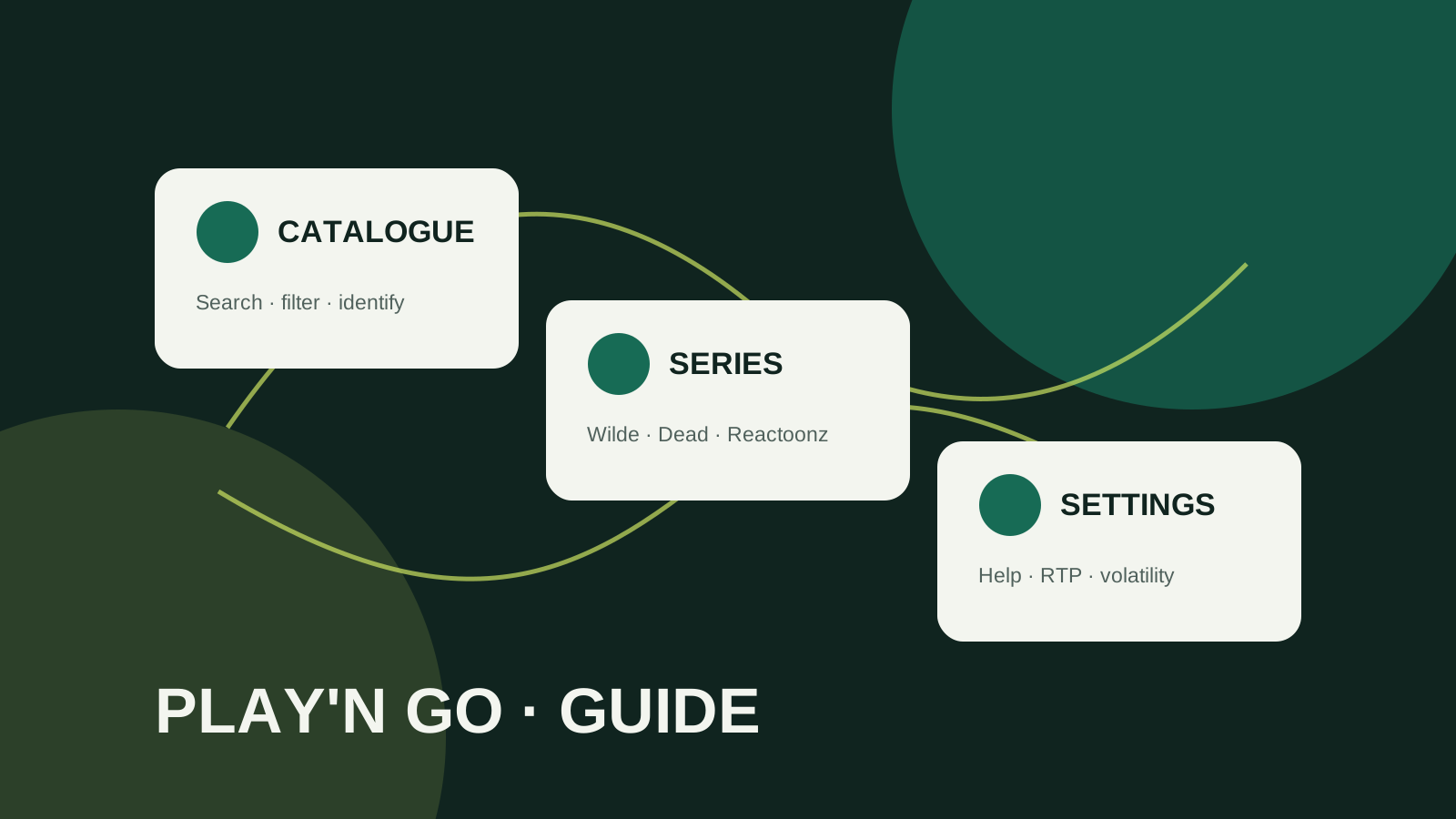
The official games directory is useful for discovery. At our check on 6 October 2026, it offered an all-games view, title search and theme filtering. It also exposed named catalogue groupings including Blitzways, Grid Slots, 100 Games, Joker Series, Legion Gold, Music Slots, Reactoonz, Rise of Olympus, Sweet Alchemy, Table Games and Wilde Series. These labels help a reader move from a broad idea—such as a character-led adventure or a grid game—to titles the studio itself associates with that idea.
A catalogue card is not a complete specification. It may show the title, artwork, format tags or a short marketing description, but that is not enough to establish every pay rule. Release records and game rules can provide additional fields. For the four detailed guides in this batch, the official records distinguish game IDs, release dates, volatility scores, configurable RTP values and win caps. Those fields must be read title by title.
The directory also changes. New titles appear, older filters can be renamed, and a product may be presented differently in regional deployments. For that reason, our list is a dated map rather than a promise of permanent completeness. We record the date beside the evidence, link to the studio's live catalogue and avoid statements such as “all Play'n GO games” when we have not enumerated and verified every current item.
Use search when you know the title. Use series groupings when you are comparing related mechanics. Use a game-specific guide when a number matters. That simple division makes the catalogue faster to navigate and reduces the chance of transferring a figure from one release to another.
Families, not substitutes
Series and catalogue families worth distinguishing
Play'n GO uses several kinds of grouping. Some centre on a recurring character, some on a game engine or format, and some on a recognisable world. A family label can explain why games look related, but it does not make their mathematics identical. The official catalogue currently surfaces Wilde Series as a navigation category, while separate editorial material discusses the Book of Dead line and other game series.
Wilde adventures
Rich Wilde is a recurring character. The best-known title in this batch is Rich Wilde and the Book of Dead, with selectable lines and an expanding-symbol free-spin feature.
Dead-themed successors
Legacy of Dead and Pilgrim of Dead use their own free-spin counts, expansion rules and mathematical profiles. The shared naming is not a version number.
GO Collect variant
Book of Dead GO Collect adds Gold Staters, a Treasure Vault respin feature and an optional gamble. It is a distinct 2026 release, not a cosmetic reskin of the 2016 game.
Mechanic-led collections
Labels such as Grid Slots, Blitzways, Reactoonz or Sweet Alchemy can point to format or franchise connections. Always check the individual help file for the precise grid, ways, feature and return configuration.
Series navigation is most useful for forming the next question. If you like a particular free-spin structure, compare how the special symbol is chosen, whether it stays sticky, whether more symbols can be added, and whether retriggers are capped. If you are comparing risk, look at volatility and the maximum win in the same unit. If you are checking value, look for the RTP displayed in the actual game—not only the highest percentage quoted on a review page.
One URL per title
Dead-series guides in this release
Our current set deliberately covers four exact Play'n GO products. The purpose is not to declare a “best” game. It is to give each search task one canonical home where rules, configurations, mobile notes, demo limits and source dates can be evaluated together.
| Title | Release | Core distinction | Verified RTP settings | Guide |
|---|---|---|---|---|
| Rich Wilde and the Book of Dead | 14 Jan 2016 | Up to 10 selectable lines; 10 free spins with one expanding regular symbol | 96.21%, 94.25%, 91.25%, 87.25%, 84.18% | Read rules |
| Book of Dead GO Collect | 26 Feb 2026 | Fixed 10 lines; Gold Staters and three-respin Treasure Vault | 96.2%, 94.2%, 91.2%, 87.2%, 84.2% | Read rules |
| Pilgrim of Dead | 19 Jan 2023 | Five free spins; sticky selected symbols can expand reels | 96.2%, 94.2%, 91.2%, 87.2%, 84.2% | Read rules |
| Legacy of Dead | 2 Jan 2020 | Eight free spins; retriggers add another expanding symbol | 96.58%, 94.51%, 91.51%, 87.56%, 84.55% | Read rules |
The table is a route map, not a substitute for the full guide. For example, a 96.2% option in two games does not mean their hit patterns or feature frequency are the same. Likewise, a 10,000-times win cap says nothing about how likely that cap is. Open the relevant page for the full sequence and the distinction between total-bet multipliers, currency exposure at maximum bet and probability figures.
New exact-title records
Three more current Play'n GO rules guides
The catalogue now links to three additional single-title reviews. Each keeps rules, RTP variants, mobile help, demo limits and evidence conflicts on one canonical URL rather than creating separate pages for each subtopic.
Lady of Fortune Remastered
Read the complete guide for reel-three multiplier Wilds, Pick-a-Prize values and the disclosed 150x-versus-1,500x source conflict.
Dansband på Turné
Read the complete guide for full stacks, the carrying Win Multiplier and the retriggerable 5–15 Free Spins range.
Wildest Gambit
Read the complete guide for the Chile, Peru, India and Egypt route and the three Wilde-family Wild systems.
Configuration awareness
Which game settings can vary
The most important catalogue lesson is that a title can be deployed with more than one certified return setting. The help files checked for this batch list five RTP configurations per game. The first is the highest listed configuration, but an operator may use another approved value. A review that prints only the top number without explaining configurability can leave the reader with the wrong expectation.
Other fields have a different status. Reel and row counts, line structures and feature rules generally belong to the named version we reviewed. Bet controls can still be constrained by currency, platform or operator. The official game rule sheets use generic values and reference currencies; they do not establish that an identical range is available in New Zealand dollars. We therefore report the mathematical limits as documented and tell readers to rely on the live game screen for the deployed denomination.
Win cap needs a unit. The official public records for these games use total-bet multipliers: 5,000x for Rich Wilde and the Book of Dead and Legacy of Dead, and 10,000x for Book of Dead GO Collect and Pilgrim of Dead. A separate “maximum exposure” field in a rule sheet is a currency-denominated ceiling at maximum stake. Combining those two fields into one headline number is misleading, so our individual guides keep them separate.
Volatility is also comparative rather than predictive. The current records rate Book of Dead at 7, GO Collect at 7, Pilgrim at 8 and Legacy at 8 on Play'n GO's scale, all described publicly as high. It means returns are designed to arrive unevenly; it does not let a player forecast the next feature or set a safe session length.
Evidence hierarchy
How we verify rules without copying marketing copy
We use a source hierarchy. First comes the current in-game help or official game rules sheet for the exact title and game ID. It defines the win evaluation, scatter behaviour, feature trigger and mathematical options. Second comes the official product page, which can supply the published release date, public title, volatility label and win-cap field. The wider catalogue confirms that the studio documents the title and shows how it is grouped.
Those sources can answer different questions. A product page may summarise a feature as “expanding symbols”; the rule sheet explains when the symbol is selected, whether it pays on non-adjacent reels and what a retrigger changes. Rather than repeat promotional story text, our guide translates the operational sequence into plain English. We also state when an official record is silent. Silence is not permission to import a claim from an affiliate review.
Third-party pages are useful for gap analysis, not for overriding the game rules. During this batch we found examples of old free-spin counts, single-RTP presentations, incorrect caps and fixed-versus-selectable line descriptions. Those differences are why every numerical claim in the game pages is tied back to the dated Play'n GO record. If the studio updates a rule sheet, the page should be rechecked rather than silently preserving the old number.
We do not reproduce full copyrighted paytables or provider descriptions. A player who needs symbol-by-symbol awards should use the help panel in the exact game session. Our job is to explain the structure and show where configuration matters.
Long-run mathematics
How to read RTP and volatility together
Return to player is the theoretical proportion of stakes a game model returns over a very large number of rounds. It is not an account-level promise. A 96.2% model does not return $96.20 from every $100 session, and a run of losses does not prove that the published percentage is false. Random variation dominates short play.
Configuration makes the first check simple: open the game menu and look for RTP, help, rules or information. Record the percentage before wagering. If a site does not make the value available where expected, do not infer it from the title or an old review. The same game name can be served with one of several certified options. The differences in this batch are material: the lowest listed settings are roughly twelve percentage points below the highest.
Volatility describes the shape of possible returns. A high-volatility game can produce longer quiet spells and more concentrated prizes than a lower-volatility model, although no rating predicts a particular session. Maximum win provides another boundary, but it remains a ceiling, not a typical outcome. Probability statements in the rules—where supplied—describe the model at a given configuration or maximum exposure; they should not be turned into advertising claims.
The practical reading order is RTP setting, volatility, win cap, bet controls, feature cost or gamble rules if present, and only then thematic preference. A lower stake does not change a game's percentage by itself, but it can reduce the money exposed per round. Time limits, loss limits and breaks remain more useful for personal control than attempting to time a random feature.
Access is a separate check
Mobile support and demo pages
The official records for the four titles covered here identify both mobile and desktop formats. That confirms a technical release format; it does not guarantee smooth performance on every device, browser or operator wrapper. Screen orientation, sound controls, reduced motion, connection quality and the way a help panel opens can differ. On mobile, the most important test is whether the rules and RTP remain readable before play.
Play'n GO also presents public entertainment-only game pages for some titles. Where a no-purchase demo is available, it can help a reader locate the paytable and observe the interface. Demo credits have no cash value, and a demo sequence cannot establish the odds of the next paid round. We do not embed a provider client or frame it as a “free winning strategy.”
Access can be restricted by age, geography, platform or operator arrangements. The existence of an official demo is not proof that real-money play is permitted from New Zealand. Nor does a mobile tag establish that a game appears in a locally authorised catalogue. Those are operator and regulatory questions that must be checked at the time of use.
For usability, take a screenshot or note of the title, game ID or version displayed in help if you need to report a discrepancy. That is more useful than quoting a lobby thumbnail. If the live rules differ from our dated guide, stop and use the current in-client information as the controlling source, then send us the evidence through the corrections route.
Local context
What the catalogue does not prove for New Zealand
New Zealand's online casino framework is changing, so availability claims need a date and an operator-level source. The Department of Internal Affairs' player information page was checked on 6 October 2026. It explains the transition under the Online Casino Gambling Act and distinguishes the period before 1 December 2026 from the later licensing process. This provider guide is not a substitute for that official notice.
We therefore avoid saying that every Play'n GO title is “available in NZ.” A provider can publish a global catalogue while individual operators select only part of it, use different certified settings, or restrict access. A reader should verify the operator, its current New Zealand status, the precise game and the rules shown in the session.
For the local framework rather than studio content, use our online casino legal-status guide. It records the relevant dates and links back to the primary New Zealand source. Keep that task separate from game comparison: legality and operator status are not features of a slot, while provider ownership does not confer an operator licence.
Marketing language deserves the same caution. “New Zealand casino,” “NZ players accepted” or a kiwi-themed landing page is not official evidence. Do not rely on currency display alone. Read the current terms, identity requirements, payment rules, complaints route and responsible-gambling controls before creating an account or depositing.
Match the question
Choose the right game guide
Open the Rich Wilde and the Book of Dead review if you need the original 2016 game's selectable-line rules, its ten-free-spin feature and the five current RTP options. It is also the page that explains why the 5,000x cap and 500,000 maximum-exposure record are different measurements.
Open Book of Dead GO Collect for the 2026 release. Its Gold Staters, Treasure Vault, three-respin loop, jackpot-style bonus values and optional Treasure Gamble create a different rules task. It is not enough to read the original Book of Dead guide and assume the rest.
Use the Pilgrim of Dead guide when the question concerns sticky selected symbols, whole-reel expansion, the five-spin starting award or the 30-free-spin cap. Use Legacy of Dead for the eight-spin award and the rule that a retrigger can add another special expanding symbol.
If your question is broader—such as how to search the studio catalogue, why two reviews show different RTP values, or whether a series label implies identical mechanics—stay on this page. If your question concerns a provider not named Play'n GO, this is the wrong entity page. That boundary is intentional and prevents an unfocused “all slots” index from competing with specific game answers.
Before relying on a listing
A short verification checklist
- Match the exact title. Include qualifiers such as GO Collect; do not treat a shared series name as the same product.
- Confirm the publisher. The official Play'n GO catalogue or product page should document the title.
- Open the live help. Check the RTP, version, line structure, bet unit and feature rules in the actual client.
- Keep units attached. Distinguish a total-bet win multiplier from a currency maximum exposure and from a symbol paytable award.
- Date the availability check. A studio page proves publication, not current New Zealand operator access.
- Read operator terms. Verify legal status, age requirements, account checks, payments and responsible-gambling controls independently.
- Set a limit. RTP and volatility cannot make a session predictable; decide time and money limits before play.
If any field conflicts with the game client, the current in-game help for that deployed version should take priority. Save the title and version details and use our corrections page to report the mismatch. A dated correction is more useful than quietly blending incompatible figures.
Questions answered
Frequently asked questions
Is every game on Play'n GO's website available in New Zealand?
No. A studio catalogue confirms that Play'n GO publishes or documents a title; it does not confirm that a licensed or otherwise lawful New Zealand-facing operator currently offers it. Availability must be checked at the operator level.
Does one Play'n GO title have one universal RTP?
Not necessarily. The current game rules for the titles covered here list multiple certified configurations. The value in a live game should be checked in that game's own help or information screen.
What is the difference between a series page and a game review?
A series or provider page helps you navigate related titles. A game review records one title's rules, feature sequence and verified settings. This guide links to one consolidated page per game rather than splitting RTP, bonus and demo information across duplicate URLs.
Are the illustrations on this site game screenshots?
No. They are original editorial diagrams used to explain catalogue and rules concepts. They do not represent the appearance of the live game client.
Can RTP predict what I will win in a session?
No. RTP is a theoretical long-run model. Individual sessions can finish far above or below it, and a higher published setting does not remove volatility or guarantee a return.
Evidence record
Primary sources
Facts and configurations were checked against the following first-party records. A public product page is not proof that a game is available through a New Zealand operator.
- Play'n GO — official games catalogueChecked 6 October 2026
- Play'n GO — Book of Dead slots series articleChecked 6 October 2026
- Play'n GO — game series news categoryChecked 6 October 2026
- New Zealand Department of Internal Affairs — online gambling for playersChecked 6 October 2026