Short answer
Evidence-led verdict
Lady of Fortune Remastered is Play'n GO Game ID 976, version 1.0, released on 3 October 2024. The checked official records describe five reels, three rows and a public product record of fifteen paylines; see the documented line-count conflict below. This guide keeps that exact identity separate from similarly named games and from generic summaries of the studio's catalogue.
The provider's current mathematical record lists five selectable return configurations: 96.2%, 94.2%, 91.21%, 87.2%, 84.2%. These are alternative builds, not five returns operating at once. Only the help panel in the deployed game can establish which one an operator is running.
Official risk fields record volatility level 4, a maximum award of 1,500x total bet, reference stakes from 0.15 to 60, and maximum exposure of 91,400 at the reference maximum stake. The listed probability for the maximum event is 1 in 1,000,000,000. None of those figures predicts the result of a session.
This is a rules and evidence guide, not proof that the title is offered for real-money play in New Zealand. We found no operator-level evidence within this article's scope, so readers must verify the operator, territorial access, active RTP and live help separately.
- Game ID
- 976 · v1.0
- Release
- 3 October 2024
- Volatility
- 4
- Win cap
- 1,500x
Exact remaster
Release, Game ID and version identity
Play'n GO's product record dates Lady of Fortune Remastered to 3 October 2024. The current Game Rules Summary identifies Game ID 976, version 1.0 and internal name “ladyoffortunerm,” with mobile and desktop formats. Those fields distinguish the 2024 remaster from the studio's earlier Lady of Fortune and from similarly named fortune-telling games.
The remaster keeps a conventional five-reel, three-row presentation, but the evidence is not perfectly aligned on paylines. The public product record and catalogue data describe 15 lines. The GRS rules discuss line awards and positions, yet its mathematical information table contains “Fixed 1.” Because both are first-party records, the honest approach is to preserve the discrepancy rather than silently choose the convenient number.
For a deployed client, open the paytable and check how many lines are active and whether they are fixed. Do not infer the answer from the visual grid. A 5×3 display can support many line structures, and the total bet may be represented differently even when every line is always active.
The release page establishes public status, not local availability. No New Zealand operator was verified within this article's scope. A studio record can prove the game's identity and rules without proving that a person in New Zealand can access a real-money instance.
Line evaluation
How ordinary wins are evaluated
The checked rules say matching symbols normally pay on a payline, with the highest win awarded per line. A material variation is that a winning combination may begin on reel one, two or three. That differs from the familiar leftmost-reel rule used by many five-reel slots, so a symbol group beginning in the middle can still be relevant when the paytable supports it.
Line awards from the same spin are added. The Scatter is evaluated through its own rule and does not behave as an ordinary line symbol. Wilds replace ordinary paying symbols but not the Scatter. Always use the live paytable for the exact symbol values, because artwork alone does not reveal which three-, four- or five-symbol combination is being paid.
The total stake funds the complete paid round. If the client exposes coin value, bet level and total bet separately, the total bet is the number to use for the 1,500x cap and Pick-a-Prize multipliers. Changing a denomination can alter the charged amount even when the line diagram remains unchanged.
The current GRS does not describe a free-spins round, cascading reels, expanding grid or bonus buy. We have not imported those mechanics from another “Lady” title. The game-specific features verified here are the multiplier Wilds and the three-Scatter Pick-a-Prize event.
Reel-three modifiers
The four multiplier Wilds
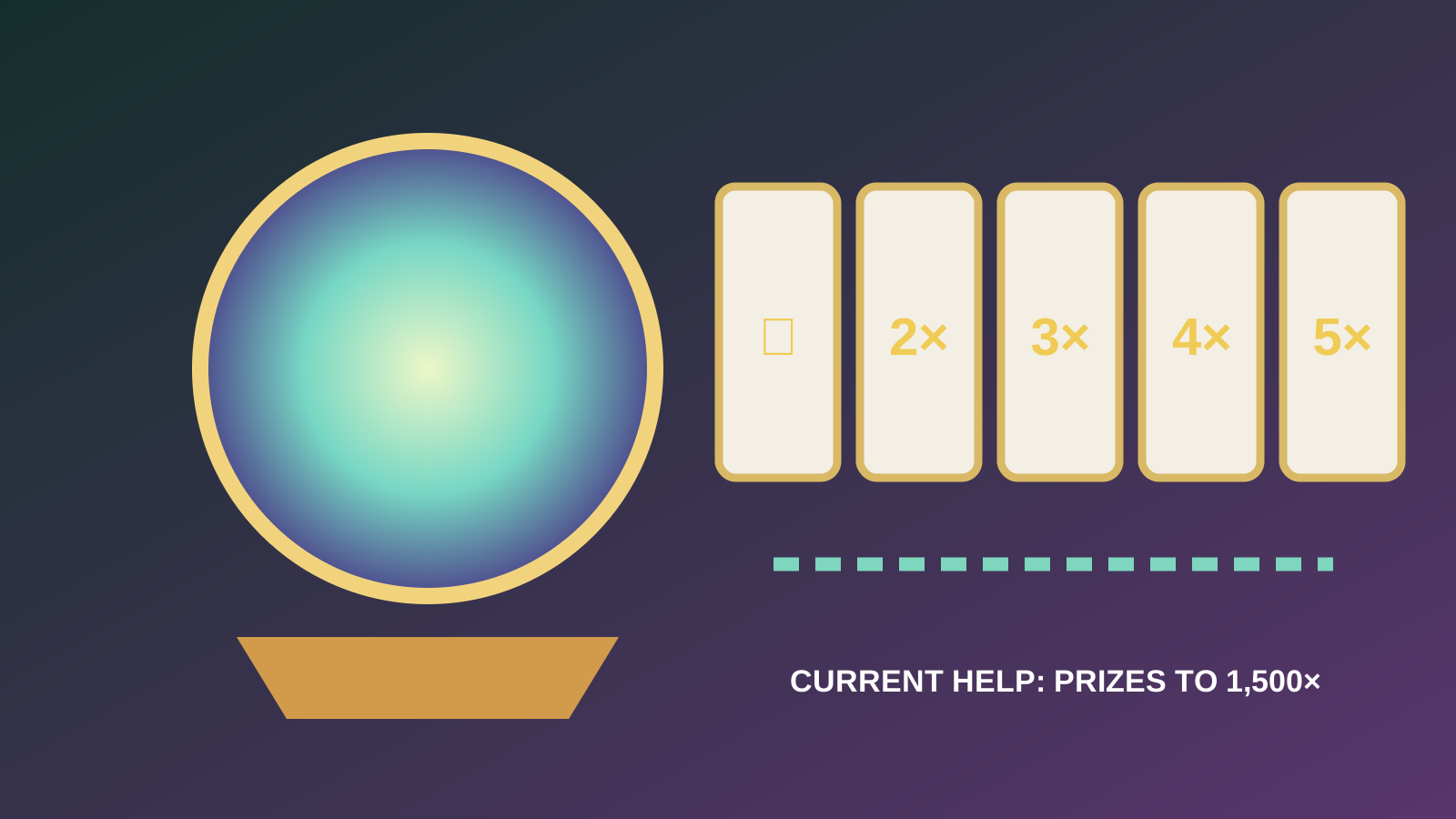
Four Wild designs carry multipliers of 2x, 3x, 4x and 5x. The rules restrict them to reel three. Each substitutes for ordinary paying symbols and multiplies a line award that includes it. The multiplier therefore modifies an already evaluated win; it is not a standalone prize simply for appearing.
The reel restriction is useful when reading a result. A Wild-looking emblem on another reel should not be assumed to use the same rule without confirmation in the live help. Likewise, the four values are alternatives attached to symbols, not a guaranteed 2×3×4×5 combined multiplier on every spin.
When several paylines use the same Wild, each qualifying line is evaluated under the paytable and the relevant multiplier. The rules' “highest win per line” provision prevents multiple interpretations of the same line from stacking. Separate winning lines can still be added to the spin total.
A multiplier can increase the size of an ordinary line award, but it does not change the documented RTP or prove a higher chance of winning. RTP already incorporates the probability and value of Wild-assisted results across the mathematical model.
Three specific reels
Scatter trigger and Pick-a-Prize values
The Ouija-planchette Scatter is restricted to reels one, three and five. One Scatter can land on each of those reels; all three trigger Pick-a-Prize. The positional rule matters: this is not a generic “three or more anywhere” trigger copied from another slot.
The current rules list twenty possible stake-relative prizes: 5x, 8x, 10x, 12x, 15x, 20x, 25x, 30x, 35x, 40x, 50x, 75x, 100x, 125x, 150x, 250x, 500x, 750x, 1,000x and 1,500x total bet. A revealed value is the complete feature award described by that table; the sequence is not a ladder the player climbs through.
The top 1,500x value agrees with the largest prize in the current GRS but conflicts with the shorter product-page sentence. It remains a rare ceiling, not an average bonus value. The GRS lists the maximum-event probability as one in one billion, which should not be converted into a session expectation.
There is no skill in selecting a covered prize. A different choice does not create a strategy for changing the underlying random award. The interface may make the reveal interactive, but the result belongs to the game's random model rather than the player's ability to identify a “better” card.
Do not hide discrepancies
Why the current help outranks older marketing copy
The public product page uses an older headline description saying Pick-a-Prize can award up to 150x. The Game Rules Summary dated 5 February 2026 explicitly lists values through 1,500x. Because the assignment requires numerical claims from current help, this review uses 1,500x and records the 150x statement as stale or incomplete rather than blending the two.
The line-count conflict is handled differently because the GRS itself is internally sparse: its prose describes paylines without giving a count, while the math table says Fixed 1 and the public record says 15. We do not rewrite “Fixed 1” as 15 or declare the live presentation settled. A user should check the payline screen in the exact deployed client.
The product page also mentions a card-gamble round in its descriptive copy. The checked 2026 GRS does not document that feature. Availability can vary by jurisdiction or build, so we do not present the gamble as a universal current rule. If it appears, the live help should state its odds, limits and eligibility.
This source hierarchy protects the article from false precision. Current rules control current numbers; a dated marketing page supplies release context; unresolved first-party conflicts remain visible. A competitor's confident summary cannot resolve a disagreement between two official records.
Five configurations
Verified RTP settings and house edge
The official Game Rules Summary does not support presenting one RTP as universal. It lists the alternatives below. A casino, platform or jurisdiction can use a supported configuration, so a review that prints only the highest number is incomplete unless the live game proves that exact build.
| Official setting | Theoretical RTP | Theoretical house edge |
|---|---|---|
| 1 | 96.2% | 3.80% |
| 2 | 94.2% | 5.80% |
| 3 | 91.21% | 8.79% |
| 4 | 87.2% | 12.80% |
| 5 | 84.2% | 15.80% |
House edge here is simply 100% minus RTP. At 96.2% RTP, the corresponding theoretical edge is 3.80%; at 84.2%, it is 15.80%. That comparison is useful because it shows how materially two authorised settings can differ even though the title, graphics and feature names look identical.
RTP is a designed long-run average across a very large volume of play. It is not a promise to return that percentage of one deposit, one hundred spins or one evening's total stake. A short session can finish well above or below the theoretical value without the game changing configuration.
Do not estimate the active RTP from demo credits, recent wins, bonus frequency or the experience of another player. Open the information or help control inside the exact operator client. Save the displayed percentage, title and version together if the difference matters to a decision.
The top setting is not proof of favourable short-term odds, while the lowest setting does not make every individual round lose. Random outcomes and distribution still dominate a small sample. The percentage is most useful for comparing the designed cost of repeated play, not for predicting the next result.
Separate measures
Volatility, maximum win and maximum exposure
Play'n GO assigns volatility level 4 in the checked mathematical record. That scale describes the distribution of awards in the model; it does not guarantee a regular feature cycle, a maximum win within a given number of rounds, or a smooth path towards the published RTP.
The maximum win is 1,500x total bet. “Total bet” is the full amount charged for the paid round, not a single coin or one line value. If a hypothetical total bet were $1, the stake-relative ceiling would be calculated from that $1; the example does not claim that NZD play is available or recommend a stake.
The GRS field “maximum exposure” is 91,400 at its reference maximum stake. That is a currency exposure field used in the mathematical specification. It must not be rewritten as 91,400 times stake. The stake-relative cap is the separate 1,500x figure stated by the provider.
The maximum-event probability is listed as 1 in 1,000,000,000. It describes the rare event in the tested model, not a countdown. Previous losses do not make the maximum closer, and a near miss does not change the next random outcome. Using that probability as a session target would be a category error.
Risk is also affected by the active RTP, total stake, speed and number of paid rounds. A game with a modest cap can still produce rapid losses. Set money and time limits before play, and do not increase the stake because a meter, respin or feature animation looks “due.”
Reference limits
Bet range, coins and real cost
The official summary records reference stakes from 0.15 to 60. These figures are useful for identifying the tested model, but they are not a promise of New Zealand-dollar denominations. An operator can apply market controls, denomination choices or account limits that change what appears in the client.
Before a paid round, read the displayed total bet after every adjustment. Games can show coin value, bet level and total stake in separate controls. The amount that leaves the balance is the relevant exposure. A bonus round or cascade may continue from the initiating stake without another charge, but the following paid spin creates a new exposure.
Fast modes and autoplay, where offered and permitted, can compress many paid rounds into a short period. They do not improve RTP. A useful affordability check multiplies total bet by the maximum number of rounds you are prepared to buy, then assumes the entire amount could be lost.
Promotions also sit outside the game's mathematical return. Wagering requirements, eligible-game contributions, maximum-bet clauses and withdrawal limits can change the practical cost of a bonus. Read those terms separately instead of adding promotional value to the published RTP.
Interface check
Mobile play, help and demo limits
The current rules record lists mobile and desktop formats. On a smaller screen, first locate the information control, total bet, balance, paytable, feature rules and configured RTP. Rotate the device or expand the help view if labels are truncated; do not rely on a search snippet for a field the game itself displays.
A public demo can teach symbol movement, feature order and interface controls without risking money. It cannot measure RTP over a brief sample, prove that a feature arrives at a fixed interval, or establish that a real-money operator offers the same configuration.
Demo credits have no cash value. A successful demo run is not evidence that paid play will reproduce the sequence, and an unsuccessful run is not evidence of a defective game. Each random round must be understood within the rules and tested model.
If mobile and desktop help show different identifiers or returns, stop and record the difference. It could indicate a cached client, an operator configuration or an update. The deployed help for the exact version is stronger evidence than an undated review, but inconsistencies still deserve clarification from the operator or provider.
Operator-level proof
New Zealand availability is not inferred
This article verifies that Play'n GO publishes Lady of Fortune Remastered and documents its rules. It does not assert that a named operator currently offers the title to a person in New Zealand. Catalogue publication, public demo access, operator availability and lawful access are separate facts.
Before considering real-money play, verify the operator's identity, territorial terms, age and location controls, payments, withdrawal policy, complaints route, account limits and self-exclusion tools. A New Zealand flag, NZD wallet or localised landing page is not by itself regulatory proof.
New Zealand's online-gambling framework is time-sensitive. The Department of Internal Affairs player guidance and our dated legal-status guide should be checked at the point of use. This game article does not provide legal advice and does not replace current primary guidance.
Even after verifying an operator, open the live game help. Operator status does not prove the highest RTP setting, and a correct RTP does not prove operator status. Keeping those evidence chains separate prevents a global product record from becoming an unsupported availability claim.
Source reconciliation
What the official record proves—and what it does not
The public product page establishes the title, studio, marketing description, release record and headline maximum win. The Game Rules Summary supplies the game ID, version, mathematical settings, volatility, reference stakes, maximum exposure and detailed help text where present.
The GRS is dated 5 February 2026 and is newer and more detailed than the short public product copy. It lists Pick-a-Prize values through 1,500x, so we use that current rules value while preserving the older page's 150x statement as a visible conflict. The GRS mathematical table also says Fixed 1 while the product record says 15 paylines; the live help must settle the deployed line count.
Third-party reviews were used only to identify common questions and conflicts. They were not allowed to override the official record. Competitor pages frequently collapse multiple RTPs into one value, round exact percentages, or copy a feature label without its trigger and end condition.
The evidence was checked on 6 October 2026. “Checked” means the source was accessible and the cited field was present on that date. It does not freeze future versions. If the provider updates the game, the article needs a new comparison against the live help and the current GRS.
Absence also matters. We do not add a bonus buy, gamble feature, retrigger, hit frequency or New Zealand operator claim unless the checked first-party record supports it. A precise omission is more reliable than filling a gap with a similarly named game's rules.
Two-minute audit
Checklist before relying on this guide
- Match the full title Lady of Fortune Remastered and provider Play'n GO.
- Confirm Game ID 976 and version 1.0 where the client exposes them.
- Check the documented layout: five reels, three rows and a public product record of fifteen paylines; see the documented line-count conflict below.
- Read the live trigger, substitution and feature-ending conditions rather than only the feature names.
- Record the active RTP; do not assume 96.2% because it is the highest listed option.
- Keep the 1,500x cap separate from 91,400 maximum exposure.
- Confirm the displayed total stake and currency after changing bet controls.
- Verify the operator and current New Zealand access independently.
- Read promotional and withdrawal terms separately from the game rules.
- Set money and time limits that remain acceptable if no feature appears.
If the live help differs, use the exact deployed rules for that build and send the title, version, date and screenshot through our corrections process. That evidence lets the page be updated without merging two configurations.
Exact-title navigation
Related Play'n GO guides
Slot RTP and house edge explained — turn the configured return into a theoretical edge without treating it as a session forecast.
Play'n GO games guide — navigate the studio catalogue without mixing rules from similarly named titles.
The useful comparison is not which theme looks more exciting. Compare the active RTP, evaluation model, feature trigger, volatility, maximum-win unit and evidence date. Those fields show whether two games are mathematically and mechanically similar.
Our Play'n GO catalogue guide keeps each title under one canonical URL. That prevents separate RTP, demo and bonus pages from repeating partial rules or competing with the complete review.
Questions answered
Frequently asked questions
What is the Lady of Fortune Remastered RTP?
The current Game ID 976 summary lists 96.2%, 94.2%, 91.21%, 87.2% and 84.2% as alternative configurations. The deployed help must identify which setting is active.
How do the multiplier Wilds work?
Four Wild types carry 2x, 3x, 4x or 5x multipliers. They appear only on reel three, substitute for ordinary paying symbols and multiply line awards that use them.
How is Pick-a-Prize triggered?
One Scatter can appear on each of reels one, three and five. Landing all three triggers the pick feature; the current GRS prize list runs from 5x to 1,500x total bet.
Is the maximum prize 150x or 1,500x?
The older public product copy says up to 150x, but the current rules summary dated 5 February 2026 lists a 1,500x top Pick-a-Prize value. This guide uses the current rules and flags the conflict.
Is Lady of Fortune Remastered available in New Zealand?
This page does not make that claim. The studio page and demo do not prove operator-level availability; check the operator and the exact live client separately.
Evidence record
Primary sources
Facts and configurations were checked against the following first-party records. A public product page is not proof that a game is available through a New Zealand operator.
- Play'n GO — Lady of Fortune Remastered product pageChecked 6 October 2026
- Play'n GO — current Game ID 976 rules summaryChecked 6 October 2026
- Play'n GO — games catalogueChecked 6 October 2026
- New Zealand Department of Internal Affairs — online gambling for playersChecked 6 October 2026