Catalogue verdict
Use the official catalogue as an index, not as proof of casino access
This Booming Games games guide has one job: help a reader identify the studio’s own titles, preserve exact versions and move from a catalogue card to the evidence needed for an individual review. The starting point is Booming Games official games catalogue. It is a first-party record of names and product navigation, but it is not an operator lobby, a New Zealand licence or a promise that a particular game is available for real-money play.
When checked, the catalogue exposed All Games and Upcoming Games navigation and cards including Primal Buffalo and PowerGrid, alongside future October 2026 dates. Catalogue cards can change after release, and “new”, “upcoming”, seasonal and sequel labels are time-sensitive. We therefore record a check date, reproduce only what the supplier actually exposes and avoid turning a changing list into a permanent ranking.
The catalogue footer identifies Booming Games (Malta) Limited and presents supplier-side UK Gambling Commission account 57254 and Malta Gaming Authority B2B licence MGA/B2B/459/2018. This identity matters because aggregators, distributors and casino lobbies can display games from many studios. A title should be attributed to Booming Games only when a first-party product record or exact game help supports that attribution.
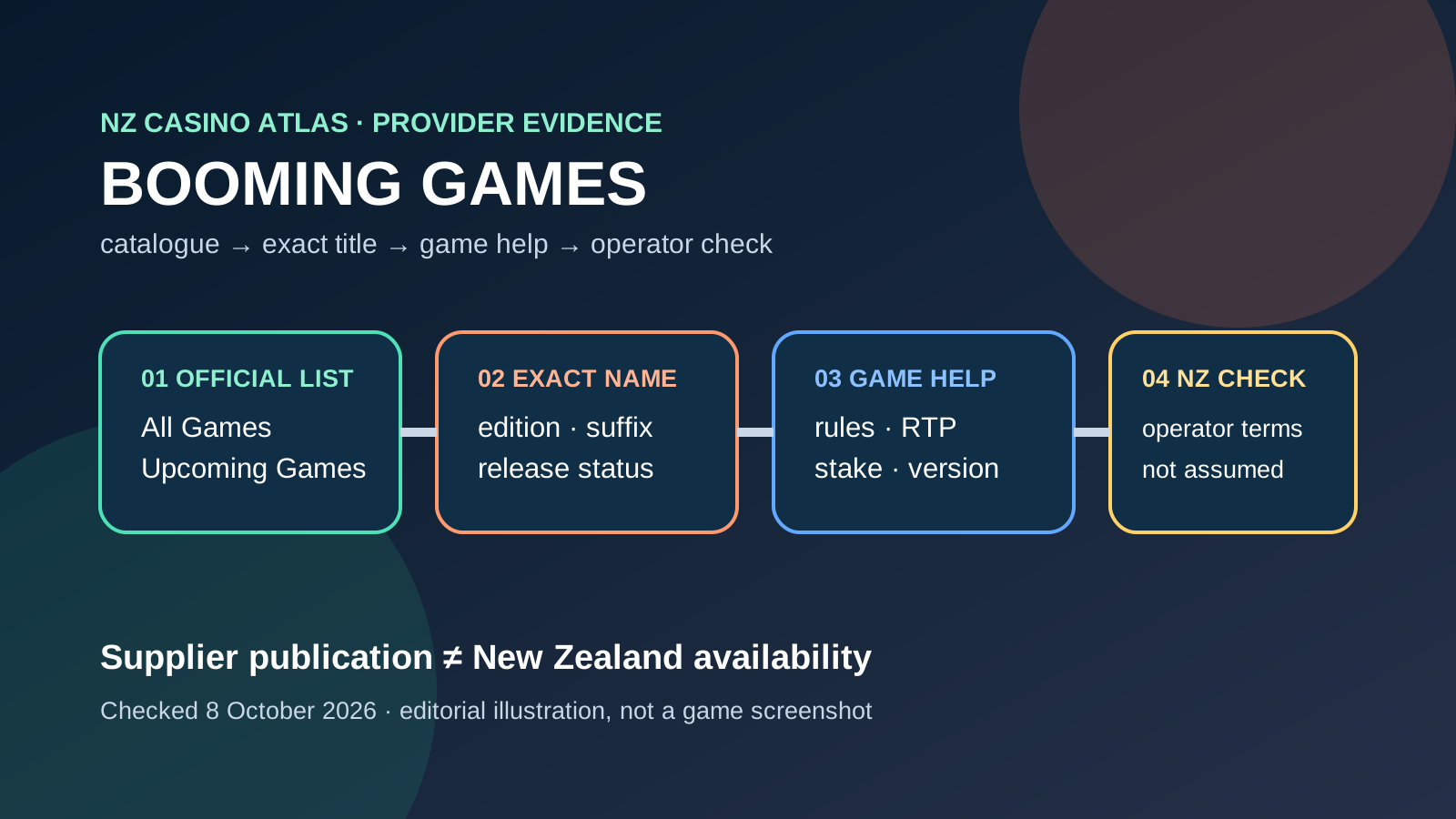
The practical result is a two-stage check. First, use the supplier catalogue to identify the exact product. Second, open the deployed game help at the intended operator to verify rules, RTP, stake range, version and limits. Neither stage can safely replace the other.
- Owner
- Booming Games
- Primary record
- Official catalogue
- NZ availability
- Not established
- Checked
- 8 October 2026
Studio identity
What the catalogue can establish about Booming Games
A supplier’s own site is the strongest public starting point for studio attribution. It connects the trading name, catalogue navigation and product pages under one controlled domain. That connection is more useful than an affiliate list that may mix studios, reskins or distribution partners.
The catalogue footer identifies Booming Games (Malta) Limited and presents supplier-side UK Gambling Commission account 57254 and Malta Gaming Authority B2B licence MGA/B2B/459/2018. The statement is intentionally narrower than “licensed for New Zealand”. Corporate and supplier credentials identify the business behind the catalogue; they do not approve every operator using the games, and they do not show that a New Zealand resident may open an account.
Brand identity can also drift across old pages. A renamed studio, acquired company, commercial platform or white-label distributor may appear beside the developer name. When an individual review is written, the exact help screen and copyright line should be preserved so the credited developer is not inferred from lobby placement alone.
Those UK and Malta records describe supplier activity within their scope; they are not a licence for an unrelated casino and not proof of permission to offer games to New Zealand residents. A B2B authorisation concerns the supply of games in the regulator’s scope. The casino taking a player’s money needs its own contracting entity, terms, permissions and country controls. This hub keeps those claims separate.
Finding exact products
How to navigate the Booming Games catalogue
Begin with the official catalogue rather than a search engine result. Search snippets can preserve an obsolete title, omit punctuation or open a campaign page without help. Within the supplier site, use the available filters, search field, status labels or sitemap to locate the exact entry.
- Use the catalogue search to preserve the exact visible title rather than a shortened search-query version.
- Check whether the card sits under All Games or Upcoming Games and record the status on the date reviewed.
- Open the dedicated product route, where available, before looking for the matching help inside an operator client.
- Treat artwork and promotional tags as discovery aids, not as complete mathematical documentation.
Do not assume the order is a quality ranking. Catalogue order can reflect release date, promotion, localisation or a site redesign. It does not prove popularity, payout quality or New Zealand demand. This guide therefore uses the catalogue for identification and navigation, not a “best games” table.
Where the catalogue exposes a dedicated product URL, save it with the check date. Where it exposes only a list or sitemap, preserve the exact link target and visible label. A stable evidence note should allow another editor to repeat the path without guessing the title from artwork.
An entry’s mere presence establishes neither release everywhere nor continued support at every operator. Suppliers can publish globally while operators enable selected titles or versions by jurisdiction, device and commercial agreement.
Named examples
Examples that show why exact naming matters
The following names were used as catalogue examples, not recommendations. They help demonstrate how an editor should preserve spelling, numbers and qualifiers before opening game help.
- Primal Buffalo — a current catalogue name whose exact title should be retained when matching an operator lobby.
- PowerGrid — another exact catalogue label; the product record and deployed help must be matched before rules are described.
- Upcoming Games cards — future dates such as 15, 22 and 29 October 2026 were time-sensitive announcement evidence, not proof of a released client.
A list like this is deliberately short. Reproducing every catalogue card would become stale quickly and would duplicate the supplier. The maintained value of this hub is the method, the date and links to complete reviews owned by NZ Casino Atlas.
Readers should not transfer a rule from one example to another. Similar art, a shared mechanic word or a numerical sequel can hide different evaluation models, feature prices, maximums and RTP profiles. Every exact title keeps its own evidence record.
Release labels
Released, new and upcoming are different states
An upcoming card can confirm that the studio has announced a product, but it cannot confirm that a playable build is live. A future date can move, regional launches can differ and a product page can appear before final help is public. Reviews must label the state observed on the check date.
A “new” label is also relative to the catalogue interface. It is not a technical version number and does not establish that every operator has integrated the game. Once the label disappears, the product remains the same title unless first-party evidence says otherwise.
For released games, a public demo or product page still may not expose the exact configuration. The strongest review records a catalogue state and separately records the live help from the intended client. If only one is available, the missing layer should be stated as a limitation.
Do not publish a future game as reviewed merely because artwork and marketing copy exist. A complete review needs operational rules or a clearly labelled preview whose unknown fields remain unknown.
Identity-bearing text
Keep sequels, editions, punctuation and suffixes
Exact titles are data. A number, colon, apostrophe, “Hold & Win”, seasonal label or jackpot suffix can identify a different product. Removing it for a cleaner heading may join evidence from incompatible games.
- A jackpot, Hold & Win, Megaways-style or seasonal suffix can identify a different mathematical product.
- A sequel number must not be dropped even when the artwork resembles the first release.
- An upcoming working title may change before release; preserve the check date and recheck the final product page.
- An operator lobby can abbreviate a title, so match provider credit and game ID before merging records.
When two official pages look related, compare their canonical URLs, visible names, release labels and help identifiers. Treat them as separate until the supplier explicitly documents a shared configuration. A franchise relationship is not a rules relationship.
Normalise only the website slug, not the displayed game name. The canonical URL can use ASCII hyphens while the page heading preserves the official punctuation. This keeps navigation predictable without rewriting the underlying entity.
If a supplier corrects a typo or changes a stylisation, record the old and new labels with dates. Redirects can then preserve search navigation while the review explains which official record is current.
Primary rules evidence
Move from the catalogue card to game help
A catalogue card normally summarises theme and headline mechanics. It may omit evaluation order, symbol exceptions, retrigger limits, maximum exposure conditions, feature prices and the active mathematical profile. Those fields belong to the exact game help or paytable.
Open the help from the same client you intend to assess. Record provider, complete title, game ID or build where available, currency, total stake, RTP and date. Screenshots should retain enough surrounding context to prove which title and setting produced the number.
Read rules in sequence. First identify the grid or reel layout and win evaluation. Then record Wild, Scatter or bonus roles. Next map cascades, respins, meters, multipliers and feature endings. Finally capture caps, stake restrictions and any separate purchased-feature profile.
If public help is unavailable, say so. A product description can support named mechanics, but it cannot silently fill an undisclosed paytable or probability. Precision without a source is not an upgrade.
Configuration, not prediction
RTP and house-edge checks belong to the exact build
Return to player is a long-run theoretical setting. It does not promise that a player will recover the stated percentage from a session, deposit or fixed number of spins. House edge is the arithmetic complement, 100% minus RTP, and is equally non-predictive.
The same game art can be supplied with multiple RTP profiles. Reporting only the highest value found online can misdescribe the operator deployment. The active help screen is the relevant evidence, while the supplier page can document supported or default values when it says so explicitly.
Do not infer RTP from hit frequency, volatility or a feature price. Those fields describe different parts of the model. A feature buy can also have a separate profile, and jackpot contributions can affect what the displayed percentage covers.
For a deeper explanation, use the site’s theoretical RTP and house-edge guide. This provider hub avoids duplicating that general mathematics and focuses on where the exact Booming Games setting should be found.
Feature-family discipline
Mechanic names are navigation aids, not complete rules
Studios often reuse mechanic labels across a family. That can help a reader find related titles, but the shared label does not guarantee identical triggers, prices or persistence. The exact help remains controlling for each product.
Describe what the mechanic does before judging it. State which symbols or positions it affects, when it activates, what persists, how the round ends and where a cap applies. Avoid promotional adjectives that imply frequency or value without a documented probability.
Feature buys, ante bets and enhanced modes need separate treatment. Record the price as a multiple of the base stake, any change to RTP, the starting state and regional availability. A visible button in a demo does not prove that the option is lawful or enabled at an NZ-facing operator.
Progressive jackpots require pool and trigger evidence. A “max win” is not automatically a jackpot, and a jackpot label does not promise a win by a deadline. Our progressive versus fixed jackpot guide owns that general distinction.
Reference mode only
What a demo can and cannot prove
A supplier demo can expose interface, help, symbols and a reference configuration without risking funds. It is useful for documentation when access is permitted. It does not prove real-money availability, an operator contract, New Zealand eligibility or identical currency and stake settings.
Compare demo and real-money clients field by field: exact title, provider, build, currency, stake range, RTP, feature controls and paytable. If a value cannot be compared, label it unresolved rather than assuming parity.
Do not use simulated outcomes to estimate a personal win rate. A short run is not a reliable test of long-run RTP, and a memorable bonus does not establish feature frequency. The demo is an interface and rules record, not a forecasting tool.
Our demo versus real-money settings guide explains this comparison in detail. This page applies the same evidence discipline to the Booming Games catalogue.
Interface verification
Mobile checks must preserve the same evidence
Responsive design may move the help button, collapse the paytable or hide long text behind tabs. Verify that essential rules, RTP and total stake remain readable on the actual device. A screenshot of reels alone is not enough.
Check portrait and landscape behaviour, touch targets, scrolling, audio controls and whether reconnecting restores a completed result correctly. These are usability observations, not claims about better odds.
Browser compatibility can change independently of the game model. Record device, operating system, browser and date if a problem matters to a review. Do not generalise one failed load to every mobile user or every Booming Games title.
Never install an app or file from a third-party download simply to reach a game. Confirm the operator’s official domain and application provenance first.
Country evidence
Studio publication does not establish New Zealand access
The public catalogue is global supplier material. It cannot show that a particular operator accepts New Zealand residents, that its casino product is enabled here or that the exact title is in its authenticated lobby.
Country access requires a separate chain: the operator’s legal entity, current terms, prohibited-territory wording, registration acceptance, product restrictions, cashier and the current New Zealand framework. An NZ flag, localised page or NZD selector alone is not enough.
Those UK and Malta records describe supplier activity within their scope; they are not a licence for an unrelated casino and not proof of permission to offer games to New Zealand residents. Supplier credentials should never be rewritten as a consumer-facing New Zealand casino licence. The operator and game deployment need their own evidence.
Use the site’s dated New Zealand legal-status guide for national context. This hub does not offer legal advice and does not say that any Booming Games game is available at a named casino.
Editorial ownership
How this hub links to complete game reviews
This is the single Booming Games catalogue owner on NZ Casino Atlas. Each assigned title should have one complete canonical review that combines rules, features, RTP evidence, demo and mobile checks, limitations and sources.
Separate pages for “RTP”, “bonus”, “demo” and “rules” of the same title would fragment evidence and risk contradictions. The complete review owns those subtopics. The provider hub summarises the navigation method and links only to pages that have actually been published.
- Booming Seven Deluxe — documents the 3×3, ten-line configuration, free spins, 2-way-pay, gamble and Legacy-version evidence limits.
- Vegas Wins — covers the 5×3, 20-line record, Wild, free spins, gamble and exact-client setting checks.
- Big Apple Wins — documents the New York symbol roles, stacked symbols, free spins and gamble evidence.
- Paris Nights — covers the 5×3 Paris-themed line game and separates descriptive features from unverified settings.
- Wild Diamond 7x — uses Booming Games’ own 3×3, ten-line, 7x multiplier and 2-Way Pay feature record.
- Burning Classics — keeps the original, Royal Edition, Burning Classics 2 and 5000 version checks on one canonical page.
- Cash Pig — keeps Cash Pig, Cash Pig 2 and the 15,000 version on one evidence-led family page.
- Diamond Riches — documents the official 3×3, ten-line, Diamond Payout and free-spins record.
- Buffalo Hold and Win — covers original rules plus separate Extreme and Extreme 10,000 version checks.
- Wild Wild Vegas — uses the official multiplier-Wild and free-spin-choice feature record.
- Greek Legends — covers the 5×3, 20-line mythology game and configuration-specific RTP evidence.
- Howling Wolves Megaways — documents six variable-height reels, cascades, four wolf modifiers and non-retriggering free spins.
- Flaming Chillies — covers the 3×3, ten-line game, Chili Payouts, golden free-spin coins and Double or Nothing.
- Jester's Riches — documents Jester Payouts, free-spin retriggers and the exact Wild exclusions.
- Gamblelicious Hold and Win — covers the 5×3, 25-line coin respins, free spins and Quick Hit prize record.
- Legendary Diamonds — documents Diamond Payouts, the free-spin wheel and configuration-specific RTP evidence.
- The Wild Wings of Phoenix — separates the original expanding-Wild rules from the later Deluxe version.
- Let It Spin — documents Random Wilds, Bursting Wilds, Minor Elimination and the Scatter award ladder.
- TNT Bonanza — keeps the original cascade multipliers separate from TNT Bonanza 2 bomb mechanics.
- The Mighty Toro — covers additive Wild multipliers and non-retriggering Walking Wild free spins.
- Super Duper — documents permanent two-way paylines, stacked Wilds and the two 3× layers.
- King Cobra — documents Poison Spins, reel-value arithmetic and multiplying Mystery Wilds.
- Power of Olympus — covers 7×7 cluster pays, cascades and additive Wild multipliers.
- Gold Gold Gold — keeps the original, 5000 and Hold and Win configurations distinct.
- Classic Fantastic — documents permanent two-way lines, stacked Wilds and two 3× layers.
- Bamboo Wilds — covers additive Wild values and non-retriggering Walking Wild free spins.
- Holly Jolly Bonanza — keeps the original rules separate from Holly Jolly Bonanza 2 Gift modifiers.
- Stampede Bonanza — documents separate Random Wild and free-spin multiplier meters.
- Boogie Boom — covers the irregular cluster grid while leaving undisclosed live settings unresolved.
- Bang Bang Reloaded — documents two-way lines, cascade ladders and Big Shot Wheel evidence.
- Diamond Hits — separates the original configuration from Diamond Hits Trio: InstaStrike.
- Reels Paradise — documents the distinct jobs of its symbol, value and feature reels.
- Jam Bonanza — covers scatter pays, cascades and additive free-spin multipliers.
- Ronaldinho Spins — separates the original fixed-line game from Streetball Bonanza.
- Hot Charge — discloses the public payline conflict and documents the charge meter.
- 64 Gold Coins Hold and Win — keeps original and 20,000 operator configurations separate.
- Jester's Bells Bonanza — documents scatter pays, cascades and persistent random multipliers.
- Dynamite Trio — covers the seven Boost, Expand and Collect Hold and Win combinations.
- Howling for Gold — labels operator-specific RTP evidence and the free-spin upgrade system.
- Tasty Bonanza — keeps the original, 10,000 and Max Scatter versions distinct.
- Holly Jolly Cash Pig — documents collection, cascades and golden symbol upgrades.
- Coin Crusher Hold and Win — documents fixed lines, coin respins, Feeding Frenzy and Shark Zone.
- Fish Tales: Halloween — keeps six assigned Fish Tales versions and their settings separate.
- Easter Classics — covers selectable lines, stacked symbols and retriggerable free spins.
- Mustang Hold and Win — covers coin respins, stacked Wilds and configuration-specific figures.
- Spooktacular Bonanza — discloses the RTP conflict and documents free-spin multipliers.
- Inferno Fortune Power Hit — documents 4096 ways and collection mechanics alongside the separate InstaStrike version.
- Thunder Eagle Hold and Win Extreme 10,000 — covers four linked respin grids, the prize wheel and configuration-specific figures.
- Power of Atlantis Trio — documents the seven Boost, Expand and Collect chest combinations.
- Mustangs and Stallions — covers Walking Wild respins, rising multipliers and operator-record limits.
- Mr. Oinkster's Power Hit — keeps Power Hit, Hold and Win, Hold and Win 10,000 and Key to Riches distinct.
- Ra's Relics Bonanza — documents 6×5 scatter pays, cascades, Scarab collection and free-spin multipliers.
- Forbidden Temple Power Hit — covers variable reel heights, Phoenix collection, Reel Frenzy and conflicting RTP records.
- Burning Love — documents stacked symbols, direct Scatter awards and public RTP/cap conflicts.
- Fly On! — treats the crash format, four wager modes and independent-round risk without reel terminology.
- Shields of Gold Valkyrie Hold and Win — covers Wild Transform, shield respins and dual free-spin choices.
- Greedy for Gold: Power Hit — documents variable reels, coin collection, Clover Pot and Reel Frenzy evidence.
- Bonza Bucks Hold and Win Extreme 10,000 — covers fixed lines, the bonus wheel, four linked grids and separate prize caps.
- Liberty and Freedom Hold and Win Extreme 10,000 — covers the Liberty wheel, four respin grids and the 60-position Grand condition.
- Blazin' Bonus — uses first-party evidence for five lines, three buildable bonuses and the prize wheel.
- Diamonds of Liberty — separates ten-line wins from the Diamond Hits prize ladder.
- Diamonds Diamonds Diamonds Hold and Win — separates the compact line game, expanding bonus, Super Diamond and overall cap.
- Polar Buffalo Hold and Win Extreme 25,000 — covers the Buffalo Bonus, four grids and separate 25,000× Grand and total cap.
- Ultra Buffalo Hold and Win — uses first-party evidence for the wheel, 5×8 bonus and Ultra Reel.
- 64 Presents Hold and Win — documents Frosty Respins and Santa’s Gift while disclosing trigger and cap conflicts.
- Santa in Vegas — covers Coin Collect, evolving free spins, Gift Spin and the public row-count conflict.
- Gold and Glamour Hold and Win — covers 25 lines, resetting Coin respins and retriggerable free spins.
- Black Friday Cart Craze — documents Cart Craze Collect, evolving Super Sale Spins and Wild Drop.
- Power of Hercules Bonanza — separates cascade and multiplier evidence from configuration figures.
- Blazing Bullets: Hold and Win — covers dual collection chests, respins and the revolver sequence.
- Twin Buffalo: Hold and Win — uses first-party evidence for dual pots, Jumbo Coins and bonus paths.
- Berserkin' Buffalo Power Hit — covers two Collector positions, Bonus Spins and separate prize-pot and total caps.
- 64 Nuggets: Hold and Win — documents Gold Rush Respins, Boom Blitz and expansion from 5×5 to 8×8.
- Lucky Charms Trio — compares the original and 10,000 versions on one canonical URL.
- Trollfufu Bonanza — uses first-party evidence for Scatter Pays, cascades and stacking multipliers.
- Henhouse Hustle: Hold and Win — separates Golden Egg free spins from regular Egg respins.
- Gates of Hercules 10,000 — documents Scatter Pays, cascades, random multipliers and the free-spin multiplier sequence.
- Wild Silverback — covers variable reel heights, Wild Coin Connect, prize pots and Super Spin charging.
- Sacred Buffalo — documents both Totem paths, Sacred Spirit upgrades and the public grid-layout conflict.
- Way of the Wolf: Hold and Win Extreme 10,000 — separates the four-grid Grand prize from the documented total maximum win.
- Booming Buffalo Hold and Win Extreme 25,000 — covers the Buffalo Bonus wheel, four linked grids and deployment-specific RTP evidence.
- Diamond Forge: Link & Loot — documents Diamond Boost, merging Diamonds, Colossal spins and free spins.
- Bubble Works — covers the separate Bubble Shelf, three collection scopes and Bubble Stash.
- Fortune Surge — documents side-reel Scatter Coins, centre collectors and repeated bonus collection.
- Greedy for Gold: Hold and Win — keeps this Pot, Hat and Jumbo-symbol sequel separate from Power Hit.
- Tasty Rush Sweet Spots — covers 7×7 clusters, cascading Sweet Spots and conflicting public RTP records.
- Regal Coins Hold and Win — documents Royal Coin, Coin Fountain, grid expansion and separate regular and Super respins.
For a comparison of catalogue structures, readers can use the Thunderkick guide or AvatarUX guide. Those pages own their studios; none is a general provider ranking.
Quality controls
Common catalogue-review errors
- Calling an announced or upcoming title fully released.
- Dropping an edition, sequel number or identity-bearing suffix.
- Attributing an aggregated game to the platform displaying it.
- Copying a default or highest RTP into every operator review.
- Treating demo access as real-money NZ availability.
- Presenting supplier credentials as the casino’s consumer licence.
- Converting a maximum win into an expected or likely result.
- Publishing a complete paytable without opening exact help.
The repair for each error is the same: narrow the claim to what the first-party record proves, add the check date and keep unresolved fields visible. An honest limitation is more useful than a confident composite assembled from several versions.
Practical workflow
Booming Games catalogue checklist
- Open the official catalogue and save the check date.
- Copy the exact title, punctuation, number and edition.
- Record whether the entry is released, new or upcoming.
- Open the dedicated product record where available.
- Match the deployed client to the same provider and title.
- Capture game ID or build, currency and total stake.
- Read evaluation, symbols, features and ending rules.
- Record the active RTP and any separate feature profile.
- Keep maximum game win separate from withdrawal limits.
- Verify operator identity and NZ eligibility independently.
- Link one complete canonical review, not thin subtopic pages.
- Recheck changing claims before publication or play.
This workflow is deliberately reproducible. Another editor should be able to follow the same links and understand which facts came from the catalogue, which came from game help and which remain unknown.
Reader decision
What to know before choosing a title
A catalogue is good for discovery. It is not sufficient for a money decision. Before considering play, understand the exact win evaluation, active RTP, volatility description, stake range, feature pricing and cap. Then assess the operator separately.
Prefer evidence that can be repeated: official URL, visible title, dated help and account terms. Treat screenshots without context, unsourced comparison tables and “best” labels as leads to verify, not final proof.
Set an affordable loss and time limit before a session. Higher speed, autoplay and purchased features can increase exposure per minute even when they do not change base odds. Stop controls are safeguards, not strategies for recovering losses.
The useful conclusion of this guide is modest: Booming Games maintains the official catalogue used here for exact-title discovery. Everything about an operator account, New Zealand access and deployed settings needs its own current evidence.
Questions answered
Frequently asked questions
Where is the official Booming Games catalogue?
Booming Games publishes its catalogue at booming-games.com/games, with catalogue navigation that included All Games and Upcoming Games when checked on 8 October 2026.
Does a Booming Games catalogue entry prove New Zealand availability?
No. It identifies supplier material, not an operator account, country permission or an NZ-enabled deployment.
Where should RTP and game rules be checked?
Use the exact deployed game help or paytable. A product card may summarise mechanics but does not necessarily expose the active operator configuration.
Can an upcoming Booming Games title be reviewed as released?
No. An upcoming label supports an announcement only. A playable build and exact help must be checked separately.
Are Booming Games’ UK and Malta credentials an NZ casino licence?
No. They are supplier-side B2B or jurisdiction-specific credentials and do not authorise a New Zealand-facing operator.
Evidence record
Primary sources
Facts and configurations were checked against the following first-party records. A public product page is not proof that a game is available through a New Zealand operator.
- Booming Games — official games catalogueChecked 8 October 2026
- Booming Games — corporate and licensing footerChecked 8 October 2026
- New Zealand DIA — online gambling for playersChecked 8 October 2026