Evidence-led answer
What can be verified about Gamblelicious Hold and Win
Gamblelicious Hold and Win is a Booming Games title. The official studio catalogue is the primary identity source used for this review. It supports the connection between the exact title and the studio; it does not, by itself, publish every mathematical setting or prove that a particular New Zealand-facing casino carries the game.
The catalogue establishes the exact title and studio. Booming Games’ own video supplies the grid, line count, volatility label, triggers and prize structure. A first-party operator page confirms a particular 95.9% configuration, which is reported as configuration evidence rather than a universal setting.
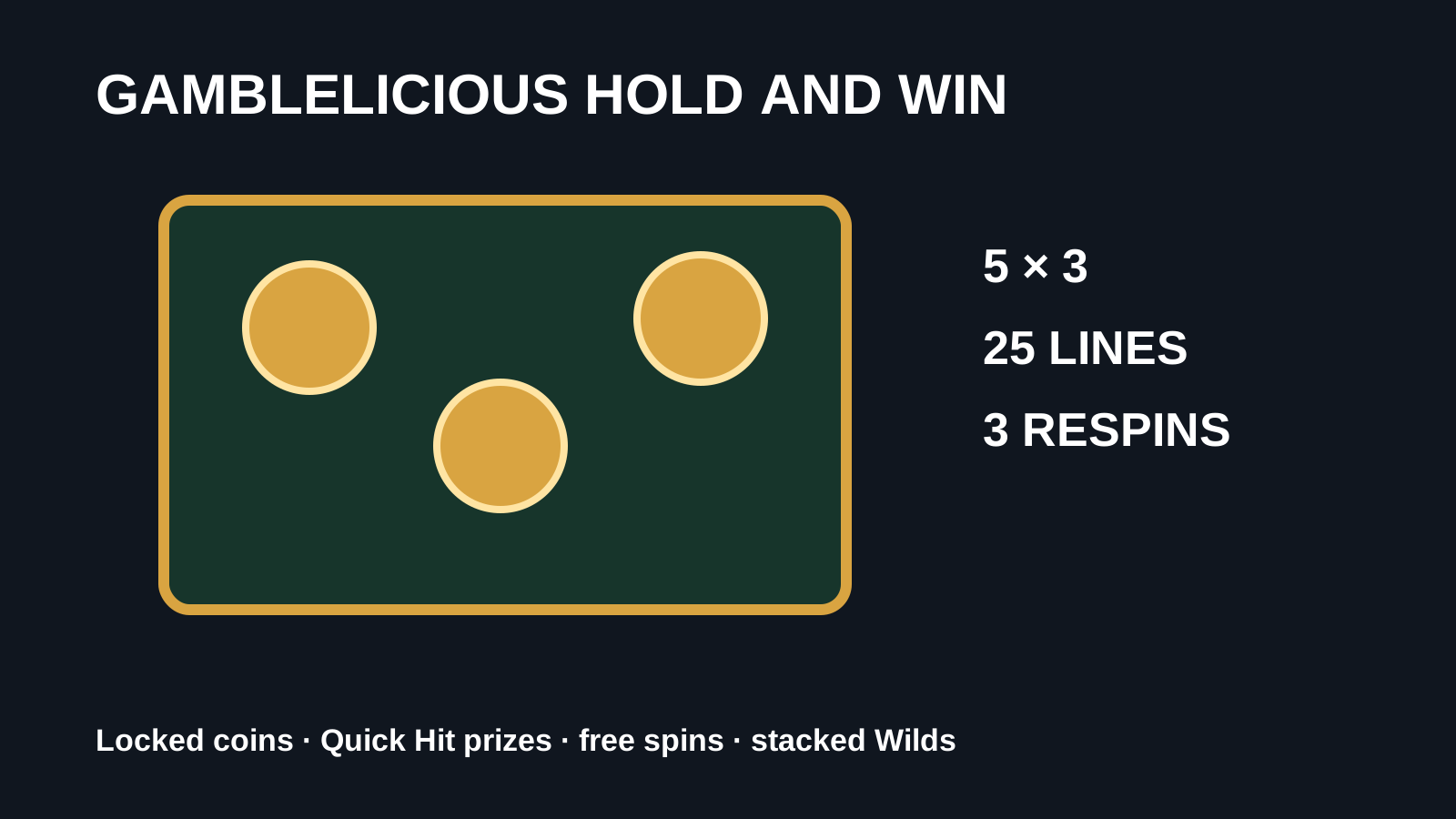
The working layout record is 5 reels × 3 rows, with 25-payline evaluation. The mechanics that can be described with reasonable confidence are Scatter-triggered free spins, stacked Wilds, six-coin Hold and Win with three resetting respins and Mini, Major and Grand Quick Hit prizes. These statements identify how the named game is presented; they are not a promise that every historic, jurisdictional or operator build uses identical controls.
No universal RTP, minimum stake, maximum stake, volatility label or maximum-win figure is promoted as verified here unless it appears in the exact help for the deployed client. Several third-party databases publish numbers, but their figures are not a substitute for the version-specific information panel. Where sources disagree, this guide preserves the uncertainty rather than choosing the most attractive number.
- Studio
- Booming Games
- Layout record
- 5 reels × 3 rows
- Win model
- 25-payline evaluation
- NZ availability
- Not established
Exact product first
Title, studio and version identity
A correct review begins with the complete title, the Booming Games credit and the build shown by the game client. Search snippets, lobby thumbnails and fruit-machine artwork are weak identifiers because many classic slots reuse sevens, bars, fruit, neon signs and similar reel frames.
The official catalogue is the right starting point for studio ownership and catalogue navigation. It is not a current operator inventory and it does not prove the mathematical profile loaded by an operator. A product can remain discoverable in historic integrations after a catalogue redesign, and an operator can expose an approved configuration that differs from a summary published elsewhere.
This page covers Gamblelicious Hold and Win only. It does not merge other Hold and Win releases merely because their respin counters or prize-pot labels look similar.
When comparing two apparently identical listings, record the full title, game ID, version string, copyright line, interface language, currency and date. A different lobby name may be harmless presentation, while a small suffix can identify a separate mathematical product. The evidence has to resolve that distinction before figures are merged.
The canonical URL on NZ Casino Atlas owns the complete search task for this title: rules, paytable method, feature evidence, RTP checks, mobile and demo limits. Separate thin pages for “free spins”, “RTP”, “demo” or “how to play” would fragment the same entity and are intentionally not created.
Base-game evaluation
Grid, paylines and how a result is settled
The checked descriptive record uses 5 reels × 3 rows and 25-payline evaluation. A reel stop is only the visual input to settlement. The paytable and rules determine which symbol counts, how many matching positions are required, where the sequence must start and whether the relevant line or pattern was active.
Before a spin, the player should identify whether the interface shows a total bet or a per-line coin value. If lines are selectable, changing their number can change both coverage and total cost. A symbol combination on an inactive line is not a payable win merely because it looks aligned.
The safest sequence is: open Help, confirm the grid, inspect the line diagram, identify the award unit, set the stake, confirm the total amount debited and only then start the round. After settlement, compare the highlighted line with the paytable rather than estimating the award from symbol artwork.
Classic presentation does not mean simple evidence. A game can include stacked symbols, special substitutions, both-way evaluation, a multiplier, a Scatter award or a post-win gamble. Each rule needs its own trigger and unit. Combining them into a vague claim such as “more ways to win” hides the conditions that determine the actual result.
The base paylines settle before bonus logic. Scatters can open free spins, while six or more coins open Hold and Win. During the respins, coins lock and every new coin resets the remaining count to three; blank positions continue to respin.
Read the deployed table
Symbols and paytable evidence
The base game uses card-room and casino imagery, with high-value symbols isolated during the documented free-spin feature. Coin values settle inside Hold and Win, while the Mini, Major and Grand are conditional Quick Hit awards. The regular symbol table still needs the active help.
A complete paytable record needs six fields: the symbol, required count, direction, eligible line or position, award basis and any multiplier. A bare number is not enough. For example, a value expressed in coins cannot safely be rewritten as a multiple of the total stake unless the help explicitly supplies that conversion.
The title’s theme can help identify symbols, but theme is not settlement evidence. Red and blue sevens may pay differently; a landmark may be a regular symbol in one title and a Scatter in another; a diamond can be a Wild, a multiplier or an ordinary high-value icon. The exact help resolves those roles.
If a paytable scrolls across several screens, capture all pages and the stake state shown at the time. Check whether values update as the line bet changes. When awards are presented as credits, note how the interface converts credits to the account currency and whether the total bet covers all lines.
This review does not reconstruct missing symbol values from screenshots or affiliate tables. That is an editorial limitation, not a missing invitation to guess. A later verified help capture can be added without changing the canonical URL.
Mechanics with conditions
Features documented for the named game
The evidence set describes Scatter-triggered free spins, stacked Wilds, six-coin Hold and Win with three resetting respins and Mini, Major and Grand Quick Hit prizes. Every feature should be read as a conditional rule, not as a frequency promise. A feature name says what can happen after its trigger; it does not say when the trigger will arrive or what a particular session will return.
For Wild substitutions, verify excluded symbols and whether the Wild has its own award. For Scatters, verify the minimum count, whether they pay anywhere and whether the trigger depends on active lines. For free spins, record the number awarded, retrigger condition, stake basis and any change to reels or symbol behaviour.
If a multiplier appears, identify whether it multiplies a line win, all wins on a spin, only free-spin wins or one symbol combination. A “7x” graphic is not automatically a seven-times total-spin multiplier. The nearby paytable text controls.
A post-win gamble is another separate system. It risks a win that could otherwise be collected. A correct choice may increase it and an incorrect choice can erase the amount placed at risk. It is not a free bonus and does not provide a strategy for recovering previous losses.
Feature availability can also be configuration-dependent. Jurisdictional rules or operator settings may remove autoplay, a gamble control or other optional functions. The active client is therefore stronger evidence than a historic promotional video for the final user-facing feature set.
Configuration-specific mathematics
RTP evidence, house edge and missing numbers
The official catalogue used here establishes product identity but does not expose a readable mathematical sheet for this exact title. Consequently, this page does not label an aggregator’s RTP as the universal Booming Games value. The value to use is the percentage shown in the help for the exact deployed version.
RTP is a long-run theoretical return for a mathematical configuration. Its complement is the theoretical house edge: a 96% configuration, for example, corresponds to a 4% edge before any separate transaction or operator condition. That example explains the calculation; it is not a claim that this title uses 96%.
A short demo or real-money session cannot verify RTP. Random variation can produce a result far above or below the model over hundreds or thousands of spins. Realised payout reports for a month also measure a finite sample, not necessarily the designed percentage.
When the help shows multiple RTP profiles, record each supported value and identify the active one. Do not average them. If the operator does not reveal which profile is loaded, describe the active RTP as unconfirmed and ask support for a written answer before wagering.
Stake, currency and RTP should be captured together because the same title can appear through different integrations. The record should include title, studio, version or game ID, percentage, date, currency and operator. Our theoretical RTP guide explains why none of these values guarantees a session return.
Do not fill gaps with marketing
Volatility, hit rate and maximum win
Volatility labels are relative scales, not standardised measurements across every studio. “Low”, “medium” or “high” is useful only when the publisher explains the scale or the exact help assigns the label. This review does not upgrade a third-party label to a verified fact.
Hit frequency, if disclosed, is not the probability of finishing a session ahead. It can count awards below the stake and says nothing by itself about award size. Feature frequency is another measure again. None of these figures can be inferred reliably from a reviewer’s small spin sample.
A maximum win needs an unambiguous unit. It may be stated per line, per spin, as a total-bet multiple, in credits or as a currency cap. Copying the largest visible paytable number without its basis can overstate or understate the real cap.
A game maximum is also different from an operator withdrawal limit. The first is part of game settlement; the second is an account contract. One does not prove the other. The site’s max-win versus cashout guide owns that general distinction.
Risk remains real even where the presentation is simple. Players control stake, pace, time and whether to use an optional gamble; they do not control reel outcomes. Set money and time limits before starting and never increase a stake to chase a feature or recoup a loss.
Currency is part of the evidence
Stake range and account denomination
No universal minimum or maximum stake is asserted from the catalogue. Operator configuration, currency and jurisdiction can change the exposed ladder. A value shown in euros, pounds or credits must not be relabelled as NZD without a client that actually offers NZD.
Check the lowest and highest selectable total bet, not just the smallest coin denomination. In a line game, coin value multiplied by coins and active lines may produce the actual debit. The interface should show that total clearly before the spin.
Feature states normally use the triggering stake unless the help says otherwise. Changing a control after a feature is awarded may be blocked, and a displayed feature value can reflect the earlier stake. Read the rule rather than assuming the new selection applies retroactively.
A stake range documented at one operator is configuration evidence for that operator only. It can help identify a build, but it does not establish what every Booming Games integration permits. This page therefore directs readers to the active control and help instead of publishing a false global range.
Same questions, smaller screen
Mobile controls and demo limitations
An HTML5-style game can adapt to desktop and mobile, but screen compatibility is not territorial availability. On a phone, rotate only if the client supports it and open the information panel before play. Verify that total stake, balance, win, line state and help remain readable without hidden horizontal scrolling.
A demo can teach control placement and feature presentation. It cannot prove that the real-money build has the same RTP profile, currency ladder or optional controls. Demo credits are not cash, and an accessible demo does not grant permission to create an account or wager from New Zealand.
Compare demo and real-money versions by title, provider, game ID, RTP, line model, stake ladder and paytable. If the demo does not disclose its configuration, it is unsuitable as the sole source for a numerical review.
Autoplay, turbo speed and gamble controls may be hidden, disabled or altered by market rules. Their absence on one device is not necessarily evidence that the underlying game lacks the feature. Record the interface and jurisdiction before describing the difference.
Operator proof is separate
New Zealand availability is not established
The Booming Games catalogue does not prove that Gamblelicious Hold and Win is offered by an operator that accepts New Zealand residents. It is supplier evidence, not an operator’s country-permission statement. This review therefore makes no “available in NZ” claim.
Before creating an account, verify the operator’s legal identity, current restricted-country list, casino permission, account terms, cashier, withdrawal conditions, support and account controls. An NZ flag, an NZD selector, an IP-based landing page or a search snippet is not sufficient evidence.
The existing CPA route on this site leads to a separate advertised destination. It is not labelled “Play Gamblelicious Hold and Win” because the evidence does not confirm this title there. Editorial facts and advertising remain distinct.
For national context, use the site’s New Zealand online-casino legal-status guide and current Department of Internal Affairs information. This exact-game article is not legal advice and does not replace an operator’s contract.
Practical audit
What to verify before relying on a listing
- Match the full title and Booming Games credit.
- Record the game ID and version or build string.
- Confirm the 5 reels × 3 rows layout and 25-payline evaluation.
- Open every paytable page and note the award unit.
- Check Wild and Scatter exclusions and triggers.
- Confirm free-spin count, retriggers and stake basis.
- Identify any multiplier’s exact scope.
- Check whether a gamble feature is enabled and capped.
- Read the active RTP from the deployed help.
- Record total stake in the actual account currency.
- Keep the game maximum separate from withdrawal rules.
- Verify NZ account permission independently.
- Confirm the five-by-three grid and 25-line model.
- Verify six coins are required for Hold and Win.
- Check the three-respin reset rule and all 15 positions for Grand.
- Treat 95.9% as the cited operator configuration until live help confirms the active value.
If a live help screen contradicts this record, the deployed version controls that session. Preserve a dated capture with the title and game ID and submit it through the corrections process. That permits a version-specific update without silently replacing one configuration with another.
Navigate the studio catalogue
Compare the title without merging it
The Booming Games catalogue guide is the parent navigation page for this review and other named Booming Games titles. It explains exact-title matching and why catalogue presence does not prove operator availability.
Comparison should focus on documented structure: grid, line or ways model, special symbols, feature trigger, RTP profile, stake ladder and maximum-win unit. Theme alone is a poor comparator, especially across classic slots that share fruit and seven symbols.
Keep each exact game on its assigned canonical URL. Do not move an RTP or feature from another title simply because both use a similar reel frame. Where a family version belongs in this article, it is discussed here and not split into a second page.
Bottom line
A useful guide without invented precision
Gamblelicious Hold and Win is tied to Booming Games and is reviewed here as one exact entity. The supported structural record is 5 reels × 3 rows with 25-payline evaluation; the described mechanics are Scatter-triggered free spins, stacked Wilds, six-coin Hold and Win with three resetting respins and Mini, Major and Grand Quick Hit prizes.
The public studio catalogue does not settle the deployed RTP, stakes, volatility, maximum win or complete paytable. Those fields belong to the exact help inside the active build. Leaving them unfilled is more accurate than presenting conflicting aggregator data as official.
The practical decision is straightforward: identify the client, read its help, verify the operator and set limits before play. If any essential field remains hidden, do not assume the missing answer.
Questions answered
Frequently asked questions
What is the Gamblelicious layout?
Booming Games describes a five-reel, three-row game with 25 paylines.
How is Hold and Win triggered?
Six or more winning coins trigger three respins; new coins lock and reset the counter to three.
How are free spins triggered?
Scatters on reels two, three and four award eight spins with only high-value symbols in the checked studio description.
What are the Quick Hit prizes?
The studio video records Mini and Major prizes and a Grand for filling all 15 positions; exact multipliers apply only to the checked configuration.
Is NZ availability verified?
No. Neither the supplier catalogue nor the studio video confirms a current NZ operator deployment.
Evidence record
Primary sources
Facts and configurations were checked against the following first-party records. A public product page is not proof that a game is available through a New Zealand operator.
- Booming Games — official games catalogueChecked 8 October 2026
- Booming Games — Gamblelicious official videoChecked 8 October 2026
- Grosvenor Casinos — game configuration pageChecked 8 October 2026
- New Zealand DIA — online gambling for playersChecked 8 October 2026