Evidence-led verdict
What Play’n GO's product record proves
The exact Play’n GO page identifies Three Pots of the Genie as its own title and publishes a compact configuration record: not published on the checked catalogue page and not published on the checked catalogue page. RTP is not published on the checked catalogue page; volatility is not published on the checked catalogue page; maximum exposure is not published on the checked catalogue page. Those are supplier statements or explicitly marked evidence gaps checked on 8 October 2026, not measurements made by this site.
The same page describes the named features covered below. It does not publish a complete symbol paytable, mathematical probability table, universal stake interval, build number or operator-specific currency menu. Those fields remain unresolved until the information panel in the deployed game is opened.
A supplier record establishes product identity, not New Zealand availability. A casino may omit the title, use a different permitted configuration or reject an account under its country rules. Operator identity, eligibility and cashier evidence form a separate chain.
This review therefore has a narrow purpose: explain the documented rules, show which exact fields still need checking, and prevent one Play’n GO title's mechanics from being copied into another with similar artwork or a shared series name.
- Format
- not published on the checked catalogue page
- Evaluation
- not published on the checked catalogue page
- RTP
- not published on the checked catalogue page
- Maximum
- not published on the checked catalogue page
Round model
Start with the exact evaluation rule
Three Pots of the Genie is documented with not published on the checked catalogue page. That label determines how symbol positions are evaluated and must be read before looking at animations. A payline, cluster, ways or occurrence model cannot be substituted merely because another Play’n GO game uses it.
The official format is not published on the checked catalogue page. Grid dimensions and reel count describe visible positions, but they do not reveal hit frequency or the probability of a feature. Symbol weights and the random game model remain unpublished.
In the live help, record the direction of evaluation, minimum matching count, whether combinations must begin from a particular reel, and any special-symbol exceptions. If the title uses fixed paylines, open the line map; if it uses a non-line method, save the formal connection or counting rule.
A completed round should reconcile the total stake, all qualifying evaluations and the final credited win. Decorative movement is not a separate paid event unless the rules explicitly define another wager.
Documented feature set
The named mechanics need help-screen definitions
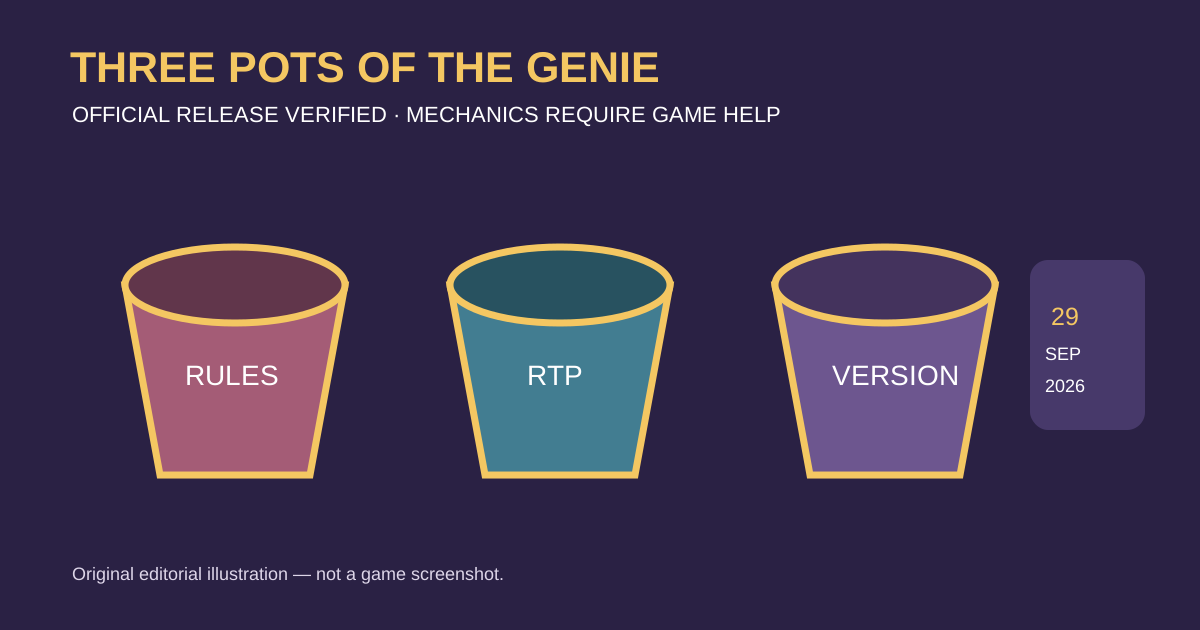
The official page establishes the exact title, video-slot type, 29 September 2026 release date and Adventure/Ancient Civilization themes. It does not publish a mechanic description.
The title alone is not evidence that each pot collects symbols, triggers a feature or modifies a bonus. Record the actual pot labels and rules only after opening the official game help.
The official free-play launcher can be used to locate rules and paytable controls, but demo outcomes cannot establish probabilities, RTP or real-money availability.
Save grid, evaluation method, Wild and Scatter behaviour, pot triggers, feature sequence and any paid option as separate fields. Leave each one unresolved if the exact client does not expose it.
Feature names are useful navigation, not complete rules. For every named mechanic, the deployed help should state how it starts, when it resolves, what it can affect, whether it persists and how it ends.
Do not infer a probability from how often a feature appears in a demo session. A small personal sample cannot establish frequency, RTP contribution or expected value.
Settlement order
Follow one round from stake to account history
Open the official demo where permitted and save the untouched starting interface, title, provider, help version and total-bet control.
Capture the first ordinary result and apply only the evaluation definition shown in help; do not interpret pot animation before reading its formal rule.
For a feature round, record every collected item, pot state, trigger and settlement, then keep the valueless demo result separate from operator evidence.
Record base wins before multipliers, respins or transformations are applied. If two mechanics appear together, the order can change the result; use the formal rule and round history instead of animation speed.
The account-history total is the final reconciliation point. Preserve the round identifier, timestamp, displayed total stake and help version if a result cannot be explained by the documented sequence.
Long-run mathematics
RTP requires the active game help
The public Play’n GO product page does not publish a universal RTP for this configuration. This guide therefore does not assign a percentage or calculate a house edge from an unverified third-party value.
Open the information panel in the exact deployed client and record its RTP together with the full title, game ID or version where exposed, operator, currency and check date. A different permitted configuration may use the same artwork.
The live information panel matters even when a product card shows a figure. Operators and jurisdictions can deploy approved profiles that look visually identical. Save the RTP shown inside the exact client, along with title, provider, currency and check date.
Do not estimate RTP by dividing demo wins by demo stakes. Short samples are dominated by variance, and demo credit has no cash value. RTP verification requires a rule or help record tied to the active version.
Distribution label
Volatility is not established by the product card
The checked Play’n GO product card does not publish a formal volatility classification for this configuration. Feature design alone cannot be converted into an official risk band.
The public page does not provide a numerical variance value or feature-odds table. It would therefore be misleading to convert the qualitative label into claims such as “a bonus every X spins” or a recommended bankroll.
Stake size changes cash exposure, not the underlying published RTP percentage. Increasing the bet after losses does not make a feature due or improve the expected return.
Plan time and loss limits before play. The limit should include every paid round and any optional feature price shown in the exact client, rather than treating feature access as separate money.
Game ceiling
The maximum award needs live-help evidence
The checked product card does not publish a maximum-award figure. Open the active help and record the cap and its unit rather than importing a number from another version or affiliate page.
A mathematical cap does not reveal the probability of reaching it. It also does not guarantee that every operator deploys the same version or accepts the maximum permitted stake.
Keep the game ceiling separate from casino withdrawal limits, account reviews, bonus restrictions and payment processing. Those are contractual operator fields and must be checked in current terms and the authenticated cashier.
If the help screen shows a different cap, preserve both records and ask verified support which build is active. Do not silently choose the more attractive number.
Exact client evidence
The public product card is not a complete paytable
A complete review needs symbol values, evaluation thresholds, Wild and Scatter behaviour, trigger conditions, multiplier operations, retriggers, ending rules and maximum-award settlement. The public Play’n GO page summarises only part of that record.
Open the information or question-mark control before staking. Save the title, provider, RTP, total bet, currency, version or game ID where exposed, and the rules for every paid option.
Do not import missing values from an affiliate review, search snippet or a different casino. A third party may have tested another profile, language, market or build.
If a field is absent, label it “not published” or “not verified”. Absence from a marketing page does not mean a mechanic has no limit or probability.
Configuration identity
Match name, provider and version before comparing numbers
Use the complete title Three Pots of the Genie, not a shortened lobby label. Preserve punctuation, subtitle and series wording because related products can use different mathematics and feature logic.
Confirm that Play’n GO is named inside the game and that the supplier link resolves to https://www.playngo.com/games/three-pots-of-the-genie. A copied image or lobby thumbnail is weaker evidence than the in-game information panel.
Record device, operating system, language, currency and operator domain. Interface controls may differ on mobile without changing the core mathematics, while a genuinely different game ID or RTP value may indicate another configuration.
Recheck after a substantial interface update. This article is a dated evidence snapshot, not a guarantee that the public page or every deployment will remain unchanged.
Learning mode
A supplier demo can explain controls, not NZ eligibility
The checked product page presents demo access through the supplier interface. Use a permitted demo to locate help, understand the evaluation display and observe feature order without risking money.
Demo credit is not withdrawable and a demonstration does not prove that the same title is enabled for real-money play at a particular operator. It also does not establish the contracting entity or permitted countries.
Compare demo and real-money title, game ID, RTP, rules, maximum, stake controls and feature options. Similar artwork is not enough to establish identical settings.
On a small screen, expand the information panel and check that the total bet is visible. A cropped control should be investigated rather than guessed.
Interface check
Mobile review is about access to rules and controls
A responsive game can rearrange reels, payline controls and help panels. Verify that the same title, RTP and rules remain readable after orientation or viewport changes.
Before a paid round, make sure the displayed amount is total stake rather than coin value. Accidental changes are easier when controls are condensed.
Use operating-system screen recording or screenshots only where permitted and avoid exposing account identifiers, wallet addresses, balances or verification documents.
Mobile compatibility does not imply a native app is required. Prefer the operator's documented route and do not install packages from advertisements, direct messages or unrelated download pages.
New Zealand boundary
Neither the supplier page nor demo establishes local access
Play’n GO publishes game information globally. That publication does not show that an operator accepts New Zealand residents, offers the title to them or uses the same configuration.
Check the operator's current legal entity, official domain, restricted-country clause, age rule, identity requirements and authenticated cashier. An NZ flag, NZD display or successful page load is not enough.
Keep the national context separate from product evidence. The site's New Zealand legal-status guide records the wider framework; it does not endorse an operator or turn a supplier licence into local authorisation.
Never bypass a country block or misstate residence. If terms are unclear or conflict with the interface, stop and request written clarification from verified support.
Common mistakes
Four shortcuts make a precise-looking review unreliable
First, reviewers copy the highest RTP found on the web instead of the value shown in the active client. Second, they turn a qualitative volatility label into an invented feature frequency.
Third, they borrow rules from another series entry. Fourth, they describe demo access as proof of real-money availability. Each shortcut connects evidence to a claim it does not support.
Another error is treating maximum exposure as likely, or as evidence about withdrawal limits. The game cap, its probability and the operator's cash-out contract are three separate questions.
The remedy is a dated evidence record: exact URL, exact title, in-game help, operator terms and clear labels for unresolved fields.
Worked evidence method
How to audit one ordinary round and one feature round
For an ordinary round, write down the displayed total stake before pressing spin. Capture the untouched not published on the checked catalogue page result, then apply only the not published on the checked catalogue page definition found in the help panel. Mark each qualifying symbol group or line and copy its base paytable value. If the game then substitutes Wilds, changes symbols, adds multipliers or awards another evaluation, record each stage in the order shown.
Do not treat a sound, label or moving counter as a separate cash award. Wait for the round to finish and compare the game's final win display with account history. If the totals differ from your reconstruction, first check stake units, payline direction, Wild exceptions and whether a displayed multiplier was already included.
For a feature round, preserve the entry event, starting counter, initial board state and any multiplier or persistent value carried in. Record every retrigger and state change. At feature end, distinguish the feature subtotal from the complete paid-round result so the initiating spin is not counted twice.
This process tests whether published rules explain an observed settlement; it does not reveal hidden probabilities. Ten dramatic rounds cannot establish feature frequency, and a long losing sequence cannot prove that a win is due. The evidence remains descriptive rather than predictive.
Dispute-ready record
What to save before contacting support
Keep the exact title, Play’n GO name, operator domain, date and time, currency, total stake, round identifier and balance before and after the event. Add the relevant help page and a contextual screenshot that excludes personal identity data.
Describe the mismatch narrowly: for example, which documented combination appeared, what award you expected under the displayed paytable and what the round history credited. Avoid claiming manipulation when the immediate issue may be a misunderstood rule or another configuration.
Use contact details reached from the authenticated operator account, not a social-media reply or unsolicited direct message. Never give support a password, one-time authentication code, wallet seed phrase or remote control of the device.
If the operator identifies a different version, ask for the version-specific rule and preserve the response. That evidence can resolve the individual question and support a dated correction to this guide.
Two-minute audit
Three Pots of the Genie verification checklist
- Match the full title and Play’n GO provider name.
- Open the exact product record and note the check date.
- Confirm not published on the checked catalogue page and not published on the checked catalogue page in live help.
- Record the active RTP rather than a search snippet.
- Check every feature trigger, multiplier and ending rule.
- Separate not published on the checked catalogue page game exposure from casino cash-out terms.
- Confirm total stake, currency and any paid feature cost.
- Compare demo and real-money settings instead of assuming equality.
- Verify operator identity and New Zealand eligibility independently.
- Set affordable loss and time limits before play.
Source boundary
What remains unresolved after the public-page check
The first-party page supports the title, developer, not published on the checked catalogue page, not published on the checked catalogue page, not published on the checked catalogue page RTP, not published on the checked catalogue page volatility, not published on the checked catalogue page maximum exposure and the feature summary reported here.
It does not expose a full mathematical model, outcome probabilities, universal stakes, complete symbol table or a build identifier. Those details are not inferred.
The public record also does not establish New Zealand operator availability. That requires a separate, current operator evidence trail.
Readers who find a documented conflict can use the site's corrections process and include a dated help-screen record without personal account data.
Questions answered
Frequently asked questions
When was Three Pots of the Genie released?
Play’n GO’s official page states 29 September 2026.
What type of game is it?
The official catalogue identifies it as a video slot.
What themes are listed?
Adventure and Ancient Civilization.
Does the official page offer free play?
Yes, it links to a playable demo; that does not prove real-money or NZ operator availability.
Is RTP published on the catalogue page?
No. Check the exact game help.
Evidence record
Primary sources
Facts and configurations were checked against the following first-party records. A public product page is not proof that a game is available through a New Zealand operator.
- Play’n GO — Three Pots of the GenieChecked 8 October 2026
- Play’n GO — Games catalogueChecked 8 October 2026
- New Zealand DIA — online gambling for playersChecked 8 October 2026