Short answer
Evidence-led verdict
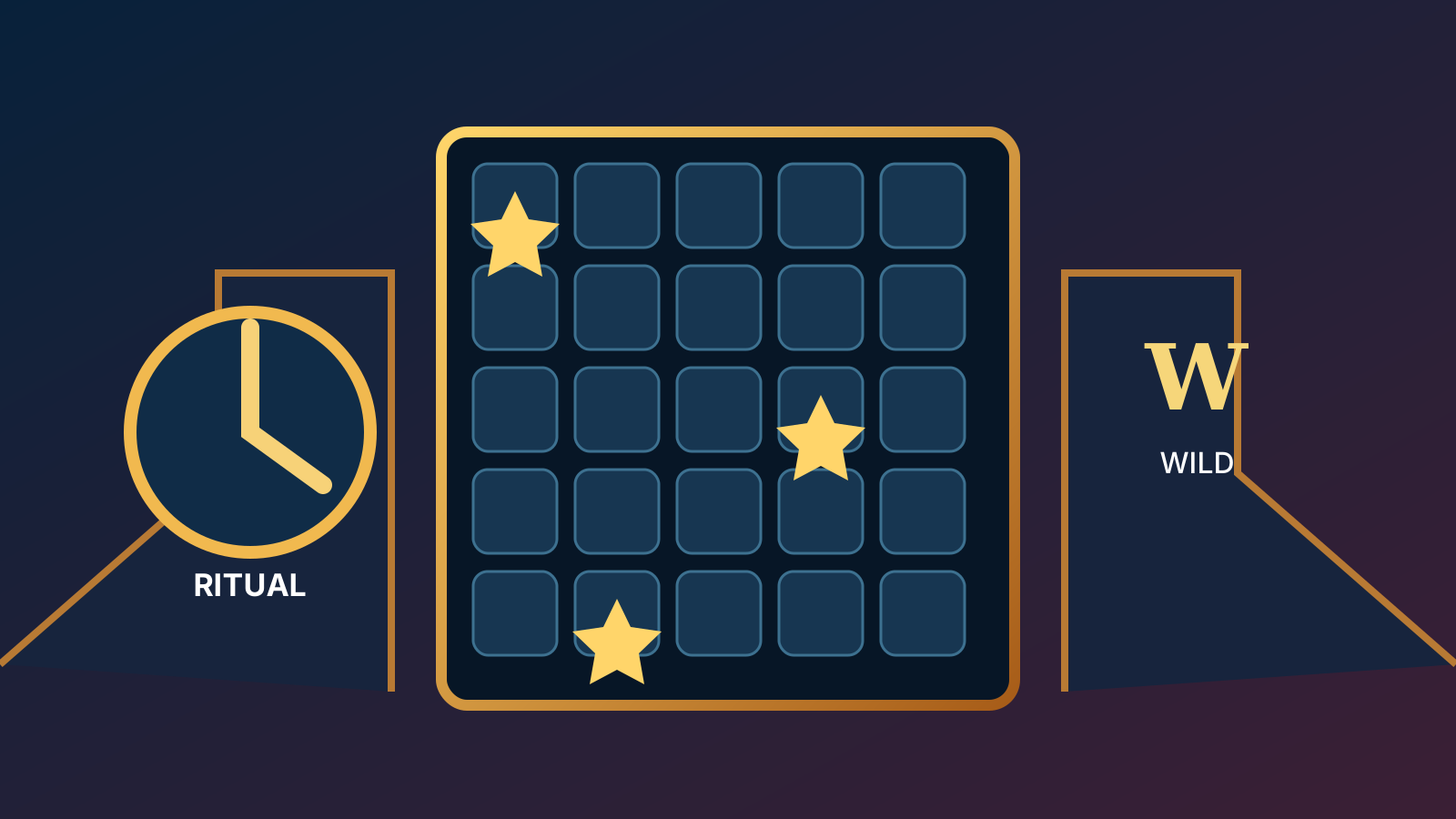
Rich Wilde and the Tome of Dead is Play'n GO Game ID 1013, version 1.0, released on 24 April 2025. It is not a payline sequel that simply changes Book of Dead artwork. The game uses a five-column by five-row grid, cluster wins and cascading symbols. Four or more matching symbols connected horizontally or vertically form a cluster; winners disappear and the grid refills.
The design builds around a Ritual charge meter. Winning symbols fill thresholds at 8, 16, 30 and 48. Early stages add Altar Wilds and can trigger Devour or Judgement. The 48-charge threshold starts Banishment: one free round carrying three random Ritual effects, with overcharge able to raise the total to seven.
The official mathematical record rates volatility at level 6. It lists five RTP alternatives—96.2%, 94.2%, 91.2%, 87.2% and 84.2%—and the public page gives a 5,000x total-bet maximum win. The size of that RTP range is material: a search result quoting only the highest configuration does not establish what a live operator uses.
The layered feature system is relatively dense. It rewards learning an exact sequence more than recognising an Egyptian theme: cascades first, eye and Ritual effects after cascades stop, then any resulting Wild interaction. The rules explain order; they do not provide a strategy that changes random outcomes.
- Game ID
- 1013 · v1.0
- Release
- 24 Apr 2025
- Volatility
- 6
- Win cap
- 5,000x bet
Exact product
Release, version and title identity
The official product record names the title Rich Wilde and the Tome of Dead. The rules sheet identifies it as “tomeofdead,” Game ID 1013, version 1.0, and lists both mobile and desktop channels. These identifiers separate it from Rich Wilde and the Book of Dead, Tome of the Lost and the earlier Tome of Madness.
The public release date is 24 April 2025. An operator can add a game later, and a region-specific certification can carry another date, so the publication date is not evidence of present New Zealand availability. We checked the product page and full rules on 6 October 2026.
Several competitor pages reviewed during research reduce the return to one rounded number or call the volatility “medium.” The official record is more precise: five configuration choices and volatility level 6. We use that first-party scale rather than translating it into an unsupported label.
The exact-title rule also matters for mechanics. Tome of Dead has cluster wins and a single special round driven by a charge meter. Importing ten free spins, expanding book symbols or fixed paylines from Book of Dead would describe another product.
Base engine
Five-by-five cluster wins and cascades
The grid has five columns and five rows. A regular win requires at least four matching symbols connected across a horizontal or vertical edge. Diagonal contact by itself does not connect a cluster. Larger connected groups use the paytable for that symbol and cluster size.
After a win, the contributing symbols are removed. New symbols fall into the gaps, and the game evaluates the refreshed grid. This cascade process repeats for as long as a new winning cluster forms. One paid round can therefore contain several win evaluations without becoming several separately staked spins.
The rules record “fixed 1” rather than a conventional number of paylines because the cluster model evaluates the whole grid. The mathematical table also lists ten coins and a reference stake range from 0.10 to 100. Those are generic rule-sheet units; an operator can display another denomination or local limit.
Cluster size is not the only progression input. Winning symbols also contribute to the Ritual meter, and wins can cover All-Seeing Eye positions. The display may therefore advance after a cascade even when the cash award itself was modest. Meter progress is feature state, not stored money.
No timing choice changes the symbol generation. Quick play, stopping a cascade animation or selecting a different stake does not make connected symbols more likely. Read the current paytable for symbol-specific awards rather than copying them from an image or third-party review.
Substitution and multipliers
Altar, Multiplier and Ammit Wilds
Altar Wilds substitute in cluster formation and act as anchors for several feature effects. The game can add them after an All-Seeing Eye or a Ritual threshold is resolved. Their placement matters because a win involving an Altar Wild may trigger Devour or Judgement at the relevant charge level.
Multiplier Wilds carry 2x, 3x, 4x or 5x values in the base game. In Banishment they can carry 2x, 3x, 5x or 10x. When more than one Multiplier Wild belongs to a cluster, the rules apply only the highest displayed Wild multiplier rather than adding every value.
Ammit is a two-by-two Wild. When summoned, it moves three times. Ammit can also have a multiplier from the All-Seeing Eye sequence during Banishment. The Multiplier Wild rule is important here: its applicable value multiplies the Ammit multiplier. That interaction should not be simplified into a claim that every visible multiplier always multiplies every other one.
Wilds help complete connected groups, but they do not make the game predictable. An Altar Wild can land away from a useful cluster, and Ammit's movement can finish without creating a large award. Feature descriptions identify evaluation rules, not expected outcomes for a session.
Covered positions
All-Seeing Eyes in base play and Banishment
In the base game, an All-Seeing Eye can appear beneath a grid position. When a winning symbol covers that position, the eye opens. After cascades have stopped, the effect adds two to four Altar Wilds. Delaying the award until the cascade sequence finishes preserves the order of operations.
Banishment uses a more elaborate eye layout. The rules describe twelve normal eyes and six special eyes. Opening all twelve normal eyes summons Ammit. Opening four, five or six special eyes applies a 2x, 3x or 4x multiplier to Ammit respectively.
The eye count belongs to that free round, not to a permanently saved player meter. If the condition is not completed within the round, it does not create a promise for a later session. Likewise, seeing several eyes open does not state the probability of opening the remaining positions.
When checking a live build, compare the help text to these two contexts. A summary that says only “eyes award Wilds” omits the separate Banishment conditions and the Ammit multiplier ladder.
Four thresholds
Ritual charges at 8, 16, 30 and 48
Winning symbols charge the Ritual meter. At eight charges, the game adds two to four Altar Wilds after the active cascade sequence. This first stage has no additional named modifier in the checked rules.
At sixteen charges, the game again adds two to four Altar Wilds. If those Altar Wilds participate in a win, Devour is triggered. Devour destroys symbols in specified diagonal, horizontal or vertical positions, which can reshape the grid and permit another cascade evaluation.
At thirty charges, two to four Altar Wilds are added and a qualifying win with them triggers Judgement. Judgement upgrades low-value symbols and canopic jars into higher-value or Ritual-statue symbols. The effect changes symbol identity; it does not directly guarantee a winning cluster.
At forty-eight charges, the game awards Banishment. This is a single free spin or free round rather than a conventional block of ten or more free spins. The distinction is central to the product: its value comes from layered effects and cascades within one round.
Thresholds explain when an effect becomes available, not the cost of reaching it. A round can contribute multiple winning symbols through cascades, but random outcomes determine progress. The meter should never be described as an investment balance or as value that can be cashed out independently.
Concentrated feature
How the Banishment Free Spin resolves
Banishment starts with three random Ritual effects. The game performs the free round and its cascade chain. Whenever cascades stop, one of the available effects is selected and executed; the grid is then evaluated again. This continues until all awarded Ritual effects have been used and no further wins remain.
Overcharge can add effects. For each four extra winning symbols beyond the forty-eight-charge trigger, one additional effect is awarded, with a maximum total of seven. The rule creates a clear ceiling on the number of stored effects even though cascades can continue while wins form.
Possible effects draw from the feature system, including Altar Wild additions and the named destructive or upgrading actions. All-Seeing Eyes can also lead to Ammit and its multiplier. The final result depends on the random effect order, positions and subsequent symbols; the same number of awarded effects need not produce a similar return.
Calling Banishment “free spins” in the plural can mislead readers. The official rules mark a free game and the product uses one free round. Extra Ritual effects extend the internal sequence, not the starting spin count. A third-party review that describes a standard ten-spin bonus is not describing the checked version.
Configuration menu
Five verified RTP settings
The official rules list five alternative configurations. Only the exact game client's information panel can show which one an operator deploys.
| Configuration | RTP | Theoretical house edge |
|---|---|---|
| 1 | 96.2% | 3.8% |
| 2 | 94.2% | 5.8% |
| 3 | 91.2% | 8.8% |
| 4 | 87.2% | 12.8% |
| 5 | 84.2% | 15.8% |
The house-edge column is the arithmetic complement of the published return. RTP is theoretical over a very large number of rounds, not a promise that $100 of play returns a stated amount. Session results can sit far above or below the model.
A difference of twelve percentage points separates the highest and lowest options. That is too large to hide in a footnote. If a casino landing page uses 96.2% in marketing but the client shows another value, the client value is the relevant configuration for that deployed game.
Changing bet size, device or animation speed does not move the title between these certified configurations. The operator deploys a build; the player cannot infer the setting from a short sample of wins or losses.
Keep units separate
Volatility, maximum win and exposure
Play'n GO's mathematical record rates volatility at level 6. We keep the provider's numeric scale instead of assigning an unsupported universal category, because “medium” and “high” cut-offs vary across review sites.
The official product page states a 5,000x maximum win relative to total bet. At a hypothetical $1 stake, that ceiling corresponds to $5,000 before operator rules. This is an arithmetic illustration, not a claim that NZD staking or the title itself is available locally.
The rules sheet separately records maximum exposure of 500,000 at the maximum reference stake and a maximum-win probability of less than one in one billion. Maximum exposure is a currency-denominated mathematical field, not a 500,000x multiplier. The stake-relative public cap remains 5,000x.
A high ceiling does not describe typical play, and an extreme probability is not a countdown. Budgeting should assume the feature may not arrive within a session. Chasing the forty-eight-charge round with larger stakes only increases financial exposure; it does not improve random symbol probabilities.
Reference range
Bet settings and practical exposure
The GRS lists a reference minimum of 0.10 and maximum of 100 with ten coins. These figures are not guaranteed New Zealand-dollar limits. Operator denomination, account currency, market controls and promotional rules can alter what is displayed.
Always use the total-bet field when applying the 5,000x cap. A coin value or line-style display can be only one component of the stake. Confirm the amount again after changing denomination, device or any quick-bet control.
Cluster play can make one paid spin last through several cascades, but it remains one initial stake. Conversely, rapid or automatic play can increase the number of paid rounds per minute. A longer animation is not lower risk if the same money is committed.
Set a fixed entertainment budget and a time limit. Do not increase stake because the meter is close to a threshold unless the full resulting spend remains affordable; progress does not turn the next result into a certainty.
Interface literacy
Mobile, help and demo boundaries
The rules list both mobile and desktop. On a small screen, locate total bet, balance, RTP, paytable, Ritual thresholds and the feature order before starting. The help should explain that clusters connect only horizontally or vertically and that Banishment is one concentrated round.
The provider's public demo is described as entertainment-only, with no purchase and no real-money prize. It can help a reader find controls and watch cascades, but demo credits have no cash value and short results cannot verify RTP.
Public demo availability also does not establish real-money access in New Zealand. An operator can carry a different configuration, restrict a title by location or not offer it at all. Treat provider demo, operator catalogue and legal status as three separate records.
If mobile help omits the RTP or differs from desktop, capture the version and ask the operator. Do not fill the gap with the top number from a search snippet.
Operator-level evidence
New Zealand availability is not assumed
This page confirms publication by Play'n GO, not current access through a New Zealand operator. A global product page cannot prove an operator's identity, geographic rights, configuration or legal status.
DIA player guidance was checked on 6 October 2026. The New Zealand online-gambling framework is in a time-sensitive transition, including the period around 1 December 2026 and a later licensing process. Read the official DIA page and our dated status guide; this game review is not legal advice.
Before using any operator, verify its legal identity, age and location requirements, payment and withdrawal rules, complaints channel, payout limits and self-exclusion tools. Then separately confirm Game ID, RTP and feature rules in the client.
An NZD selector, local imagery or public demo is not proof of authorisation. Accurate game rules likewise do not endorse the operator serving them.
Two-minute audit
What to verify in the live game
- Match the title and Play'n GO provider credit.
- Look for Game ID 1013 or version 1.0 where shown.
- Confirm a 5x5 grid and clusters of four connected horizontally or vertically.
- Check the Ritual thresholds: 8, 16, 30 and 48.
- Read Devour, Judgement and Altar Wild sequencing.
- Confirm Banishment is one free round with three effects and up to seven after overcharge.
- Record the configured RTP from the five official options.
- Keep the 5,000x cap separate from maximum exposure.
- Verify operator and New Zealand access independently.
If the deployed help differs, use it for that build and report the discrepancy through our corrections process. Include the exact version, date and a permitted screenshot rather than merging two rule sets.
Exact-title navigation
How Tome of Dead differs from related games
Rich Wilde and the Book of Dead uses five reels, selectable paylines and ten free spins with a selected expanding symbol. It is not a substitute rules source for this cluster game.
Tome of the Lost also uses a 5x5 cluster grid, but its progression is a Compass at 7, 14, 27 and 42, with Kraken Marks and Treasure Cave effects. Its volatility, RTP menu and 2,000x cap differ.
The Play'n GO catalogue guide groups exact titles without merging their rules. Compare the deployed RTP, grid, progression thresholds and maximum-win unit; theme and a shared word such as “Tome” do not establish mechanical equivalence.
No title is automatically better because it has more effects or a larger cap. Tome of Dead concentrates its feature into one layered round, while Book of Dead spreads a selected-symbol mechanic over a fixed starting set of spins. The practical task is to understand the exact help, choose an affordable stake and keep operator assessment separate from game preference.
Questions answered
Frequently asked questions
What is the Rich Wilde and the Tome of Dead RTP?
The official Game ID 1013 rules list 96.2%, 94.2%, 91.2%, 87.2% and 84.2%. They are alternative configurations, not values that run simultaneously. Check the live information panel.
How are wins formed?
Four or more matching regular symbols must connect horizontally or vertically on the 5x5 grid. Winning symbols are removed and new symbols cascade until no further win forms.
How does the Banishment Free Spin work?
At 48 Ritual charges the game awards one free round with three random Ritual effects. Overcharge adds one effect per four extra winning symbols, to a maximum of seven effects. The effects play one at a time after cascades stop.
What is the maximum win?
The official product page lists 5,000 times total bet. The rules sheet separately lists maximum exposure of 500,000 at maximum bet; that field is not a 500,000x cap.
Is it the same game as Book of Dead?
No. Tome of Dead uses a 5x5 cluster-and-cascade engine, Ritual charges and one concentrated Banishment round. Book of Dead uses five reels, selectable paylines and a different ten-spin expanding-symbol feature.
Evidence record
Primary sources
Facts and configurations were checked against the following first-party records. A public product page is not proof that a game is available through a New Zealand operator.
- Play'n GO — Rich Wilde and the Tome of Dead product pageChecked 6 October 2026
- Play'n GO — official game rules sheet (Game ID 1013, version 1.0)Checked 6 October 2026
- Play'n GO — games catalogueChecked 6 October 2026
- New Zealand Department of Internal Affairs — online gambling for playersChecked 6 October 2026