Short answer
Treat the changed casino as a new evidence problem
A crypto casino ownership or domain change breaks the shortcut that makes an old review feel convenient. The old article may accurately describe the company, web address and rules that existed on its check date, yet none of those fields automatically follows the brand into a new contract. Begin again with the current terms and exact destination.
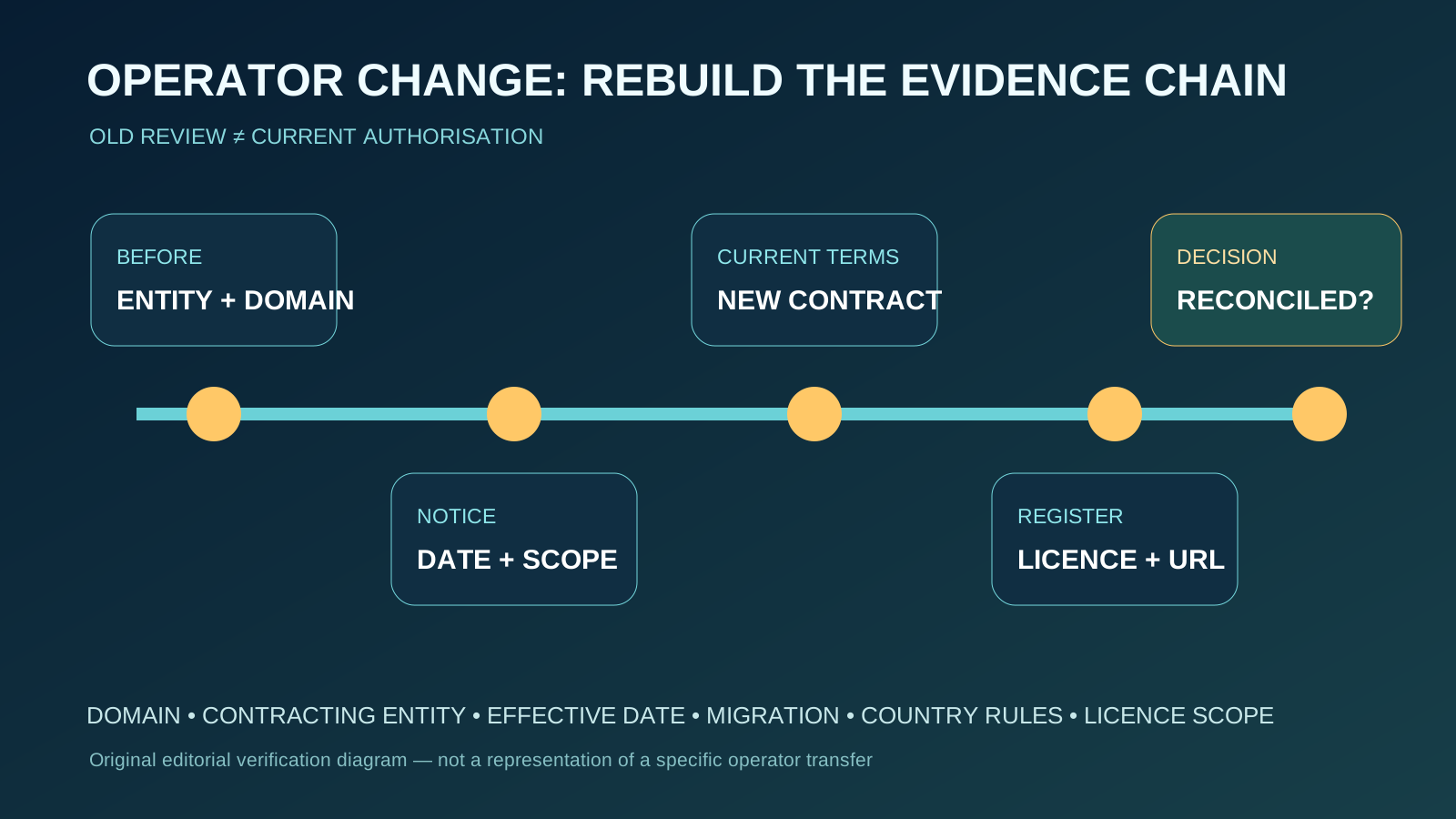
Verify six linked facts: the domain you reached, the legal entity offering the service, the date its terms took effect, the account-migration mechanism, the current country restrictions and the authoritative licence record where a licence is claimed. Each fact needs evidence controlled by the organisation responsible for it.
A familiar logo, functioning password, transferred balance or automatic redirect can support a migration story but cannot complete it. A clone can imitate a brand, while a genuine migration can still change eligibility, dispute rights, custody, verification duties and promotional balances.
This guide supplies a comparison process, not a claim that any named casino has changed ownership. Its Stake example is deliberately limited to a dated current-policy snapshot: it shows how to record a counterparty today, not evidence of a before-and-after transaction.
Define the event
“New owner” can describe several different legal and technical changes
A shareholder may acquire control while the contracting company remains the same. A brand may move from one operating company to another. The same company may adopt a new trading name, or the service may add, remove or replace a domain without changing its company. These events should not be collapsed into one label.
Corporate control concerns who can direct the licensed company. The UK Gambling Commission, for example, describes reportable control around shareholding, voting power or significant influence and requires an application process in relevant cases. That regulatory concept is more specific than a news headline saying a brand was “bought”.
A contracting-entity change is directly relevant to the user because terms define who holds the account relationship and responds to complaints. A domain change concerns the address through which the service is delivered. Either can occur without the other, so verify both fields independently.
Write the event as a testable statement: “On date A, terms at domain B name entity C.” If a source also proves an earlier state, record it separately. Do not convert rumours, affiliate updates or a corporate group name into an asserted transfer.
Before-and-after record
Build a baseline before comparing claims
Start with the exact old review. Record its publication date, last substantive update, domain, legal entity, named licence, country conclusion and the primary sources it cited. A page without dates or source links cannot reliably prove even its own historic scope.
Separate stable description from dynamic facts. Game themes and an explanation of blockchain confirmations may remain useful; contracting entities, domains, restrictions, bonuses, supported networks, withdrawal procedures and licence status can change. Mark each dynamic field for rechecking rather than discarding the entire review.
Create a second column for current evidence and a third for the difference. Use exact strings, including company suffixes, registration numbers, domain spelling and terms dates. “Same group” is not an adequate match when one document names a different legal person.
Save the source URL and observation date for each entry. Screenshots add context, but preserve accessible text or a PDF where permitted because images can hide links and are hard to search. Never include passwords, complete identity documents, session tokens or wallet secrets in the record.
Primary contract
Read the current terms from the independently verified domain
Navigate independently rather than through an email announcing the change. Use a verified bookmark, a regulator-controlled domain listing where applicable, or another established official route. Then open the legal terms from that destination and record the complete URL, title, effective date and access time.
Locate the clause that names the contracting company and any payment agent. A payment processor, intellectual-property owner and customer-facing operator can be different entities. Do not describe every footer company as the casino operator unless the contract assigns that role.
Search for assignment, transfer, novation, change-control, account closure, governing law, dispute, privacy and data-transfer provisions. The wording may explain whether an account relationship can move, how notice is given and what a user can do if they do not accept revised terms.
If the policy has no effective date or the named company conflicts with another current page, preserve both records and mark the counterparty unresolved. A polished FAQ cannot overrule a formal contract without evidence explaining the relationship.
Legal identity
Match the company, registration and role—not just the brand
Copy the entity name exactly, including punctuation and corporate suffix. Add the registration number and registered jurisdiction when the terms publish them. A small spelling difference may identify another company rather than a harmless editorial variation.
Use the authoritative company register for the relevant jurisdiction where it is publicly available. The New Zealand Companies Register, for example, explains searches by company name, company number or NZBN and makes current and removed shareholder information available, while warning through its record structure that filings have dates and scope.
A register proves filed corporate information; it does not prove that a foreign casino accepts New Zealand customers, controls a particular wallet or honours withdrawals. Conversely, failure to find a foreign entity in the NZ register says little if it is not claiming to be an NZ company.
Record parent, subsidiary and trading-name relationships only when a primary corporate or regulatory source connects them. Shared directors, similar names or a common office can prompt further checking but do not independently prove that one entity assumed another's player liabilities.
Official communications
An announcement should identify what changed and when
Look for a notice on the verified old or current domain, an investor announcement by the relevant companies, and a regulator update where a licensed entity or domain is affected. Prefer a document that identifies buyer, seller, affected entity, completion date and operational consequence.
Distinguish signing from completion. A proposed acquisition, regulatory approval and completed transfer are different milestones. A press release dated before completion may describe an intention rather than the current contract.
Marketing announcements often celebrate a brand expansion without explaining player accounts. Pair them with terms, privacy notices and account messages that state what happens to balances, personal data, complaints and consent.
Save the announcement at the source that issued it. A copied article can be useful for discovery but should not become the sole evidence for a legal transfer. If the primary release disappears, an archive can preserve what was published, provided it is clearly labelled historic.
Address evidence
Prove that the new domain belongs to the current service
Compare the registrable domain character by character. A brand word in a subdomain, search advert or social profile does not establish control. Check the final URL after every redirect and avoid shortened links supplied only through a message.
A server-side redirect from the established domain to the new one is meaningful technical evidence, especially when current terms and official notices agree. It is not sufficient alone: an old domain can be compromised, sold or configured incorrectly.
Where a regulator maintains authorised domain records, match the exact company and domain in that register. The UK Gambling Commission explains that licensees can apply to add or remove domain names; this illustrates why a licence number without a domain match is incomplete.
Record whether the old domain still serves accounts, redirects, displays a closure notice or has become unrelated. Do not log in merely to test a suspicious destination. Domain history and registration data provide context, but privacy services and registrar changes are not standalone proof of ownership.
Timeline control
Align announcement, completion and terms-effective dates
Make a simple chronology: old terms checked, change announced, regulatory decision if any, transaction completed, migration notice issued, new terms effective and old domain retired. Missing dates should remain visible rather than being smoothed into a confident story.
A terms page updated after an announcement may contain the first operative customer information. Equally, a future effective date means the old contract may still govern until the stated transition, subject to its own clauses. Do not backdate the new entity.
Use calendar dates with timezone where material. Crypto services operate across borders, and a midnight cutover can fall on different local dates. Account notices should be preserved with the time received and the date the change claims to begin.
When two official sources conflict, prioritise neither silently. Record the conflict and ask verified support for a written explanation tied to the exact account jurisdiction. The absence of an answer means the state remains unresolved.
Existing accounts
Account migration needs more than a working login
A complete notice should identify the old and new counterparties, effective date, affected accounts and whether action or consent is required. It should address cash and crypto balances, open bets, pending withdrawals, bonuses, loyalty points, limits and self-exclusion records.
Check how identity and transaction data moves. The privacy notice should explain controllers, purposes, jurisdictions and rights. Never re-upload identity documents through a link supplied only in a migration email; enter the verified account independently and confirm the request there.
Record whether credentials remain valid, whether multi-factor authentication is reset and whether deposit addresses change. A genuine migration can require technical changes, but urgency is not a substitute for provenance. No support agent needs a seed phrase, private key or one-time code.
If a balance appears at the new domain, preserve a non-sensitive account statement and the notice that explains its transfer. A displayed number supports continuity only when the new counterparty and withdrawal conditions are also verified.
Eligibility reset
Recheck New Zealand and supplier restrictions from zero
An ownership or domain change can alter accepted countries even when the interface looks identical. Read the current restricted-country clause, residency definition, age requirement, verification rules and any product-specific exclusions.
Absence of “New Zealand” from a prohibition list is not the same as affirmative acceptance. A site may use catch-all clauses, licence-territory restrictions, payment limitations or individual game-supplier blocks. Record the exact wording and date instead of simplifying it to “available”.
An NZ flag, NZD balance, reachable registration form or successful IP check is interface evidence only. It does not override written terms or establish the legal position. Never use a VPN or false residence to test access.
Link the result to the site's New Zealand legal-status guide for national context. That broader page does not endorse the migrated operator; it keeps product evidence separate from the changing NZ framework.
Regulatory scope
Old seals do not travel automatically to a new company or domain
Open the regulator-controlled register rather than clicking only the casino's badge. Match legal name, licence number, status, activities, effective dates and authorised domains where the register exposes them.
A B2B software licence does not necessarily authorise B2C casino operations. A group company may hold a licence that does not cover the contracting entity. Copy the scope as written and avoid the shorthand “fully licensed” when the record is narrower.
Corporate-control rules can require approval or notification. The UK Gambling Commission's guidance shows that regulated ownership changes can involve identity, ownership diagrams, share-transfer evidence and source-of-funds information. Requirements differ by regulator, so do not project that process onto another jurisdiction.
If the seal resolves to an expired page, another company or a domain absent from the licence, mark the claim unresolved or mismatched. Do not infer fraud from one mismatch alone, but do not treat the badge as verified either.
Dated snapshot
Stake policies show how to record current roles without inventing a change
On 7 October 2026, the checked Stake policies page and footer named Medium Rare N.V., registration number 145353, with a Curaçao address as the legal operator disclosure. The same area named Medium Rare Limited and MRS Tech Limited in payment-agent roles.
This snapshot demonstrates why roles matter: a payment agent is not automatically the contracting casino operator. It also demonstrates dating. The observation supports only what the live policy published on the check date.
This guide does not use the snapshot to claim Stake changed owner, domain or customer contract. Proving such a change would require an earlier primary record and a documented transition connecting the two states.
A reviewer applying the method should store the exact policy URL, legal names, registration details, country clause and date, then repeat the check at a later review. A difference becomes a lead for investigation, not automatic proof of a transfer.
Publication hygiene
Keep old reviews accessible but label their evidence state
An archived review can preserve valuable history. Keep the original publication date, reviewed entity, reviewed domain and evidence date. Add a prominent notice when current terms differ or the destination is no longer verified.
Do not silently rewrite the old article so it appears to have known later facts. Use an update log that separates corrections from new evidence. If the canonical page is continuously maintained, state which sections were rechecked and which historical claims remain.
Remove or disable action-oriented links that now lead to an unverified or unrelated domain. An archived article should not keep presenting an old registration button as current merely because its descriptive paragraphs are historically accurate.
For search snippets and structured data, avoid a fresh modified date based only on a cosmetic edit. A material review update should correspond to material evidence checking. Readers need to know whether the operator conclusion is current.
Payment boundary
A new deposit address needs separate authenticated verification
After identity and eligibility checks, open the cashier only from the independently verified signed-in account. Match asset, network, minimum, confirmations, destination and memo or tag requirements. Do not reuse an old address merely because it once worked.
A migration notice may explain whether deposit addresses rotate and whether pending withdrawals remain with the old entity. Preserve current instructions and transaction identifiers. Sending a token on the wrong network can be irreversible even when the operator is genuine.
Do not send a “verification deposit” requested through chat or email to prove account ownership. Do not sign an unexplained wallet transaction or approval. The site's wallet authentication guide covers connection, sign-in, transactions and approvals in depth.
This page intentionally stops at a brief safety boundary. Detailed network and cashier procedures belong to the payment-owner guides, while this guide asks whether the counterparty and destination should be trusted at all.
Transition risk
Ownership news creates an opening for impersonation
Scammers can copy a real acquisition announcement and send a false migration link before users understand the change. Independently reach both the established and current official channels; do not verify an email using contact details contained only in that email.
Review active sessions, multi-factor settings, recovery contacts, withdrawal addresses and API keys after any legitimate account move. A new domain should not require disclosure of an existing password through a message form.
Check the full hostname and redirect chain. HTTPS protects a connection to the opened domain, not the business claim on the page. The fake casino domain checklist provides deeper lookalike and incident-response checks.
Preserve suspicious notices, but redact balances, addresses where privacy matters, identity records and session data before sharing. Report impersonation through verified operator and national cyber-security channels rather than continuing a conversation with the sender.
Unfinished obligations
Identify who owns pending withdrawals and complaints
A transition should explain whether the new entity assumes liabilities, whether the old company finishes pending transactions and which terms govern an already opened dispute. Do not assume a brand acquisition transfers every customer claim.
Save the original complaint, ticket numbers, account statement, round or transaction IDs and the terms effective when the event occurred. Ask the verified current contact to identify the responsible legal entity and escalation route in writing.
If a regulator or alternative dispute body is named, confirm that the entity and activity fall within its current scope. A historic complaint route may no longer accept cases against the new company, while an old dispute may remain attached to the former licensee.
A migration is not evidence that a disputed withdrawal will be paid, nor is a delay by itself proof of insolvency or fraud. Keep the claim factual: amount, status, dates, requested documents and written responses.
Worked comparison
How to assess an email announcing a new casino domain
Suppose an old review names Company A at old.example and an email says accounts have moved to new.example under Company B. First record the message without using its link. Open the old verified bookmark and current regulator record or official company announcement independently.
At the independently verified new destination, read terms and privacy notices. Confirm Company B, the effective date, country clause, domain and migration treatment. Search the applicable licence register for Company B and new.example rather than reusing Company A's badge.
Compare the email's details with those sources. If the old site links to the notice, the new terms align and the register covers the new company and domain, the chain is stronger. If only the email supports the change, do not log in or send funds.
Finally, inspect the authenticated account without depositing. Check balance continuity, account security, notices and pending transactions. Any unexplained conflict remains a stop condition until verified support supplies evidence.
Practical audit
Crypto casino owner and domain change checklist
- Record the old review's entity, domain, sources and check date.
- Classify the claimed event: control, contracting entity, trading name or domain.
- Reach current terms through an independently verified route.
- Copy the exact legal name, registration, role and effective date.
- Find a primary announcement and distinguish signing from completion.
- Match the new domain in authoritative records where available.
- Check account-migration treatment for balances, bets, bonuses and data.
- Re-read New Zealand and supplier-specific country restrictions.
- Verify licence status, scope, entity and authorised domain.
- Preserve unresolved conflicts instead of choosing the most favourable source.
- Review security controls and reject requests for secrets or remote access.
- Verify cashier asset and network only inside the authenticated account.
- Identify who handles pending withdrawals and complaints.
- Label the old review historic, current, superseded or unresolved.
Editorial labels
Use a conclusion that matches the evidence
“Current and reconciled” means the domain, terms, entity, dates, country clause and relevant register agree. It does not guarantee solvency, game fairness or a successful withdrawal.
“Historic” means the page accurately describes a dated earlier state but does not claim currency. “Superseded” means stronger later evidence has replaced a material conclusion. “Unresolved” means current primary sources conflict or omit a necessary link.
“Blocked” is appropriate when identity, country eligibility or domain authority cannot be established before an action. It is a decision to pause, not an accusation of wrongdoing.
Publish the check date beside the verdict and the evidence that supports it. A rating score without this chain hides the very change the reader needs to evaluate.
Evidence boundary
This method cannot turn public records into a guarantee
Company and licence registers report matters within their own jurisdiction and filing scope. They do not prove wallet reserves, segregated player funds, cybersecurity, every supplier agreement or future payment performance.
Public terms may not reveal a private acquisition agreement or every group relationship. Account-specific migration details can differ by country and may appear only after authentication. This guide therefore separates verified public facts from unavailable account evidence.
Domains, entities and restrictions can change again after publication. Repeat the high-risk checks before a new deposit, identity upload, wallet permission or acceptance of materially revised terms.
The checklist is editorial and security information, not legal advice or an endorsement. When rights or a material balance are disputed, preserve evidence and use qualified advice and verified regulatory or dispute routes appropriate to the actual contract.
Questions answered
Frequently asked questions
Does a redirect from an old casino domain prove the new domain is authorised?
No. A redirect is useful technical evidence, but it must be reconciled with current terms, official notices, company identity and any applicable licence register.
Can an old licence seal prove the present operator is licensed?
No. Check the regulator-controlled record for the current company, licence status, scope and authorised domains. A copied or historic seal is only a claim.
What happens to an existing account after an operator change?
The migration notice and current terms should explain the new counterparty, effective date, balances, open bets, verification records, bonuses, complaints and any consent or opt-out process.
Should I make a small deposit to test a new domain?
Not until identity, terms, country eligibility, account security and the authenticated cashier are independently verified. A small transfer can still expose an address or create contractual risk.
How should an old review be labelled?
Keep its publication and last-check dates visible, identify the company and domain it actually reviewed, and mark dynamic conclusions stale or superseded when current evidence differs.
Evidence record
Primary sources
Facts and configurations were checked against the following first-party records. A public product page is not proof that a game is available through a New Zealand operator.
- Stake — current policies and legal footerChecked 7 October 2026
- UK Gambling Commission — change of corporate controlChecked 7 October 2026
- UK Gambling Commission — make changes to an operating licenceChecked 7 October 2026
- UK Gambling Commission — casino sector informationChecked 7 October 2026
- New Zealand Companies Register — searching the registerChecked 7 October 2026