Short answer
A licence check is a chain of matches, not a badge check
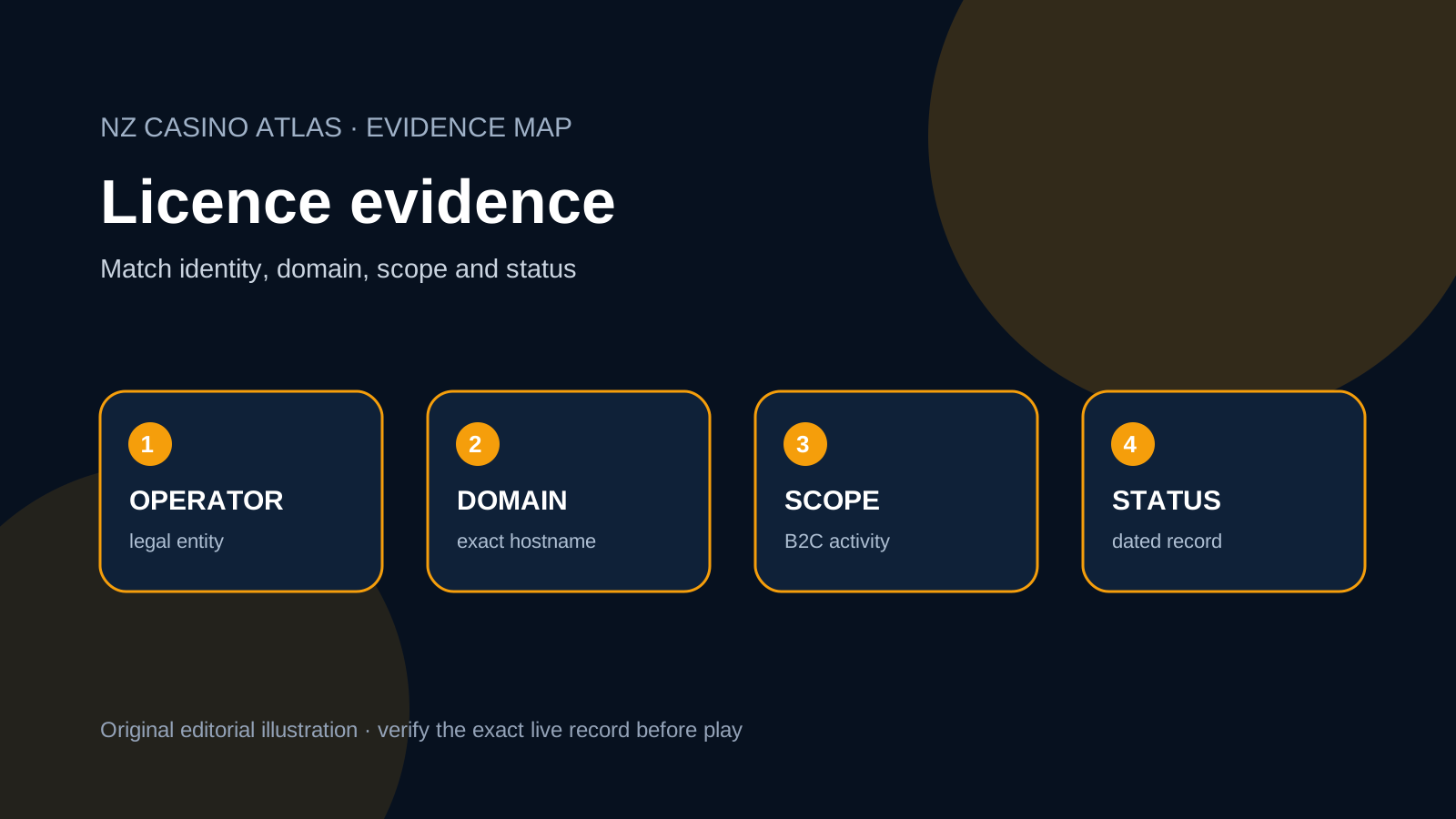
Start with the exact casino domain in the browser and the current terms on that domain. Record the legal entity that accepts the account contract, its company number, claimed regulator and licence number. Then navigate independently to the regulator’s official website and search its public register. The result should connect the same legal entity to an active permission whose scope covers player-facing online casino activity and, where the regulator records domains, the same hostname.
Five fields matter: operator, domain, activity, status and date. A match on only one is weak. A real company can display an expired number; a licensed group can operate an unlisted brand; and a software supplier can hold a valid B2B authorisation without permission to take player deposits. A copied regulator logo can coexist with all three problems.
Cloudbet provides a useful dated example, not a recommendation. Its terms updated 30 September 2026 name Halcyon Super Holdings B.V., company number 148526 and Curaçao Gaming Authority licence OGL/2024/328/0599, issued 27 May 2025. The terms separately say Solas Technologies Limited handles some payment processing and is not licensed to offer betting or gaming. That distinction shows why a processor, operator and domain must not be collapsed into one label.
Do not mark a casino “verified” merely because its terms contain a number. This guide explains how to gather and reconcile evidence. It does not certify Cloudbet or any other operator for New Zealand users, and a regulator record can change after the checked date.
- Identity
- Contracting legal entity
- Domain
- Exact player-facing hostname
- Scope
- B2C casino activity
- Status
- Active on the check date
Contract first
Find the company that actually contracts with the player
Open the current terms, not a search snippet or affiliate review. Look for phrases such as “operated by”, “provided by”, “contracting party” and “licensed by”. Save the full legal name, registered address, company number, licence number, terms date and relevant clause. A brand name alone is not enough because brands can be licensed, sold or operated by different companies.
Separate the operator from supporting companies. Payment processors, marketing partners, platform suppliers and group affiliates may appear in privacy or cashier documents. They do not become the gambling operator merely because they touch funds or data. Cloudbet’s terms explicitly say its Cyprus subsidiary provides payment processing only while gaming services are provided by the Curaçao entity.
If different pages name different entities, do not choose the most reassuring one. Record the conflict and ask which company owes the account balance, decides withdrawals and handles complaints. The answer should be consistent with the regulator record and privacy controller information.
Company incorporation is not a gambling licence. A company-registry record can confirm that an entity exists and its legal spelling, but the named gambling regulator must confirm the authorised activity.
Hostname precision
Match the exact domain, not a similar logo or brand spelling
Record the hostname after all redirects. A licence for example.com does not automatically cover example.net, a lookalike subdomain or a mobile app distributed by another entity. Check punycode and spelling carefully; phishing domains often substitute characters that look alike.
Some regulators publish declared domains. The UK Gambling Commission’s business register includes domain status fields such as Active, Inactive and White label. Curaçao Gaming Authority documentation says B2C operators must register player-facing domains and that domain actions are reflected on the online certificate and seal.
A domain’s presence in search results or ability to accept registration is not regulatory evidence. Neither is a geolocation flag or currency selector. The regulator-controlled record must connect the exact domain to the operator.
If the register does not expose domains, find the regulator’s stated verification method and preserve the operator’s footer link. Absence of a public domain field should be reported as a limitation, not converted into a positive match.
Independent route
Open the regulator’s register independently
Do not rely solely on a link supplied by the casino. Type or navigate to the regulator’s official domain, then use its licence search. Search the legal company name, licence number, trading name and exact domain where supported. Independent navigation reduces the risk of a convincing replica certificate.
Check that the register page is controlled by the regulator and uses HTTPS. Read the regulator’s explanation of its data fields. For example, the UK register explains its licence-status categories and identifies domain states. Those definitions are stronger than an affiliate’s simplified “licensed” badge.
Save the result URL and check date. Public registers change: permissions can be suspended, surrendered, revoked or varied, while domains can become inactive. A claim without a date hides that volatility.
If the register is unavailable, do not substitute an old screenshot as current proof. Report the outage, preserve the operator claim and recheck later. A temporary inability to verify is not the same as proof of no licence, but it is also not a basis for a verified badge.
Permission details
Read what the licence authorises and where it applies
An active record may cover casino, sports betting, bingo, game supply or another activity. Confirm that the activity matches the service being evaluated. A sports-only permission cannot be silently stretched into a casino licence, and a test-lab approval is not an operator permission.
Read geographic scope and customer-facing limits. A regulator can authorise activity under its own regime without confirming that every resident worldwide may use the site. Operator terms and the user’s local legal context still matter.
Check conditions, regulatory actions and linked entities where the register provides them. A licence can be active while subject to restrictions. Report the condition rather than compressing the entire record into a green tick.
A licence also does not guarantee solvency, fast withdrawals, fair promotional interpretation or suitability for one user. It identifies a regulatory relationship and complaint framework; other risks require separate evidence.
Different regulatory roles
B2B supplier authorisation does not license a player-facing casino
B2C generally refers to the business contracting with players and offering gambling. B2B commonly covers critical game supply, software, platforms or services to operators. Terminology varies by regulator, but the practical question is stable: does this permission authorise the entity to accept the player and operate the exact casino domain?
The Curaçao Gaming Authority’s 2026 portal documentation states that a B2B holder may display its blue authorisation seal on its corporate website, but that the seal does not entitle it to run player-facing gambling. Player-facing activity requires a separate B2C licence and associated domain authorisation.
This matters when a casino lists famous game studios. A studio’s supplier credentials can support confidence in the game source, but they do not license the casino, hold the player balance or resolve an operator complaint. The AvatarUX catalogue guide, for example, covers studio games rather than certifying any casino operator.
Never write “licensed by association”. Match the permission to the service and legal entity that performs it.
Clickable evidence
A genuine seal should resolve to a regulator-controlled record
Hover or inspect the footer seal without opening an affiliate redirect. A useful seal is clickable and leads to the regulator’s official certificate or register, where the domain token, operator and licence can be checked. A static PNG copied onto a page has no independent evidential value.
Curaçao portal guidance describes domain verification and regulator-hosted dynamic seals. It requires operators to register domains and associate the seal with the certificate service. That structure makes the destination and domain token more important than the appearance of the image.
Check for redirects to unrelated hosts, mismatched domain parameters, broken certificate pages or a record naming another company. Take a screenshot of the full browser address and certificate details, not just the badge.
Do not reproduce regulator logos as an editorial “verified” mark. That can imply endorsement and can remain visible after the underlying status changes.
Worked example
Cloudbet’s terms show the fields to extract before a register check
The checked Cloudbet terms name Halcyon Super Holdings B.V. in Willemstad, Curaçao, company number 148526. They claim Curaçao Gaming Authority licence OGL/2024/328/0599 issued on 27 May 2025 and identify cloudbet.com as the website. Those are the input fields for an independent register or certificate query.
The same clause names Solas Technologies Limited as a wholly owned payment-processing subsidiary and expressly says it is not licensed to offer betting, gaming or wagering services. A superficial review might mistake the processor for the operator; the terms prevent that conclusion.
This article does not convert the terms claim into a permanent certification. A complete current check would still require the regulator-controlled record or seal to match the operator, number, domain, scope and active status on the viewing date.
It also would not prove New Zealand eligibility. Terms country restrictions, location rules and local legal information remain separate evidence chains.
Time-sensitive fields
Issued, effective, expiry and status dates answer different questions
An issue date says when permission began; it does not prove the licence remains active. An expiry date can show a scheduled end but not an interim suspension. The current status field and any regulatory-action record are therefore essential.
Terms dates are different again. Cloudbet’s page says it was last updated on 30 September 2026, while the claimed licence issue date is 27 May 2025. Preserve both. A newer terms page can identify an operator change even where an older review still names the previous company.
Use exact wording such as active, suspended, surrendered, revoked, expired or pending. Do not compress pending into licensed or suspended into active. Where a status definition is unclear, quote the regulator’s own glossary in summary form.
Every editorial claim should include “checked on” or “as at”. Schedule rechecks for operator reviews and remove stale badges rather than letting a dated check look continuous.
Brand relationships
A white-label domain still needs a licensed operator behind it
A brand owner and licensed operator can be different companies. The UK Gambling Commission explains that the operator holds the licence and remains liable for gambling activity; the white-label partner does not independently hold that permission merely because its brand appears on the site.
When a register labels a domain White label, identify the licensed operator and match it to the site terms. Do not claim that the brand itself holds the licence unless the legal record says so.
Responsibility for balances, safer-gambling controls and complaints should follow the contracting and licensed operator. Marketing-company details can still matter, but they are not substitutes for the operator identity.
White-label arrangements can change. A preserved terms date and register check help explain which operator relationship applied at the time of a dispute.
Corporate cross-check
Use company records to confirm spelling and existence, not gambling scope
After identifying the legal entity, a corporate register can corroborate company number, incorporation jurisdiction, registered address and status. This helps catch invented entities and small spelling changes.
Corporate active status does not equal a gaming licence. The company may lawfully exist while lacking permission for the advertised casino activity. Always keep the corporate record and gambling-regulator record as two separate citations.
Group charts and ownership claims may help explain processors or affiliates but should not override the player contract. Ask which entity owes funds and which regulator supervises that activity.
If a company number points to another legal name, publish the mismatch and date. Do not resolve it by assuming a recent rename without an authoritative filing.
Evidence disagreement
Pause when the footer, terms and regulator disagree
Common conflicts include a footer naming one entity while terms name another, an active entity record with an absent domain, a licence number belonging to a supplier, or a seal opening a certificate for a different hostname. Any of these prevents a clean positive conclusion.
Save each record before contacting support. Ask for the exact regulator link and clause explaining the relationship. A support assertion is useful context but does not replace the regulator’s record.
If a site recently migrated, both old and new entities may appear temporarily. Report the transition and avoid definitive wording until the contract and register converge.
Do not accuse a site of illegality solely from one broken badge. State the observable mismatch, the check date and what evidence would resolve it.
Audit trail
Preserve enough evidence to reproduce the check
Save the terms title, URL, date, operator clause and licence claim; the regulator query and result; the domain record; the activity and status; and the seal destination. Include timestamps and full browser addresses.
Text export is useful because screenshots can hide links, while screenshots preserve layout and status display. Keep both where practical. Store files privately and avoid collecting unrelated personal information.
Note redirects and language versions. Translated terms may lag the governing English version, as Cloudbet’s terms explicitly warn. Identify which version controls.
A reproducible record supports corrections. If status later changes, the article can distinguish the earlier checked state from the new one rather than silently rewriting history.
Editorial language
Use precise conclusions instead of trust badges
Safe wording includes “the operator’s terms claim”, “the regulator register listed”, “the domain matched” and “checked on 7 October 2026”. Each phrase identifies the source and date.
Avoid “fully licensed worldwide”, “guaranteed safe”, “regulator approved casino” and “verified payout”. A licence does not create worldwide eligibility or guarantee individual outcomes.
Where only the operator terms were reachable, say the licence claim was not independently confirmed. Where the register matched but the domain was absent, say the entity record matched but domain authorisation remained unresolved.
The absence of a public record should prompt caution and further checking, not a fabricated badge or score.
New Zealand boundary
A foreign licence check does not rewrite New Zealand law
This page verifies evidence relationships; it does not decide whether offshore gambling is licensed in New Zealand. Use the New Zealand online-casino legal-status tracker for the national framework and date-specific official sources.
A foreign regulator’s permission can identify the overseas operator and complaint route. It does not transform that operator into an NZ-licensed casino or prove that its terms permit a New Zealand resident.
Check country restrictions separately. A reachable website, NZD display, accepted document or successful deposit does not settle eligibility. Do not bypass restrictions with false details or location masking.
Where gambling causes harm, licence research is not a reason to keep depositing. Use the site’s responsible gambling resources and stop before trying to recover losses.
Practical workflow
Crypto casino licence verification checklist
- Record the exact final domain after redirects.
- Open the current governing terms on that domain.
- Extract legal operator, company number, address and terms date.
- Record the claimed regulator and licence number.
- Separate operator, processor, supplier and marketing companies.
- Navigate independently to the regulator’s official register.
- Search legal name, licence number, brand and domain.
- Confirm player-facing B2C casino activity.
- Check active status and any restrictions or actions.
- Match the exact domain where the register supports it.
- Test the footer seal destination and domain token.
- Do not use a B2B supplier licence as operator evidence.
- Preserve screenshots, text, URLs and check date.
- Report conflicts and unavailable fields explicitly.
- Check New Zealand eligibility and legal context separately.
The correct output is sometimes “not independently verified”. That is more useful than a confident badge built from mismatched evidence.
Questions answered
Frequently asked questions
Does a licence badge prove that a crypto casino is licensed?
No. Verify the badge destination, legal operator, exact domain, licence number, scope and status in the regulator’s own current record.
Is a B2B software licence the same as a casino operator licence?
No. A B2B or supplier authorisation can cover games or platform services without authorising the holder to contract with players on a casino domain.
What if the company name in the terms differs from the register?
Do not assume a trading name, processor or group company is equivalent. Ask the casino to explain the relationship and verify the contracting operator independently.
Can a regulator record be active while a domain is missing?
Yes. An entity may hold a licence without the exact domain being authorised or listed for player-facing activity. Both the entity and domain need to match where the regime records domains.
Does a foreign operator licence make a casino licensed in New Zealand?
No. Foreign operator evidence and New Zealand legal status are separate questions. Use the site’s national legal-status tracker for the NZ context.
Evidence record
Primary sources
Facts and configurations were checked against the following first-party records. A public product page is not proof that a game is available through a New Zealand operator.
- Cloudbet — Terms and ConditionsChecked 7 October 2026
- Curaçao Gaming Authority — portal documentation suiteChecked 7 October 2026
- UK Gambling Commission — register of gambling businessesChecked 7 October 2026
- UK Gambling Commission — opening accounts and licensed statusChecked 7 October 2026
- New Zealand DIA — online gambling for playersChecked 7 October 2026