Short answer
Public addresses are pseudonyms, not invisibility cloaks
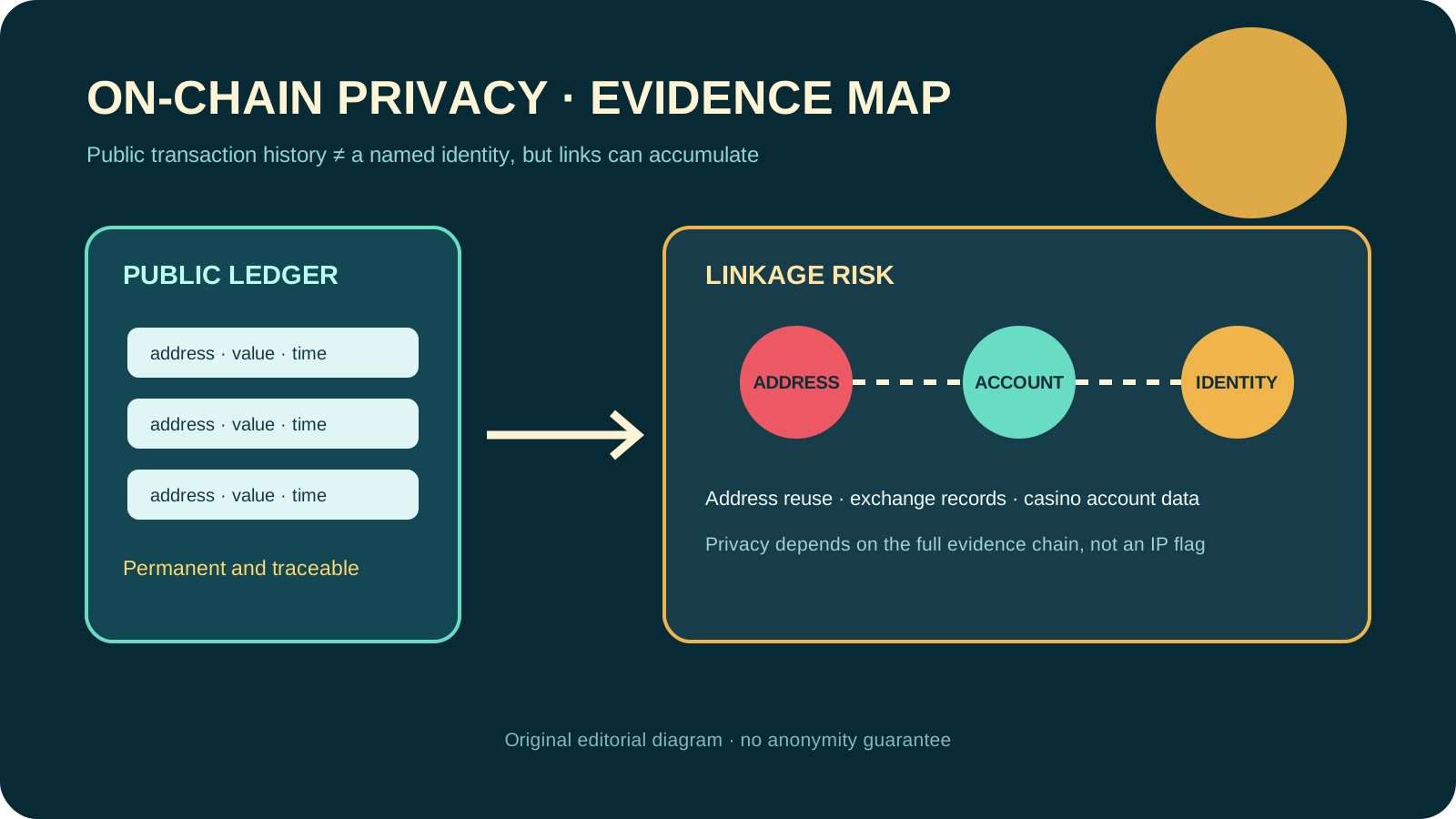
Bitcoin does not normally write a passport name into a transaction. It records addresses, amounts, inputs and outputs on a shared public ledger. Bitcoin.org therefore describes Bitcoin as not anonymous: all transactions are public and permanently stored, while the identity behind an address can become known when information is revealed in a purchase or another context.
A crypto casino creates several opportunities for linkage. The authenticated cashier can assign a deposit address to one user, watch a transaction arrive, record its transaction ID and credit the corresponding account. A withdrawal request links an account to a destination address. Customer support, identity checks and payment screenshots can add more direct evidence.
An exchange can hold a separate record. If coins leave an account at a service that knows its customer, that service can associate the withdrawal with time, amount and destination. The public blockchain then exposes the onward transaction graph even though it does not display the exchange's private customer file.
Privacy is therefore contextual. An unrelated visitor may see only character strings; the casino may know which strings belong to one account; an exchange may know the sender; and a person who obtains both records can connect them. “No name on-chain” is not the same as “nobody can identify the user.”
- Blockchain
- Public transaction graph
- Casino
- Account-payment link
- Exchange
- Customer withdrawal record
- Conclusion
- Pseudonymous, not guaranteed anonymous
Core distinction
Anonymous and pseudonymous answer different questions
An anonymous system would prevent observers from reliably connecting an action to a stable identity or profile. A pseudonymous system uses an identifier that is not inherently a real name. Bitcoin addresses are pseudonyms: their text does not certify who owns them, but repeated activity and external records can connect them.
The Bitcoin white paper's privacy model keeps public keys separate from identities but acknowledges that transactions remain public. It also notes that linkage can expose other transactions belonging to the same owner. The separation is a privacy technique, not an anonymity guarantee.
A casino username is another pseudonym. Yet the operator can associate it with email, device, login history, payment addresses and support contacts. Displaying only the username to other players does not make the account anonymous to the operator.
Use precise language when reviewing a site. “No public name appeared in the transaction” is observable. “The payment was anonymous” is much broader and usually unsupported. The strongest conclusion identifies who can see which data and what evidence could connect the layers.
Permanent ledger
An on-chain payment exposes relationships even without a legal name
Bitcoin.org states that all Bitcoin transactions are public, traceable and permanently stored. A block explorer can display a confirmed transaction's inputs, outputs, amounts, fee, time or block, and confirmation status. Anyone with the transaction ID can inspect that record.
The ledger can show that value moved from a group of inputs to a casino deposit address and that other value returned as change. Later transactions can show funds being swept into a larger operator wallet or sent onwards. Those facts do not automatically prove legal ownership, but they reveal relationships that private card statements do not broadcast globally.
Permanence matters. A relationship that is not identifiable today can become easier to interpret after an address is publicly labelled, an exchange discloses records under lawful process, or an account database leaks. Deleting a casino account does not delete the blockchain.
Do not publish a transaction ID casually. It can expose balances and connected history beyond the one payment under discussion. When reporting a dispute publicly, consider whether a partial screenshot or a privately shared complete record is sufficient.
Identity joins
One confirmed association can illuminate a larger transaction history
An address becomes identity-linked when reliable external information connects it to a person or account. That can happen through a casino's deposit assignment, an exchange withdrawal record, a published donation address, a payment invoice, support correspondence or a screenshot containing both account and transaction data.
Bitcoin.org warns that addresses involved with a public address can become affected by its history. Reusing an address makes aggregation easier because multiple receipts share one stable identifier. Wallet behaviour can also combine several inputs in a later spend, suggesting common control without proving it in every case.
Chain-analysis conclusions have uncertainty. A transaction output may be change; an omnibus wallet can represent many customers; a payment processor can stand between casino and player. Responsible writing distinguishes direct records from probabilistic clustering.
The practical point is not to defeat tracing. It is to understand that crypto payments leave auditable trails and to avoid making false anonymity promises. Users should assume a casino payment can be connected to their account by the parties handling it.
Operator evidence
The casino can connect cashier events to an authenticated account
A casino can generate a unique deposit address or memo while the user is signed in. That assignment directly links the destination with the account in the operator's database. When monitoring detects the payment, the operator can store transaction ID, asset, network, amount, confirmation count and credit time.
If addresses are shared, a memo, tag, invoice amount or internal payment reference can perform the same mapping. A missing or incorrect memo can prevent automatic credit and create a support case containing more personal evidence.
A withdrawal creates another link. The account supplies a destination address, and the operator records the request, checks, approval and outgoing transaction. Requiring return to the same source or a verified address can further connect both directions.
The public privacy policy and terms should explain categories of collected information, processors, security and retention at a high level. They rarely expose every fraud signal. Do not infer that a no-KYC marketing headline means no payment or device data is collected.
Off-chain records
An exchange withdrawal can connect a customer file to a public address
Centralised exchanges commonly maintain account, security and transaction records under their own terms and legal obligations. When a customer requests a withdrawal, the exchange can know the account, requested asset, network, amount, destination and time. The public chain then records the transaction from the service's wallet system.
A casino cannot automatically see the exchange's full customer file, and the public cannot normally see it at all. But the exchange itself can make the association, and records may be shared where required by law or with relevant processors under disclosed policies.
Conversely, a deposit from a self-custody wallet does not guarantee unlinkability. The wallet may previously have received funds from an identified service, reused an address or been revealed in a support document. The exact evidence chain matters.
This page does not advise routing, mixing or structuring transactions to avoid records. Attempts to conceal source or evade identity controls can create legal, contractual and fraud risks. The safe conclusion is that exchange and casino records may bridge a public transaction to real-world identity.
Beyond the chain
Login, device and support data can be more identifying than an address
A casino account can include email, phone, IP logs, device identifiers, browser information, language, time zone, cookies and authentication events. The precise collection depends on the operator and its disclosures. These records are off-chain but can be stored beside payment events.
Location signals may be used for country restrictions or fraud review. They do not rewrite the blockchain; they add context to an account. A VPN or changed IP does not remove previously stored records and may conflict with terms. This guide does not advise bypassing location controls.
Support conversations can include names, account handles, wallet addresses and transaction hashes. Sending them through an unofficial social-media account creates another copy outside the operator's secured channel. Use the verified help route and save the ticket reference.
Privacy review should ask which entity controls the account database, which payment and verification vendors receive data, how long records are retained, and how access or correction requests work. Those questions are distinct from whether the blockchain is public.
Evidence hygiene
A payment screenshot can reveal more than the support team needs
A wallet screenshot may show the transaction ID, full address, account label, other transfers, total balance, fiat equivalent, device notifications and application name. An exchange screenshot may also show legal name, email or account number. Before sharing, determine the minimum legitimate fields required.
Prefer copying the transaction ID into the operator's official payment form when that is sufficient. If support requests an image, crop or redact unrelated balances, other addresses and notifications while preserving the fields relevant to the case. Never alter the evidence you are actually relying on.
Do not send a seed phrase, private key, password, two-factor recovery code or remote-access permission. Those secrets are not required to verify a public transaction. A request for them is a critical warning sign.
Save an unedited local copy for your records and a redacted copy for transmission. Record the date, channel and ticket. The purpose is data minimisation and evidence preservation, not hiding transaction origin from legitimate checks.
Public verification
A block explorer proves transaction facts, not personal ownership by itself
An explorer is an interface to public blockchain data. It can verify that a transaction exists, confirm the asset and network, show outputs and count confirmations. Several explorers should agree on consensus facts once the chain is settled.
A label such as “Casino X” or “Exchange Y” can come from the explorer operator's attribution process. Treat it as a useful clue unless the named entity independently confirms the address. Labels can be incomplete or wrong, and deposit addresses can be controlled by a processor.
Ownership claims require more. A signed message, authenticated account record, official address publication or service confirmation can provide direct evidence. Simply receiving from an address does not prove the recipient knows the human behind it.
When documenting a dispute, save the chain, transaction ID, amount, destination, confirmation state and timestamp. Do not interpret every neighbouring transfer as belonging to the same person. Public visibility increases evidence, but it does not remove the need for careful attribution.
Stable identifiers
Reusing one address makes separate payments easier to associate
Bitcoin.org recommends a new address for each receipt because reuse exposes a common identifier across transactions. A casino may generate a new address per account or invoice, while another may keep a stable deposit address. Either design can still be mapped internally.
A fresh address improves separation from casual public observation, but it is not proof of anonymity. Later input combination, exchange records, account assignment or screenshots can reconnect activity. The casino already knows which addresses it issued to one account.
Do not send to an old deposit address merely because it worked previously. The operator may rotate processors, networks or assignments. Always use the current authenticated cashier and confirm the asset, chain and memo. This is payment safety, not a tracing-avoidance technique.
Address reuse in a public profile is especially revealing because it creates a direct published identity link. Once that happens, past and future activity at the address remains visible. Removing the post cannot erase the on-chain history already copied or indexed.
Not only Bitcoin
Transparency and metadata differ across chains and payment layers
This guide uses Bitcoin because the assigned primary source documents its public ledger clearly. Other networks can expose account balances, token transfers, contract calls, approvals, fees and application interactions. Account-based chains often make an address's continuing activity simple to browse.
Tokens add contract addresses and logs. The same symbol can exist on several networks, so an address without chain context is incomplete evidence. Casino records usually identify asset and network because sending on the wrong chain can prevent credit.
Off-chain payment layers and internal exchange transfers can reduce what appears on the base chain for an individual payment, but the service participants can still retain their own records. “Not visible as one base-layer transaction” does not mean “no record exists.”
Privacy-enhancing technology also has implementation, legal and operator-acceptance boundaries. This page does not rank methods or provide concealment instructions. The safe rule is to read the exact network and service documentation and assume account-linked services can retain identifying records.
Related control question
Privacy and custody are separate dimensions
A custodial casino can shield an omnibus wallet's individual allocations from random observers because balances live in an internal ledger. At the same time, the operator has detailed account-payment records and controls withdrawals. Less public granularity does not mean the operator knows less.
A smart-contract casino can leave more activity publicly inspectable while allowing the user to retain wallet control between interactions. Admin, proxy, oracle and approval dependencies can still exist. The custody-model guide maps who can move deposited funds.
Self-custody protects against some counterparty risks but increases responsibility for keys, signatures and public address history. A wallet connection does not disclose a passport automatically, yet account or exchange records may provide the link.
Evaluate privacy and custody separately: who sees the activity, who holds the signing authority, and who can block a withdrawal? One answer cannot substitute for the others.
Identity-policy boundary
Crypto payment does not cancel identity or source-of-funds clauses
KYC is an operator policy and legal-compliance process, not a property of the payment rail. A casino may permit registration before documents, then request verification before withdrawal, after a risk trigger or at a threshold defined in its terms.
“No KYC” marketing can mean no routine document upload at one stage, not an unconditional promise that checks will never occur. Read the current contracting entity, country rules, verification powers and withdrawal conditions.
Source-of-funds review can involve transaction records, exchange statements or wallet evidence. Provide only legitimate requested information through official channels. Do not fabricate documents or attempt to obscure origin; that can breach terms and law.
A dedicated KYC guide should cover document types, secure submission and rights in detail. Here the key point is narrower: public blockchain data and private account identity records can be connected, and a crypto label does not guarantee otherwise.
Advertising test
Translate “anonymous casino” into specific, verifiable statements
Ask what the claim actually promises. Does it mean no public legal name, no document upload at registration, no persistent account, or no operator knowledge of the wallet? These are different propositions with different evidence.
Check the privacy policy, terms, cashier flow and withdrawal rules on the same domain. A landing page may use broad wording while the terms reserve KYC, transaction monitoring and data sharing with processors. The current contract prevails over an undated slogan.
Look for contradictions. Requiring an email, tracking device events and assigning deposit addresses does not necessarily make the service improper, but it makes “completely anonymous” inaccurate. A wallet-only login can still create a stable address profile.
Our editorial conclusion should say “no documents were required at the observed registration step” only if that step was actually tested and permitted. This article performs no account test, so it does not award anonymity ratings or recommend brands.
If data is exposed
Preserve evidence, secure accounts and separate public from private records
If a payment screenshot, account export or address association is exposed, first identify what it contains. A public transaction ID is already inspectable, but an accompanying email, name, balance or account token can materially increase risk.
Change compromised passwords, revoke active sessions, strengthen two-factor authentication and contact the operator through a verified route. If wallet signing secrets were exposed, obtain qualified wallet-security help immediately; never move funds based on instructions from an unsolicited “recovery” contact.
Save the disclosure location, time, screenshots and support response. Do not publish more complete addresses or personal data while seeking help. A privacy incident can attract phishing attempts pretending to be support.
New Zealand privacy rights and reporting obligations depend on the entities and circumstances. Use the operator's privacy contact and relevant New Zealand authority information for a real incident. This guide provides general evidence hygiene, not legal advice.
Illustrative evidence map
One deposit can be visible differently to four observers
Imagine an account receives a unique Bitcoin deposit address from a casino and sends 0.01 BTC from a centralised exchange. A random explorer visitor sees the transaction graph and values but not a verified legal name.
The casino sees the assigned address, authenticated account, amount and credit. The exchange sees its customer account, withdrawal instruction, destination and outgoing wallet event. The user has the wallet or exchange receipt plus the casino balance record.
If these datasets are combined lawfully or leaked, the transaction can be tied to identity. If they remain separate, public observers may only infer relationships. The correct statement is therefore contextual: the payment is public and pseudonymous, while service providers possess private linkage records.
No real deposit is needed to understand the model. A public example transaction and fictional account table can demonstrate the evidence layers without creating gambling or financial exposure.
Local context
New Zealand access, privacy and gambling status require separate checks
A public blockchain can be reached globally, but that does not establish that a casino permits a New Zealand resident. Country restrictions, age, identity and the changing legal framework must be checked for the exact domain and contracting entity.
Use the site's dated New Zealand legal-status guide and the Department of Internal Affairs source. An NZ flag, NZD selector or successful wallet connection is not affirmative permission.
Privacy rights concern how personal information is collected, used, secured and disclosed. They do not erase valid public blockchain history. A data-access or correction request to an operator cannot rewrite a confirmed Bitcoin transaction.
If gambling stops being recreational, use the contacts in the responsible gambling guide. Privacy concerns should not become a reason to chase losses, move funds repeatedly or avoid legitimate account safeguards.
Practical review
Crypto casino privacy checklist
- Assume confirmed on-chain payments are publicly inspectable.
- Separate an address pseudonym from a guarantee of anonymity.
- Identify the casino's contracting entity and privacy controller.
- Read current KYC and transaction-monitoring powers.
- Check which processor generates deposit addresses.
- Record the asset, network, transaction ID and account reference privately.
- Do not reuse an old cashier address without current confirmation.
- Share payment evidence only through the official support route.
- Redact unrelated balances, addresses and notifications.
- Never disclose a seed phrase, private key or recovery code.
- Treat explorer labels as attribution clues, not automatic ownership proof.
- Remember exchanges can retain customer-withdrawal associations.
- Keep custody, game fairness and privacy as separate checks.
- Verify New Zealand eligibility independently.
A defensible conclusion identifies the audience: “the transaction is public; the casino can link it to this account; the exchange may link the withdrawal to its customer; the general public does not see a verified name from the blockchain alone.” That is more accurate than either “fully anonymous” or “everyone knows who you are.”
Questions answered
Frequently asked questions
Are Bitcoin casino payments anonymous?
No. Bitcoin.org describes confirmed transactions as public, traceable and permanent. Addresses are pseudonyms until identifying information links them to a person or account.
Can a casino link a wallet address to my account?
Yes. A unique deposit address, transaction hash, authenticated cashier request, withdrawal address or support record can create that association.
Can a public explorer show my name?
Normally it shows addresses and transactions, not a verified legal name. A name can appear through labels or external information, and linked parties may know who controls an address.
Does using crypto remove KYC?
No. Payment rail and identity policy are separate. A casino may request identity or source-of-funds evidence under its terms.
Should I send a screenshot with my whole wallet visible?
No. Provide only the fields legitimately required through the official support route and redact unrelated balances, addresses and personal information.
Evidence record
Primary sources
Facts and configurations were checked against the following first-party records. A public product page is not proof that a game is available through a New Zealand operator.
- Bitcoin.org — Some things you need to knowChecked 7 October 2026
- Bitcoin.org — Protect your privacyChecked 7 October 2026
- Bitcoin.org — How Bitcoin worksChecked 7 October 2026
- Bitcoin.org — Bitcoin white paper, privacy sectionChecked 7 October 2026
- New Zealand DIA — online gambling for playersChecked 7 October 2026