Catalogue verdict
Use the official catalogue as an index, not as proof of casino access
This BGaming games guide has one job: help a reader identify the studio’s own titles, preserve exact versions and move from a catalogue card to the evidence needed for an individual review. The starting point is BGaming Player Hub sitemap. It is a first-party record of names and product navigation, but it is not an operator lobby, a New Zealand licence or a promise that a particular game is available for real-money play.
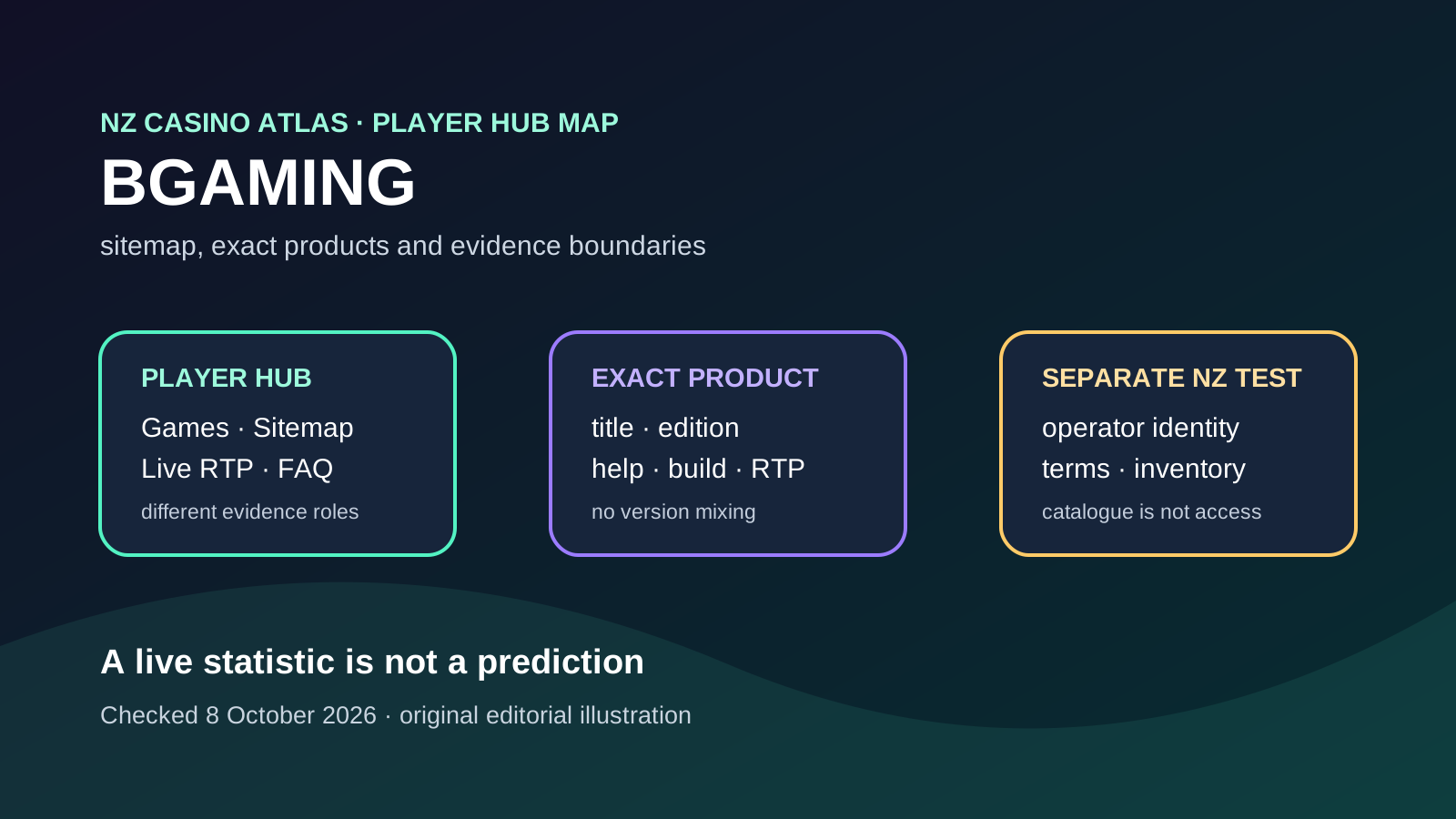
The checked sitemap exposed a large exact-title index, while the Player Hub navigation separated Games, Live RTP, Top Wins and FAQ. Those tools have different evidential roles and should not be collapsed into one promise. Catalogue cards can change after release, and “new”, “upcoming”, seasonal and sequel labels are time-sensitive. We therefore record a check date, reproduce only what the supplier actually exposes and avoid turning a changing list into a permanent ranking.
The Player Hub footer identifies Stable Games Ltd at 206 Wisely House, Old Bakery Street, Valletta VLT 1451, Malta and cites Malta Gaming Authority B2B licence MGA/B2B/785/2020, issued 18 March 2021. This identity matters because aggregators, distributors and casino lobbies can display games from many studios. A title should be attributed to BGaming only when a first-party product record or exact game help supports that attribution.
The practical result is a two-stage check. First, use the supplier catalogue to identify the exact product. Second, open the deployed game help at the intended operator to verify rules, RTP, stake range, version and limits. Neither stage can safely replace the other.
- Owner
- BGaming
- Primary record
- Official catalogue
- NZ availability
- Not established
- Checked
- 8 October 2026
Studio identity
What the catalogue can establish about BGaming
A supplier’s own site is the strongest public starting point for studio attribution. It connects the trading name, catalogue navigation and product pages under one controlled domain. That connection is more useful than an affiliate list that may mix studios, reskins or distribution partners.
The Player Hub footer identifies Stable Games Ltd at 206 Wisely House, Old Bakery Street, Valletta VLT 1451, Malta and cites Malta Gaming Authority B2B licence MGA/B2B/785/2020, issued 18 March 2021. The statement is intentionally narrower than “licensed for New Zealand”. Corporate and supplier credentials identify the business behind the catalogue; they do not approve every operator using the games, and they do not show that a New Zealand resident may open an account.
Brand identity can also drift across old pages. A renamed studio, acquired company, commercial platform or white-label distributor may appear beside the developer name. When an individual review is written, the exact help screen and copyright line should be preserved so the credited developer is not inferred from lobby placement alone.
That Malta B2B record supports supplier identity within its scope. It does not make every casino using BGaming an MGA or New Zealand licensee, and it does not establish NZ access. A B2B authorisation concerns the supply of games in the regulator’s scope. The casino taking a player’s money needs its own contracting entity, terms, permissions and country controls. This hub keeps those claims separate.
Finding exact products
How to navigate the BGaming catalogue
Begin with the official catalogue rather than a search engine result. Search snippets can preserve an obsolete title, omit punctuation or open a campaign page without help. Within the supplier site, use the available filters, search field, status labels or sitemap to locate the exact entry.
- Use the sitemap to copy the exact visible title and open its dedicated Player Hub route.
- Treat Games as discovery, Live RTP as a separately scoped display and FAQ as explanatory material rather than a single universal configuration record.
- Watch for duplicated themes, numbered sequels, Hold & Win qualifiers and seasonal editions in the long index.
- Open the actual deployed help to confirm evaluation, stake, RTP and build; do not infer them from a Top Wins entry.
Do not assume the order is a quality ranking. Catalogue order can reflect release date, promotion, localisation or a site redesign. It does not prove popularity, payout quality or New Zealand demand. This guide therefore uses the catalogue for identification and navigation, not a “best games” table.
Where the catalogue exposes a dedicated product URL, save it with the check date. Where it exposes only a list or sitemap, preserve the exact link target and visible label. A stable evidence note should allow another editor to repeat the path without guessing the title from artwork.
An entry’s mere presence establishes neither release everywhere nor continued support at every operator. Suppliers can publish globally while operators enable selected titles or versions by jurisdiction, device and commercial agreement.
Named examples
Examples that show why exact naming matters
The following names were used as catalogue examples, not recommendations. They help demonstrate how an editor should preserve spelling, numbers and qualifiers before opening game help.
- Dragon’s Gold 100 — the number is identity-bearing and must remain attached to the exact product record.
- Wincent Wolf — a distinct title that should be matched through its official route rather than a similarly themed lobby card.
- Beer Bonanza — an exact catalogue label, not evidence of one universal RTP or NZ deployment.
- 3 Lucky Monkeys Hold & Win — the Hold & Win qualifier helps distinguish its mechanic family and exact version.
- Maneki 88 Fortunes — numbers and spacing should be retained when matching help and operator records.
A list like this is deliberately short. Reproducing every catalogue card would become stale quickly and would duplicate the supplier. The maintained value of this hub is the method, the date and links to complete reviews owned by NZ Casino Atlas.
Readers should not transfer a rule from one example to another. Similar art, a shared mechanic word or a numerical sequel can hide different evaluation models, feature prices, maximums and RTP profiles. Every exact title keeps its own evidence record.
Release labels
Released, new and upcoming are different states
An upcoming card can confirm that the studio has announced a product, but it cannot confirm that a playable build is live. A future date can move, regional launches can differ and a product page can appear before final help is public. Reviews must label the state observed on the check date.
A “new” label is also relative to the catalogue interface. It is not a technical version number and does not establish that every operator has integrated the game. Once the label disappears, the product remains the same title unless first-party evidence says otherwise.
For released games, a public demo or product page still may not expose the exact configuration. The strongest review records a catalogue state and separately records the live help from the intended client. If only one is available, the missing layer should be stated as a limitation.
Do not publish a future game as reviewed merely because artwork and marketing copy exist. A complete review needs operational rules or a clearly labelled preview whose unknown fields remain unknown.
Identity-bearing text
Keep sequels, editions, punctuation and suffixes
Exact titles are data. A number, colon, apostrophe, “Hold & Win”, seasonal label or jackpot suffix can identify a different product. Removing it for a cleaner heading may join evidence from incompatible games.
- Do not merge a Hold & Win edition into a base title simply because the theme is shared.
- Numbered titles such as 3, 88 or 100 can be part of the official entity name, not descriptive copy.
- A Player Hub Live RTP display must not be rewritten as a guaranteed return or next-spin signal.
- Duplicate-looking sitemap entries may be editions or routes requiring a product-by-product check rather than automatic deduplication.
When two official pages look related, compare their canonical URLs, visible names, release labels and help identifiers. Treat them as separate until the supplier explicitly documents a shared configuration. A franchise relationship is not a rules relationship.
Normalise only the website slug, not the displayed game name. The canonical URL can use ASCII hyphens while the page heading preserves the official punctuation. This keeps navigation predictable without rewriting the underlying entity.
If a supplier corrects a typo or changes a stylisation, record the old and new labels with dates. Redirects can then preserve search navigation while the review explains which official record is current.
Primary rules evidence
Move from the catalogue card to game help
A catalogue card normally summarises theme and headline mechanics. It may omit evaluation order, symbol exceptions, retrigger limits, maximum exposure conditions, feature prices and the active mathematical profile. Those fields belong to the exact game help or paytable.
Open the help from the same client you intend to assess. Record provider, complete title, game ID or build where available, currency, total stake, RTP and date. Screenshots should retain enough surrounding context to prove which title and setting produced the number.
Read rules in sequence. First identify the grid or reel layout and win evaluation. Then record Wild, Scatter or bonus roles. Next map cascades, respins, meters, multipliers and feature endings. Finally capture caps, stake restrictions and any separate purchased-feature profile.
If public help is unavailable, say so. A product description can support named mechanics, but it cannot silently fill an undisclosed paytable or probability. Precision without a source is not an upgrade.
Configuration, not prediction
RTP and house-edge checks belong to the exact build
Return to player is a long-run theoretical setting. It does not promise that a player will recover the stated percentage from a session, deposit or fixed number of spins. House edge is the arithmetic complement, 100% minus RTP, and is equally non-predictive.
The same game art can be supplied with multiple RTP profiles. Reporting only the highest value found online can misdescribe the operator deployment. The active help screen is the relevant evidence, while the supplier page can document supported or default values when it says so explicitly.
Do not infer RTP from hit frequency, volatility or a feature price. Those fields describe different parts of the model. A feature buy can also have a separate profile, and jackpot contributions can affect what the displayed percentage covers.
For a deeper explanation, use the site’s theoretical RTP and house-edge guide. This provider hub avoids duplicating that general mathematics and focuses on where the exact BGaming setting should be found.
Feature-family discipline
Mechanic names are navigation aids, not complete rules
Studios often reuse mechanic labels across a family. That can help a reader find related titles, but the shared label does not guarantee identical triggers, prices or persistence. The exact help remains controlling for each product.
Describe what the mechanic does before judging it. State which symbols or positions it affects, when it activates, what persists, how the round ends and where a cap applies. Avoid promotional adjectives that imply frequency or value without a documented probability.
Feature buys, ante bets and enhanced modes need separate treatment. Record the price as a multiple of the base stake, any change to RTP, the starting state and regional availability. A visible button in a demo does not prove that the option is lawful or enabled at an NZ-facing operator.
Progressive jackpots require pool and trigger evidence. A “max win” is not automatically a jackpot, and a jackpot label does not promise a win by a deadline. Our progressive versus fixed jackpot guide owns that general distinction.
Reference mode only
What a demo can and cannot prove
A supplier demo can expose interface, help, symbols and a reference configuration without risking funds. It is useful for documentation when access is permitted. It does not prove real-money availability, an operator contract, New Zealand eligibility or identical currency and stake settings.
Compare demo and real-money clients field by field: exact title, provider, build, currency, stake range, RTP, feature controls and paytable. If a value cannot be compared, label it unresolved rather than assuming parity.
Do not use simulated outcomes to estimate a personal win rate. A short run is not a reliable test of long-run RTP, and a memorable bonus does not establish feature frequency. The demo is an interface and rules record, not a forecasting tool.
Our demo versus real-money settings guide explains this comparison in detail. This page applies the same evidence discipline to the BGaming catalogue.
Interface verification
Mobile checks must preserve the same evidence
Responsive design may move the help button, collapse the paytable or hide long text behind tabs. Verify that essential rules, RTP and total stake remain readable on the actual device. A screenshot of reels alone is not enough.
Check portrait and landscape behaviour, touch targets, scrolling, audio controls and whether reconnecting restores a completed result correctly. These are usability observations, not claims about better odds.
Browser compatibility can change independently of the game model. Record device, operating system, browser and date if a problem matters to a review. Do not generalise one failed load to every mobile user or every BGaming title.
Never install an app or file from a third-party download simply to reach a game. Confirm the operator’s official domain and application provenance first.
Country evidence
Studio publication does not establish New Zealand access
The public catalogue is global supplier material. It cannot show that a particular operator accepts New Zealand residents, that its casino product is enabled here or that the exact title is in its authenticated lobby.
Country access requires a separate chain: the operator’s legal entity, current terms, prohibited-territory wording, registration acceptance, product restrictions, cashier and the current New Zealand framework. An NZ flag, localised page or NZD selector alone is not enough.
That Malta B2B record supports supplier identity within its scope. It does not make every casino using BGaming an MGA or New Zealand licensee, and it does not establish NZ access. Supplier credentials should never be rewritten as a consumer-facing New Zealand casino licence. The operator and game deployment need their own evidence.
Use the site’s dated New Zealand legal-status guide for national context. This hub does not offer legal advice and does not say that any BGaming game is available at a named casino.
Editorial ownership
How this hub links to complete game reviews
This is the single BGaming catalogue owner on NZ Casino Atlas. Each assigned title should have one complete canonical review that combines rules, features, RTP evidence, demo and mobile checks, limitations and sources.
Separate pages for “RTP”, “bonus”, “demo” and “rules” of the same title would fragment evidence and risk contradictions. The complete review owns those subtopics. The provider hub summarises the navigation method and links only to pages that have actually been published.
- Beer Bonanza — documents pay-anywhere refills, Scatter awards and summed Bonus multipliers.
- Maneki 88 Fortunes — separates Golden-symbol stake multipliers, Coin Wild progress and jackpot base-bet units.
- Izzi Art — covers the 6×5 refill loop and persistent free-spin multipliers.
- Always Up! — preserves the official 559× versus 599× maximum conflict for active-help verification.
- Robospin — documents a configurable six-trait casual game without slot terminology.
- Aztec’s Claw Wild Dice — covers multiplier Wilds, Scatter awards and the Claw/D20 threshold sequence.
- Yommi Rush — documents seven-symbol clusters, moving Scatter-Wilds and two 12-spin modes.
- Fortuna TRUEWAYS — covers variable cells, Coin Respins, split cells and Dynamic Prize tiers.
- Mice & Magic Wonder Spin — documents ten-spin Wild Frames cycles and non-retriggering sticky-Wild free spins.
- Fortune Spin — separates four wheel modes, disappearing zero sectors and the theoretical RTP from Live RTP.
- Forty Fruity Million — documents stacks, expanding multiplier Wilds and two distinct Scatter rules.
- Lucky Lager x9990 — covers Bonus-symbol tiers, the 5×–999× pop-up and the separate overall ceiling.
- Dragon’s Gold 100 — documents 100 paylines, expanding Dragon Wilds and optional Gamble exposure.
- All Lucky Clovers — covers selectable 5/20/40/100 lines, two Scatters and expanding Wilds.
For a comparison of catalogue structures, readers can use the Thunderkick guide or AvatarUX guide. Those pages own their studios; none is a general provider ranking.
Quality controls
Common catalogue-review errors
- Calling an announced or upcoming title fully released.
- Dropping an edition, sequel number or identity-bearing suffix.
- Attributing an aggregated game to the platform displaying it.
- Copying a default or highest RTP into every operator review.
- Treating demo access as real-money NZ availability.
- Presenting supplier credentials as the casino’s consumer licence.
- Converting a maximum win into an expected or likely result.
- Publishing a complete paytable without opening exact help.
The repair for each error is the same: narrow the claim to what the first-party record proves, add the check date and keep unresolved fields visible. An honest limitation is more useful than a confident composite assembled from several versions.
Practical workflow
BGaming catalogue checklist
- Open the official catalogue and save the check date.
- Copy the exact title, punctuation, number and edition.
- Record whether the entry is released, new or upcoming.
- Open the dedicated product record where available.
- Match the deployed client to the same provider and title.
- Capture game ID or build, currency and total stake.
- Read evaluation, symbols, features and ending rules.
- Record the active RTP and any separate feature profile.
- Keep maximum game win separate from withdrawal limits.
- Verify operator identity and NZ eligibility independently.
- Link one complete canonical review, not thin subtopic pages.
- Recheck changing claims before publication or play.
This workflow is deliberately reproducible. Another editor should be able to follow the same links and understand which facts came from the catalogue, which came from game help and which remain unknown.
Reader decision
What to know before choosing a title
A catalogue is good for discovery. It is not sufficient for a money decision. Before considering play, understand the exact win evaluation, active RTP, volatility description, stake range, feature pricing and cap. Then assess the operator separately.
Prefer evidence that can be repeated: official URL, visible title, dated help and account terms. Treat screenshots without context, unsourced comparison tables and “best” labels as leads to verify, not final proof.
Set an affordable loss and time limit before a session. Higher speed, autoplay and purchased features can increase exposure per minute even when they do not change base odds. Stop controls are safeguards, not strategies for recovering losses.
The useful conclusion of this guide is modest: BGaming maintains the official catalogue used here for exact-title discovery. Everything about an operator account, New Zealand access and deployed settings needs its own current evidence.
Questions answered
Frequently asked questions
Where is BGaming’s official title index?
The BGaming Player Hub publishes a sitemap at hub.bgaming.com/sitemap/ with exact game labels and routes.
Does the BGaming Live RTP area predict the next result?
No. Any displayed historical or aggregate statistic is not a prediction, and the exact game’s long-run setting must still be read from its help.
Does a BGaming title in the Hub prove NZ casino access?
No. The Hub is supplier-side evidence and does not establish operator eligibility, country terms or inventory.
Why do punctuation and edition labels matter?
They can separate mathematical products, sequels and seasonal or Hold & Win versions. The exact title and game ID should be preserved.
Are BGaming’s Malta supplier credentials an operator licence?
No. A B2B supplier authorisation does not prove that a casino is licensed or available in New Zealand.
Evidence record
Primary sources
Facts and configurations were checked against the following first-party records. A public product page is not proof that a game is available through a New Zealand operator.
- BGaming Player Hub — official sitemapChecked 8 October 2026
- BGaming Player Hub — games and evidence navigationChecked 8 October 2026
- New Zealand DIA — online gambling for playersChecked 8 October 2026