Short answer
Evidence-led verdict
Tome of the Lost is Play'n GO Game ID 1015, version 1.0, released on 22 November 2025. It uses a five-by-five grid, cluster wins and cascades. Four or more matching regular symbols joined horizontally or vertically create a win; winners are removed and replaced until no new cluster forms.
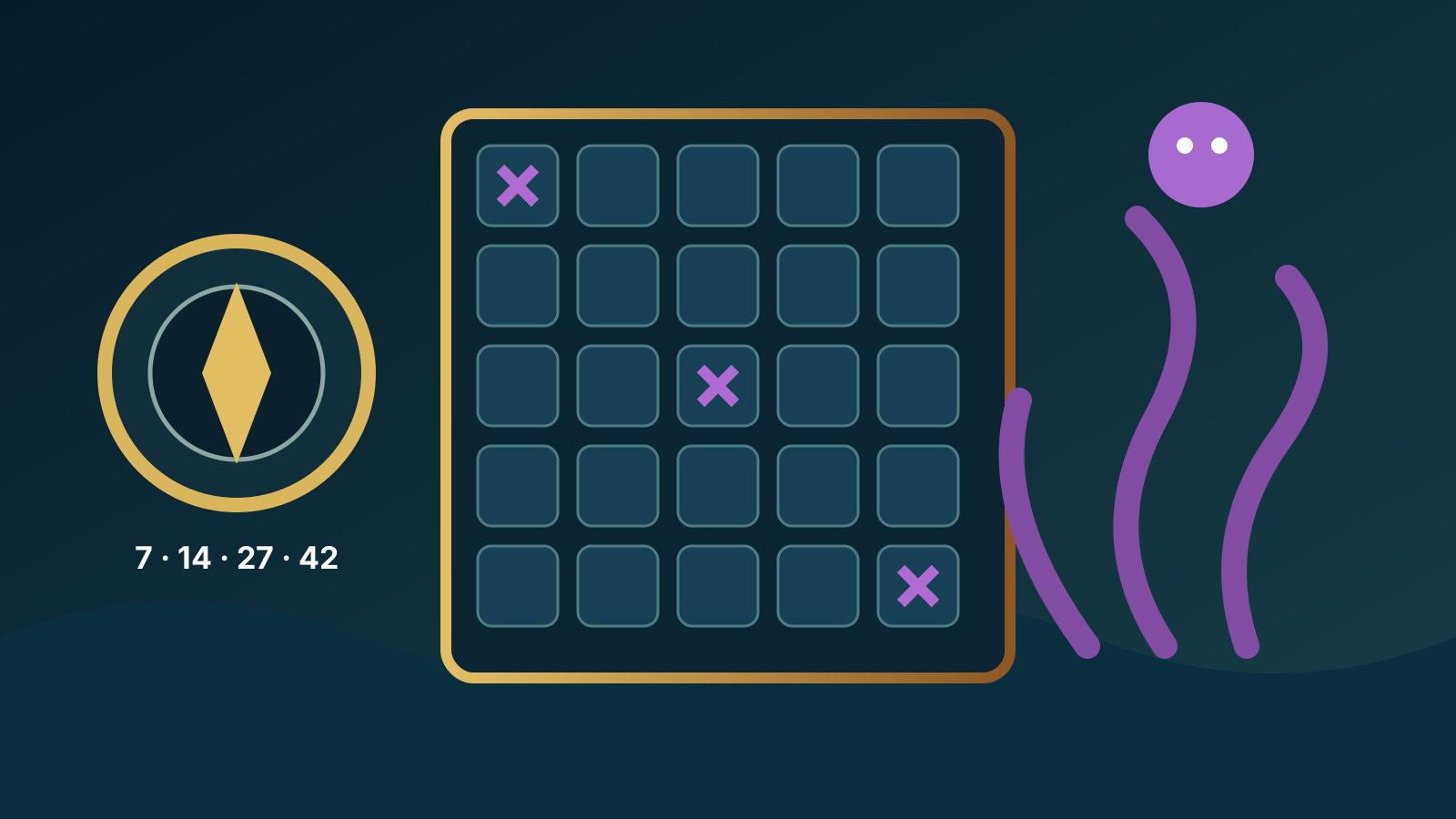
Winning symbols also charge a Compass. At seven, fourteen and twenty-seven charges, Special Wilds are added, with later stages able to trigger Darkness or Emptiness. At forty-two charges, Treasure Cave begins: one free round with three random Cave effects. Overcharge can raise that effect count to seven.
Kraken Marks supply a parallel layer. A winning symbol on a marked position awakens it, then two Special Wilds are added after the cascade sequence. In Treasure Cave there are eleven or twelve marks; awakening all of them adds a two-by-two Mega Wild Kraken that moves down as cascades continue.
The checked rules list five RTP settings from 96.59% to 84.5%, volatility level 5, maximum exposure of 200,000 at the reference maximum stake and a maximum-event probability below one in one billion. The public product page gives the clearer stake-relative cap: 2,000x total bet.
- Game ID
- 1015 · v1.0
- Release
- 22 Nov 2025
- Volatility
- 5
- Win cap
- 2,000x bet
Exact product
Release, version and title identity
The official record names the title Tome of the Lost, uses internal identifier “tomeofthelost” and lists both mobile and desktop formats. Game ID 1015 distinguishes it from Rich Wilde titles that also use the word “Tome,” and from generic pirate or Kraken slots.
The public release date is 22 November 2025. Several third-party pages in the current results show other dates, rounded RTP values or a supposed 7,500x maximum. The official product and rules documents instead support the exact configuration table and 2,000x cap used here.
A common search-result simplification calls the feature ordinary free spins triggered by Scatters. That is not the checked rule structure. The Compass reaches forty-two winning symbols and awards one Treasure Cave Free Round with staged effects. Exact terminology matters because it changes what a reader expects.
We checked the official sources on 6 October 2026. That date records the evidence state, not New Zealand operator availability. A global product page and public demo cannot prove a local real-money route.
Base engine
Five-by-five clusters and cascading symbols
The grid contains five columns and five rows. A winning cluster needs at least four matching regular symbols connected across horizontal or vertical edges. Symbols touching only at a corner do not join. The paytable sets awards by symbol and cluster size.
Winning symbols disappear, then new symbols fall into the vacated positions. The refreshed grid is evaluated again. Cascades continue without a new stake while a further winning group appears; the paid round finishes when no more cluster is present and all pending effects have resolved.
The mathematical table records “fixed 1” rather than a conventional payline count because cluster evaluation covers the grid. It also lists ten coins and reference stakes from 0.10 to 100. These are rule-sheet units, not guaranteed NZD denominations.
Every winning symbol contributes to the Compass. A symbol on a Kraken Mark can also awaken that position. One cascade chain can therefore produce money awards, Compass progress and mark progress, but those counters are not cash balances.
The game has no documented gamble mode. A third-party description of card or ladder gambling should not be imported. Always use the current in-game paytable for symbol-specific values.
Marked positions
Kraken Marks and Special Wild awards
Kraken Marks appear randomly on grid positions. When a winning symbol covers a marked position, the mark is awakened. After the cascade sequence stops, the game adds two Special Wilds. The “after” timing matters because the initial winning chain resolves before the new Wilds alter the grid.
A mark is a position condition, not a multiplier attached permanently to the symbol. A non-winning symbol resting on the mark does not awaken it under the checked rule. A win elsewhere also does not activate an untouched position.
The two added Special Wilds can substitute within clusters and can interact with Compass-stage effects. They are not themselves guaranteed to form a win. Their placement is random within the applicable rule, so two mark events can produce very different results.
In Treasure Cave, marks have an additional completion purpose connected to the Mega Wild Kraken. The base-game two-Wild award and the free-round all-marks condition should not be collapsed into one generic “Kraken bonus.”
Four thresholds
Compass charges at 7, 14, 27 and 42
Winning symbols charge the Compass. At seven charges, two Special Wilds are added. This stage introduces extra substitution positions but no named removal effect in the official rules.
At fourteen charges, two Special Wilds are added. If a win includes an applicable Special Wild, Darkness can trigger. At twenty-seven charges, another two Special Wilds are added and a qualifying Special Wild win can trigger Emptiness.
The rules contain an important priority condition: if a later charge effect is earned before an earlier effect has played, only the later charge effect is awarded. The game does not necessarily stack every crossed threshold into a queue. Articles that promise the seven-, fourteen- and twenty-seven-charge effects together on every rapid cascade overstate the rules.
At forty-two charges, Treasure Cave is awarded. It is one free round with three random Cave effects before any overcharge. The Compass describes the entry condition; it does not guarantee a particular effect order or return.
Progress can move quickly during large clusters and repeated cascades, but a nearly full Compass does not alter the random probability of the next grid. Increasing the stake changes monetary exposure, not how many winning symbols are required at each threshold.
Removal modifiers
Darkness and Emptiness explained
Darkness is tied to a win involving a Special Wild at the fourteen-charge stage or within an applicable Cave effect. It removes a row or column associated with the winning Special Wild. Symbols removed by Darkness can further charge the Compass.
If Darkness removes another Special Wild, the effect can continue. This chaining rule is positional; it does not mean every row and column is automatically cleared. The live animation should follow the chosen Wild and direction described in help.
Emptiness, connected to the twenty-seven-charge stage, selects one regular symbol and removes every matching instance from the grid. Removing symbols creates spaces for new ones and can support another cascade. It does not directly pay all removed symbols as a winning cluster unless the rules separately award them.
Both effects modify the current grid after a qualifying sequence. They do not permanently change symbol frequencies, and they cannot be selected by timing a spin. Their value depends on positions, remaining symbols and any resulting cascades.
Single free round
Treasure Cave effects and overcharge
At forty-two Compass charges, Treasure Cave begins with three random Cave effects. The official rules describe a single free round rather than a conventional bank of free spins. A cascade sequence can make that one round last through several grid evaluations.
Every three additional winning symbols beyond the trigger adds one effect. The total is capped at seven Cave effects. Once cascades stop, a random stored effect is applied; the grid is evaluated again, and the process repeats until all effects have been used and no further win remains.
The Cave effect set includes adding four Special Wilds, a Darkness version that adds four Special Wilds and can trigger the removal effect, and an Emptiness version that adds four Special Wilds and can trigger its matching-symbol removal. The sequence can therefore create several chances to reopen cascades.
Four Special Wilds are an effect input, not a stated award amount. They can land in unhelpful positions. Seven effects are an upper limit on stored Cave effects, not a guarantee of seven wins or a way around the 2,000x overall cap.
Calling the feature “free spins” in the plural can cause rules from another game to be imported. Confirm the live help says Treasure Cave Free Round, Compass 42 and three-symbol overcharge.
Free-round completion
How the Mega Wild Kraken enters
The Treasure Cave grid contains eleven or twelve Kraken Marks under the official rules. If all are awakened during the round, the game adds the Mega Wild Kraken. The creature occupies a two-by-two block and functions as a large Wild.
The Mega Wild moves downward with each cascade. It eventually leaves the grid and disappears. Its motion is therefore tied to continuing wins; it is not a permanently locked Wild for a fixed number of spins.
Awakening all marks is a condition, not a guarantee. Cave effects and Special Wilds can help create the necessary winning coverage, but random positions determine whether the full set is completed. The presence of twelve rather than eleven marks can depend on the generated round layout described by the help.
If a review says the Kraken is triggered by Scatters or awards a fixed block of free spins, it is not following the Game ID 1015 rules. Match the full product before comparing feature potential.
Configuration menu
Five verified RTP settings
The GRS lists five alternative return configurations. Only the live game's information screen establishes the setting deployed by an operator.
| Configuration | RTP | Theoretical house edge |
|---|---|---|
| 1 | 96.59% | 3.41% |
| 2 | 94.52% | 5.48% |
| 3 | 91.59% | 8.41% |
| 4 | 87.52% | 12.48% |
| 5 | 84.5% | 15.5% |
Several competitor pages round the return to 96%. That loses the configuration menu and can conceal a much lower build. Another page reviewed during research estimated a 7,500x maximum while admitting the provider had not supplied it; the official current page supplies 2,000x.
The house edge is 100 minus RTP. Both are theoretical long-run measures and cannot predict a session. A cluster-heavy demo can finish ahead at a low setting or lose at the highest without contradicting the mathematics.
Stake changes, Compass position and Mega Wild progress do not switch the certified setting. Record the value in the live client and do not infer it from animation or short-term returns.
Different units
Volatility, win cap and maximum exposure
The official mathematical document rates volatility at level 5. Review sites sometimes call it high, but we retain the provider's scale because category boundaries differ and the numeric source is verifiable.
The official product page lists a 2,000x total-bet maximum win. At a hypothetical $1 stake, that upper boundary is $2,000 before operator conditions. It is an example, not a claim of NZD access or a suggested stake.
The rules sheet lists maximum exposure of 200,000 at the reference maximum bet and a maximum-event probability below one in one billion. Exposure is a currency-denominated mathematical field, not a 200,000x maximum. The public stake-relative cap is 2,000x.
A lower cap than some related games does not mean lower session risk. Volatility, RTP configuration, stake and number of paid rounds all matter. The cap only limits the largest possible award.
Reference limits
Bet range and practical exposure
The GRS records a 0.10 minimum and 100 maximum with ten coins. Those figures describe its reference setup and are not guaranteed New Zealand-dollar limits. Operator denomination and market controls can differ.
Apply the 2,000x cap to total bet, not to one coin unit. Confirm the total after changing any quick-bet control. A cluster cascade continues from the initial paid round without a fresh stake, but the next spin starts a new financial exposure.
Automatic and rapid play can compress many paid rounds into little time. A visible Compass can encourage continued play near forty-two charges, yet progress does not make an affordable budget larger. Decide stopping limits before the meter advances.
Do not raise stake to “make Treasure Cave worth it.” Feature multipliers scale with the stake, but so does the cost of every round used to reach or miss it.
Interface literacy
Mobile, help and demo boundaries
The official rules list mobile and desktop. On mobile, locate total bet, balance, configured RTP, Compass thresholds and the description of the priority rule when a later charge effect arrives before an earlier one.
Play'n GO's public game experience is entertainment-only and does not award real money. A demo can teach cluster connections, mark animations and Cave sequencing; its credits have no monetary value and its short results cannot measure RTP.
The demo also does not prove real-money availability in New Zealand or show which configuration an operator uses. Public provider access, operator catalogue access and legal availability are separate checks.
If mobile and desktop help differ, record Game ID, version and configured return. Use the deployed information rather than filling gaps from a third-party table.
Operator-level proof
New Zealand access is not assumed
This review confirms Play'n GO publication, not availability from a current New Zealand operator. A global catalogue cannot prove territorial rights, operator status, payment access or the deployed RTP.
The DIA player page was checked on 6 October 2026. New Zealand's online-gambling framework is time-sensitive, including the transition around 1 December 2026 and a later licensing process. Consult that primary source and our dated legal-status guide; this article is not legal advice.
Check operator identity, age and location restrictions, payments, withdrawal rules, complaints, limits and self-exclusion tools. Then verify the game separately. An NZD option, local flag or demo does not prove authorisation.
Accurate rules do not endorse an operator, and an operator's status does not guarantee the top RTP. Both evidence chains should be current.
Two-minute audit
What to verify in the live help
- Match Tome of the Lost, Play'n GO and Game ID 1015.
- Confirm a 5x5 grid and clusters of four connected horizontally or vertically.
- Check Kraken Marks and the two-Special-Wild award.
- Verify Compass thresholds at 7, 14, 27 and 42.
- Read the later-effect priority rule.
- Confirm Darkness removes a row or column and Emptiness removes one symbol type.
- Check Treasure Cave starts with three effects and caps at seven.
- Record the live RTP from the five official options.
- Keep 2,000x separate from 200,000 exposure.
- Verify operator and New Zealand status independently.
If the deployed help differs, use it for that exact build and submit the version, date and evidence through our corrections process. Do not merge rules from a similarly named Tome title.
Exact-title navigation
How Tome of the Lost differs from related games
Rich Wilde and the Tome of Dead also uses a 5x5 cascading cluster grid, but it has Ritual thresholds at 8, 16, 30 and 48, All-Seeing Eyes, Ammit and a 5,000x cap.
Rich Wilde and the Book of Dead is a five-reel payline title with ten free spins and an expanding symbol. Its “Book” identity is not a source for Tome of the Lost's pirate-grid rules.
The Play'n GO catalogue guide keeps those products under exact URLs. Compare their active RTP, grid or line model, progression thresholds, volatility scale and maximum-win units rather than assuming shared title words mean shared mechanics.
Tome of the Lost's 2,000x ceiling is smaller than Tome of Dead's 5,000x, but that alone does not rank the games. A cap says nothing about typical awards or personal preference. Use the game only as paid entertainment, with a budget that does not depend on awakening every Kraken Mark.
Questions answered
Frequently asked questions
What is the Tome of the Lost RTP?
The official Game ID 1015 rules list 96.59%, 94.52%, 91.59%, 87.52% and 84.5%. They are alternative configurations; check the exact live client.
How are cluster wins formed?
At least four matching regular symbols must connect horizontally or vertically on the 5x5 grid. Winning symbols disappear and new ones cascade until no further winning cluster forms.
What do the Compass thresholds award?
At 7 charges the game adds two Special Wilds; at 14 it adds two and can trigger Darkness; at 27 it adds two and can trigger Emptiness; at 42 it awards one Treasure Cave Free Round with three Cave effects before overcharge.
How does Treasure Cave overcharge work?
Every three additional winning symbols beyond the 42-charge trigger adds one Cave effect, up to seven effects in total. Effects resolve after cascades stop until all awarded effects have played.
What is the maximum win?
The official product page lists 2,000 times total bet. The rules sheet separately lists maximum exposure of 200,000 at the maximum reference stake; it is not a 200,000x cap.
Evidence record
Primary sources
Facts and configurations were checked against the following first-party records. A public product page is not proof that a game is available through a New Zealand operator.
- Play'n GO — Tome of the Lost product pageChecked 6 October 2026
- Play'n GO — official game rules sheet (Game ID 1015, version 1.0)Checked 6 October 2026
- Play'n GO — games catalogueChecked 6 October 2026
- New Zealand Department of Internal Affairs — online gambling for playersChecked 6 October 2026