Short answer
Evidence-led verdict
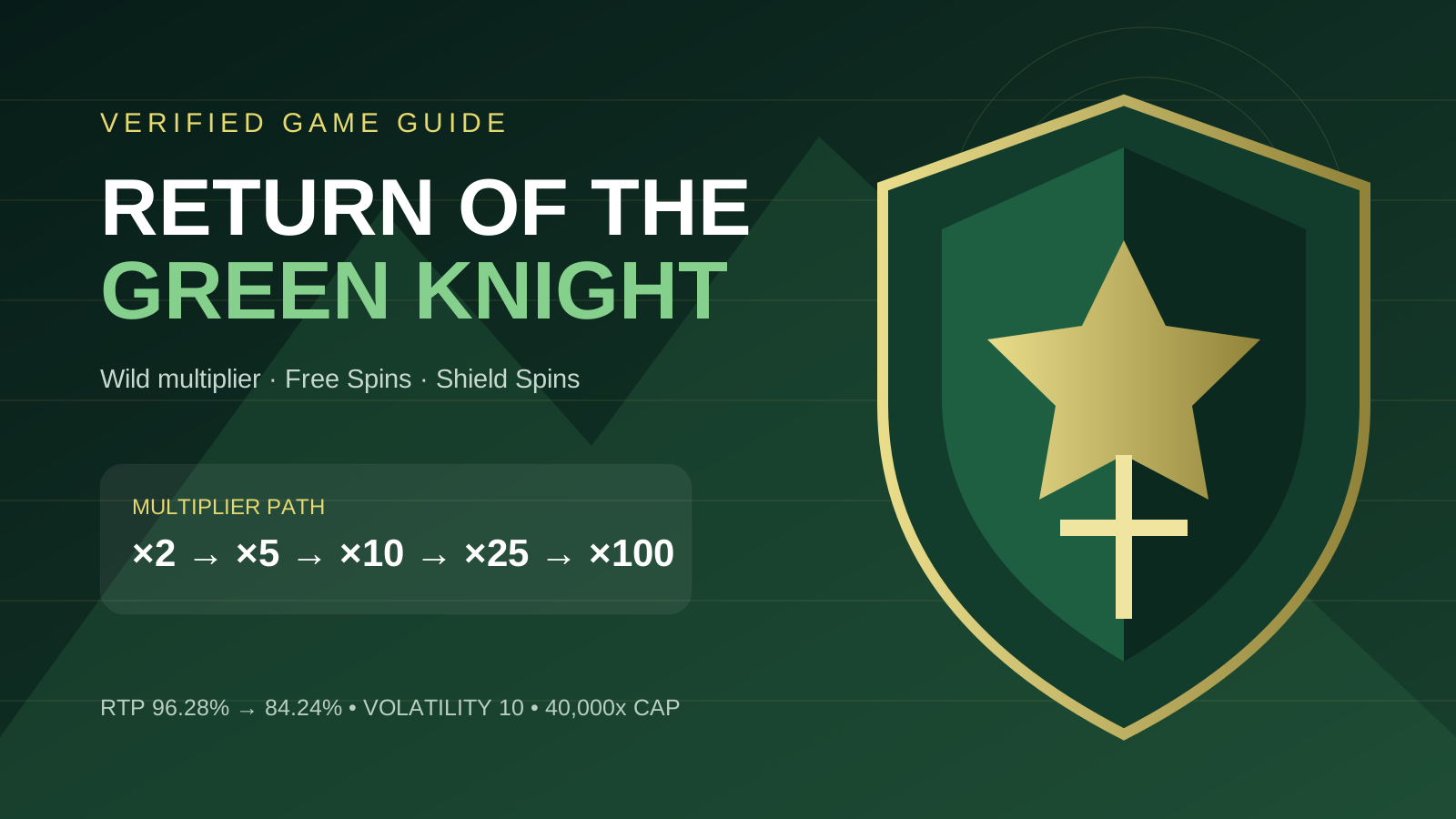
Return of The Green Knight is Play’n GO Game ID 680, version 1.0. It launched on 5 October 2023 and uses five reels, three rows and twenty fixed paylines. Regular wins run left to right across adjacent reels; the distinguishing mechanic is one multiplier value shared by all Wilds on a spin.
The Wild multiplier can be 2x, 5x, 10x, 25x or 100x. A Wild-assisted line receives the displayed value once, even if several Wilds contribute. Three or more Scatters award five Free Spins, during which the multiplier follows those five stages.
Two or more Scatters inside Free Spins trigger five Shield Spins. The multiplier current at entry is locked, and Wilds are held as Shield Spins progress. The ordinary Free Spins pause and resume after that feature ends.
The official sheet lists five RTP configurations from 96.28% to 84.24%, volatility level 10 and a maximum-event probability of one in five hundred million. The product record gives the more useful stake-relative maximum: 40,000x total bet. This is a very-high-volatility design, not a promise that large multipliers appear regularly.
- Game ID
- 680 · v1.0
- Release
- 5 Oct 2023
- Volatility
- 10 · very high
- Win cap
- 40,000x bet
Exact product
Release, version and title identity
The official title capitalises “The,” while URLs and third-party listings vary. Provider, Game ID 680 and internal identifier “returnofthegreenknight” are stronger identity checks than headline style. They distinguish the 2023 release from other Arthurian and Green Knight games.
The public product page records 5 October 2023. The rules sheet labels the supplied build version 1.0 and covers mobile and desktop. Search results that show a review’s updated date do not change the game release date.
Competitor tables conflict on both RTP and volatility: some use 96.27%, and labels range from low to high. The first-party sheet supports 96.28% for the top configuration and volatility level 10, classified as very high. Those exact values are used here.
Sources were checked on 6 October 2026. Their existence confirms a provider product record, not New Zealand operator access. This page keeps product identity, operator availability and regulatory context as separate claims.
Base engine
Five reels, three rows and twenty fixed lines
The standard screen uses five reels and three rows with twenty fixed paylines. Matching regular symbols start on reel one and continue left to right on adjacent reels. Line shape matters, so matching symbols elsewhere on the grid do not automatically pay.
The Wild substitutes for ordinary paytable symbols but not for Scatter. Scatter can pay independently of paylines: the official table records 2.5x total bet for three, 5x for four and 100x for five, alongside feature entry.
The highest ordinary symbols pay up to 25x total bet for five of a kind. A five-Wild line is shown at 100x before its current Wild multiplier is applied. These paytable figures remain subject to the 40,000x maximum for the resolved game round.
The model records ten coins and reference stakes from 0.10 to 100. These are supplied game units, not guaranteed New Zealand-dollar denominations. A live interface may expose a single total-bet control rather than per-line selection because the lines are fixed.
No gamble feature is documented. A generic after-win card game from another Play’n GO title should not be assumed. Every paid base spin is evaluated by the line, Scatter and shared-multiplier rules shown in this product’s help.
One shared value
How the Wild multiplier is applied
Every spin displays or selects one Wild multiplier from 2x, 5x, 10x, 25x and 100x. All Wilds on that spin use the same value. A line win that contains a Wild is multiplied by it.
If two or more Wilds contribute to the same line, the shared value is applied once. Two 5x Wilds do not become 10x or 25x. This non-cumulative rule is important because large Wild stacks can look as though several multipliers should combine.
A Wild-only five-of-a-kind award starts from its paytable value and then follows the same multiplier condition. The overall result can include several qualifying paylines, but each line is calculated under the help before the game-wide cap is enforced.
The multiplier is not a player-owned balance and does not make the next spin more likely to contain a Wild. In the base game it is a current-spin state. In Free Spins it follows a defined progression; in Shield Spins it is locked at entry.
Because 100x is visually prominent, reviews may describe the game primarily through its top multiplier. That value only affects a win containing a Wild. A spin showing 100x with no qualifying Wild line does not create an award.
Five-stage feature
Free Spins and the rising multiplier
Three or more Scatters in the base game award five Free Spins and the Scatter payout. The feature is deliberately short in count, with one multiplier stage associated with each of the five spins: 2x, 5x, 10x, 25x and 100x.
All Wilds appearing on a feature spin use that spin’s value. As in the base game, several Wilds on one line do not stack the multiplier. The later stages therefore raise potential without guaranteeing that a Wild or a payable combination will land.
Free Spins can be interrupted by Shield Spins when two or more Scatters appear. “Interrupted” is operational rather than negative: the remaining ordinary feature spins are paused, five Shield Spins run, and the ordinary sequence resumes afterwards.
The Scatter pays during the feature under the documented table. Its main extra role is to start Shield Spins. The rules do not describe an ordinary addition of more Free Spins from three Scatters; the Shield sequence is the retrigger-like mechanism to follow.
The final 100x stage can create a large award only when positions form an eligible line involving Wild. A short feature with a steep multiplier progression is consistent with volatility level 10. It remains possible for all five spins to pay little or nothing.
Held-Wild subfeature
Five Shield Spins at a locked multiplier
Two or more Scatters during Free Spins award five Shield Spins. The game locks the multiplier from the triggering feature spin. A trigger on the 25x stage therefore uses 25x throughout Shield Spins; the ordinary progression does not advance until the main Free Spins resume.
Wilds landing in Shield Spins are held in place for the remaining Shield sequence. New held Wilds can increase the number of paylines they help complete. They still share the locked multiplier and do not multiply it by the number of held positions.
Scatters do not appear in Shield Spins, so the feature cannot retrigger itself internally. That boundary prevents an open-ended loop. After all five Shield Spins, held Wilds leave with the subfeature and the paused Free Spins continue.
The award from the triggering Scatters is evaluated before or alongside feature transition as defined by the client. Shield Spins are additional game events with no new wager, but they remain part of the original paid round for the purpose of the 40,000x cap.
A Shield trigger at 100x is visually the most powerful state, yet there is no timing method to produce it. Scatter positions and Wild arrivals are random. Changing stake alters currency exposure, not the five-stage order or trigger rules.
Configuration menu
Five verified RTP settings
The official Game ID 680 rules list five alternative builds. The active client can use any authorised setting, so a product-page overview is not enough to establish return.
| Configuration | RTP | Theoretical house edge |
|---|---|---|
| 1 | 96.28% | 3.72% |
| 2 | 94.27% | 5.73% |
| 3 | 91.28% | 8.72% |
| 4 | 87.25% | 12.75% |
| 5 | 84.24% | 15.76% |
RTP covers the long-run mix of base lines, Scatter pays, Free Spins and Shield Spins. It does not promise a particular share from the 100x Wild stage and cannot forecast one session.
House edge is 100 minus RTP. The difference between 96.28% and 84.24% is material over long play, even though either build can produce a short winning or losing session. Confirm the current figure before staking.
A common third-party value of 96.27% differs from the checked rules. We retain the exact first-party 96.28%. If a live build displays another certified percentage, document its version rather than silently rounding it into this table.
Rare-event design
Volatility 10, 40,000x cap and maximum exposure
The official record rates volatility at 10 and calls it very high. That is the top end of this provider scale. It signals a more uneven distribution of returns, not a timetable for large awards.
The product record lists a 40,000x total-bet maximum. At a hypothetical $1 stake, the boundary would be $40,000 before operator conditions. The example does not establish NZD support or access from New Zealand.
The rules sheet lists maximum exposure of 4,000,000 at the reference maximum stake of 100. That is a currency-model field, not a 4,000,000x cap. It also gives maximum-event probability as one in 500,000,000, underlining that the cap event is exceptionally rare.
A 100x Wild and a 40,000x cap should not be read as typical feature outcomes. Large displayed potential can encourage stake escalation, but higher stake simply scales both cost and any award. It does not improve the certified return.
Reference limits
Bet range and session exposure
The rules record a reference minimum bet of 0.10 and maximum of 100. An operator can present different denominations or currency limits. Do not describe this range as NZD without live operator evidence.
Lines are fixed, so the interface is expected to focus on total bet. Verify the amount debited rather than dividing it by twenty unless the client explicitly shows line stake. The cap is expressed against total bet.
Five Free Spins and five Shield Spins are supplied without a new stake after their trigger, but repeated base spins remain paid events. Rapid play can compress high-volatility exposure into minutes.
Choose time and loss limits before a multiplier progression begins. A near Shield trigger or the knowledge that 100x is the final stage does not make another paid spin more favourable.
Interface literacy
Mobile, help and demo boundaries
The official sheet lists mobile and desktop. On mobile, locate total bet, current RTP, multiplier state, feature counter and the explanation that multiple Wilds on one line do not stack the shared value.
Play’n GO’s public experience is entertainment-only and pays no real money. A demo can show the feature order and held Wilds. It cannot estimate the one-in-500-million event or prove which RTP an operator deploys.
Public demo access is not evidence of New Zealand real-money availability. Provider access, operator catalogue access and legal status must be checked separately.
If mobile and desktop help differ, match Game ID and version. Use the deployed client’s information for that exact build and report a dated discrepancy through our corrections process.
Operator-level proof
New Zealand availability is not assumed
This guide confirms Play’n GO publication and rules. It does not claim a current New Zealand-facing operator offers the game. A global catalogue cannot establish territorial rights, operator status or configuration.
The Department of Internal Affairs player page was checked on 6 October 2026. The position is time-sensitive, including transition around 1 December 2026 and a later licensing process. Consult the primary source and our dated legal-status guide; this is not legal advice.
Check operator identity, age and location restrictions, payments, withdrawals, complaints, limits and self-exclusion. NZD or a local flag does not prove authorisation. Then record the game’s active RTP separately.
A valid game record cannot validate an operator, and an operator’s status does not guarantee the highest RTP. Both evidence chains need current proof.
Two-minute audit
What to verify in the live help
- Match Return of The Green Knight, Play’n GO and Game ID 680.
- Confirm five reels, three rows and twenty fixed lines.
- Verify shared Wild multipliers of 2x, 5x, 10x, 25x and 100x.
- Check that multiple Wilds on one line do not stack the value.
- Confirm three Scatters award five Free Spins.
- Verify the multiplier progresses across the five feature spins.
- Check two Scatters in Free Spins trigger five Shield Spins.
- Confirm the current multiplier locks and Wilds hold.
- Record the active RTP from the five official settings.
- Keep 40,000x separate from 4,000,000 exposure.
- Verify operator and New Zealand status independently.
If a field differs, save the build identifier, source URL and date and use our corrections process. Never include account or identity data.
Exact-title navigation
How it differs from related games
Legacy of Dead uses ten selectable paylines, eight Free Spins and expanding symbols. It does not share Green Knight’s five-stage Wild multiplier and held-Wild Shield Spins.
Pilgrim of Dead focuses on sticky expanding symbols and a thirty-spin feature ceiling. Shared medieval or “of Dead” search associations are not evidence of common mechanics.
The Play’n GO catalogue guide navigates exact products. Compare active RTP, line model, volatility scale, trigger and cap rather than theme artwork.
Green Knight’s 40,000x cap is higher than many catalogue entries, but the one-in-500-million maximum-event field and volatility level 10 provide essential context. A cap does not rank typical return or make a game suitable for a budget.
The cleanest comparison starts with mechanics rather than maximums. Record whether lines are fixed, how a Wild multiplier combines, what pauses the feature and whether held symbols can retrigger their own mode. Green Knight’s answers are twenty fixed lines, one non-cumulative shared multiplier, two Scatters during Free Spins, and no Scatters inside Shield Spins. Those four checks prevent rules from a visually similar medieval game being transferred by mistake.
Release age also proves little about a current integration. A 2023 product can remain in a provider catalogue while an operator removes it, changes its authorised RTP build or never offers it in a given territory. Recheck the live game and operator each time availability matters.
Questions answered
Frequently asked questions
What is the Return of The Green Knight RTP?
The Game ID 680 rules list 96.28%, 94.27%, 91.28%, 87.25% and 84.24%. These are alternative builds, so the live information screen must identify the active one.
How does the Wild multiplier work?
All Wilds on a spin share a value of 2x, 5x, 10x, 25x or 100x. A line win involving a Wild is multiplied once by the displayed value; multiple Wilds on the same line do not multiply or add it again.
How are Free Spins triggered?
Three or more Scatters award five Free Spins and the Scatter pay. The feature multiplier moves through 2x, 5x, 10x, 25x and 100x across the five spins.
What are Shield Spins?
Two or more Scatters during Free Spins award five Shield Spins. The current feature multiplier is locked, Wilds that land are held, and the remaining Free Spins resume afterwards.
What is the maximum win?
The product record lists 40,000x total bet. The 4,000,000 maximum-exposure number in the math sheet is a reference-currency field at the 100 maximum bet, not a 4,000,000x cap.
Evidence record
Primary sources
Facts and configurations were checked against the following first-party records. A public product page is not proof that a game is available through a New Zealand operator.
- Play'n GO — Return of The Green Knight product pageChecked 6 October 2026
- Play'n GO — official game rules sheet (Game ID 680, version 1.0)Checked 6 October 2026
- Play'n GO — games catalogueChecked 6 October 2026
- New Zealand Department of Internal Affairs — online gambling for playersChecked 6 October 2026