Short answer
The country list is not the main unresolved issue
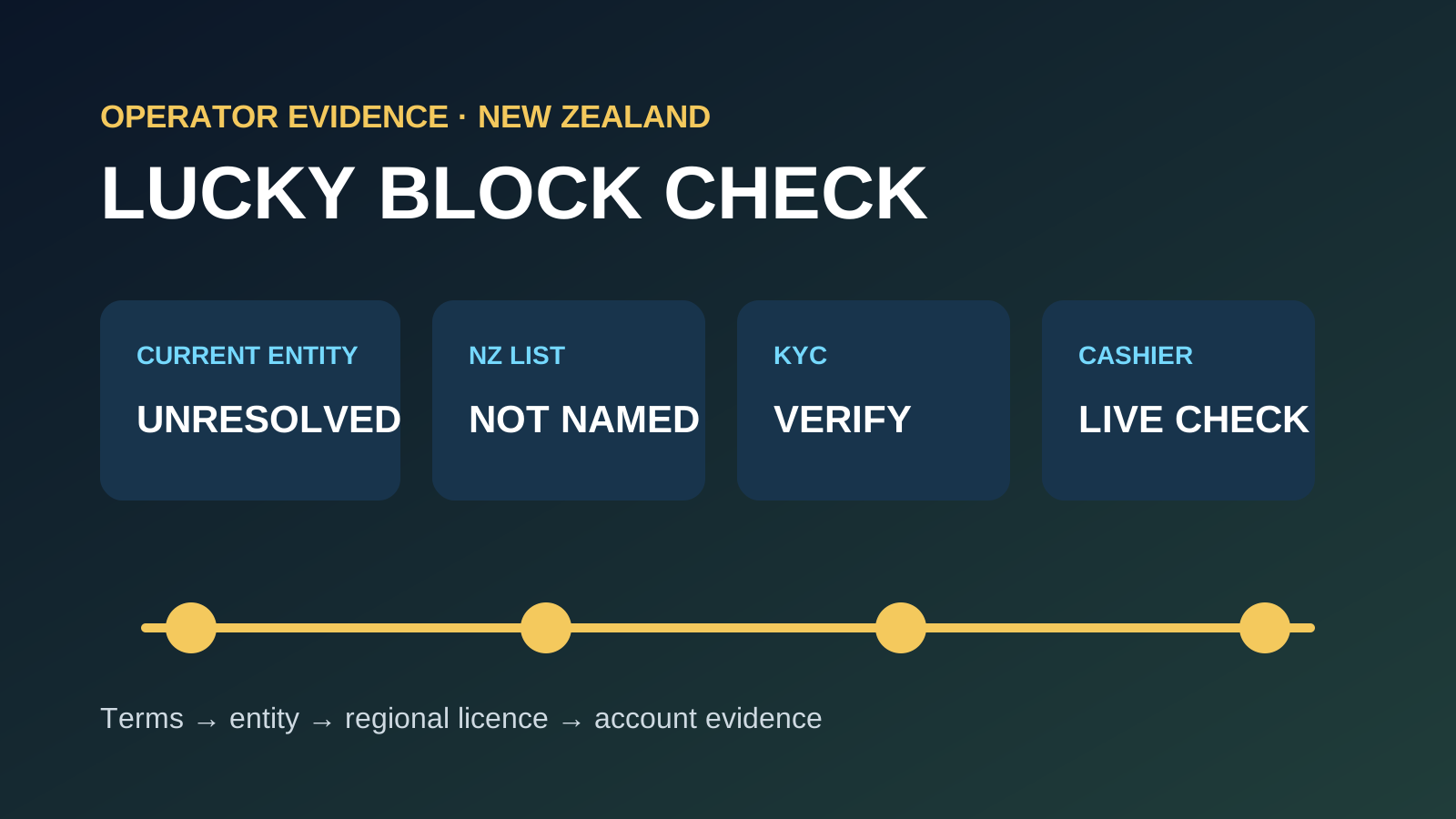
Lucky Block’s official casino terms are marked “Last updated: 2026-09-17” in the current versions accessible during research. New Zealand is not named in the displayed restricted-country list. The same terms require the user to be in a jurisdiction where gambling is permitted, make legality the user’s responsibility and prohibit a VPN or other location-masking method.
Non-listing is relevant, but it does not affirm that an NZ resident may register, complete verification, use a specific crypto route, launch every game and withdraw. The help centre says the website operates under multiple licences that differ by geography and directs users to the licence and terms presented for their region.
The more serious evidence gap is the legal counterparty. The accessible current records did not let us verify the full legal name, registration and specific licence governing an NZ user. An older Lucky Block whitepaper dated 7 December 2022 names Entretenimiento Rojo B.V. and a legacy Curaçao master-licence arrangement. That archival document is useful evidence of history, not proof of the current contract in October 2026.
No account was created and no NZ geolocation, KYC, authenticated cashier, deposit, game launch or withdrawal was tested. The appropriate verdict is unconfirmed. Obtain the current operator and licence in writing and preserve the regional footer or validation record before funding.
- Current terms date
- 17 Sep 2026
- NZ named as restricted
- No
- Current operator identity
- Not reconciled
- NZ account test
- Not performed
Material conflict
The current contracting entity must be obtained before funding
A casino review should identify the company that holds the account relationship and makes verification and cash-out decisions. The current terms page establishes customer duties, but the accessible record did not provide enough reliable text to attribute the October 2026 contract to a specific legal entity with registration details.
The old whitepaper terms identify Entretenimiento Rojo B.V., Curaçao registration number 152924, and RDL Rojo Digital Media Ltd as a payment-processing subsidiary. Those terms are dated 2022 and describe a licence structure that predates later Curaçao regulatory changes. Copying that identity into a current verdict without reconciliation would create false precision.
The privacy policy dated 7 September 2026 refers generally to “LuckyBlock” as data controller and provides support@luckyblock.com for privacy questions, but the extracted wording does not resolve a formal company name. A trading label is not a substitute for the contractual person.
Before registration, capture the regional terms, footer, licence-validation link and payment descriptor. Ask support for the legal entity, registration number, registered address, licence number, regulator and dispute route applicable to a resident physically present in New Zealand. Stop if the answer conflicts with the contract or deposit screen.
Geography-dependent claim
“Multiple licences” is not a verifiable licence record
The official help centre says Lucky Block operates under multiple licences which vary according to the geography from which the website is accessed. It tells readers to check the licence and terms shown for their region. That statement explains why an article should not publish one global licence as though it governed every account.
During this review we did not obtain a specific current validation record for a New Zealand user. We therefore do not publish a regulator, number, company or complaint path as confirmed. The 2022 Curaçao Interactive Licensing master-licence statement remains archival and is not silently promoted into a 2026 claim.
A useful licence check opens the validation page, matches the exact domain and company, records status and authorised products, and saves the date. A logo or copied footer is weaker because it can remain visible after a corporate or regulatory change.
Even a valid offshore licence would not be a New Zealand licence. It can define the operator’s foreign supervision and complaint route, but national legal context and operator eligibility remain separate questions.
Country and location rules
New Zealand’s absence does not override the legality clause
The terms’ current restricted-use section names numerous countries and territories. New Zealand was not among them. The document separately says a person must not use the service where online gambling is prohibited for residents or people inside that country.
Residence and physical location can be checked separately. A New Zealand resident travelling through a restricted jurisdiction may receive a different result from the same person at home. Citizenship, document country and payment origin can add other compliance questions.
The terms prohibit VPNs, proxies and similar services that mask or manipulate real location. Never bypass a regional block. Doing so can create a contractual breach that becomes relevant during identity or withdrawal review.
Ask support a complete question covering residence, physical location, casino play, verification, deposit and withdrawal. Preserve the answer and check that the regional terms and licence footer remain consistent when logged in.
National context
A reachable site is not New Zealand authorisation
The site’s New Zealand legal-status guide owns the national framework. Lucky Block’s foreign terms, a country selector or an unblocked homepage do not become a local approval or recommendation.
No checked source established a Lucky Block-specific licence from a New Zealand authority. The finding is narrower: New Zealand was absent from one current restricted-country list while current operator and licence evidence remained unresolved.
Recheck Department of Internal Affairs information and the operator contract before a decision. Obtain qualified advice where legal interpretation or recovery of a material balance is involved.
If government guidance, current terms, regional licence information and support disagree, stop. Do not resolve the conflict by selecting whichever source makes account opening easiest.
User obligations
Accurate identity, lawful location and personal use
The current terms require a user to be at least 18 or the higher legal age that applies, legally capable of entering the agreement and resident in a jurisdiction that permits gambling. They state that payments must be made in good faith and that the user must be authorised to use the selected payment method.
The service is for a person acting on their own behalf, not for another person or a commercial purpose. One should not use another person’s identity, card, bank account or wallet to get around a restriction.
Registration is not final approval. Identity and security checks may occur later, especially around payment activity or withdrawal. Keep account details current and make sure names, address and document data match.
Secure the email and account with a unique password and every available authentication control. Never give support a seed phrase, private key or one-time code. A legitimate ownership check can use signed messages, transaction records or other approved evidence without surrendering wallet control.
Current help evidence
KYC can require identity, selfie and recent address proof
Lucky Block’s help centre says identity proof can include front and back images of a government-issued ID, driving licence or passport, plus a selfie holding the chosen document. For address, it accepts a bank statement or utility bill issued within the previous 90 days.
The help text says all four corners must be visible and information must not be covered. That requirement should be checked again in the authenticated upload flow because accepted formats, file sizes and document types can change.
Verification can also involve payment ownership or source evidence. Crypto transfers show address activity but do not by themselves prove who controls the wallet or how funds were acquired. Retain exchange receipts, wallet records and transaction hashes where relevant.
Do not deposit an amount whose return depends on documents that are unavailable or inconsistent. Confirm the upload request through the authenticated site before sending sensitive files and preserve submission receipts and responses.
Internal balance
Deposited crypto leaves self-custody
Sending an asset to a casino address transfers control away from the user’s keys and creates an internal account balance. Continued access depends on login security, operator operation, compliance review, contract terms and successful withdrawal processing.
Because the current contracting company was not reconciled, counterparty uncertainty is higher than it would be with a clear current entity and validation record. Keep only an affordable session amount on the platform and do not use it as savings or a transfer service.
Crypto market volatility and gambling variance are separate. A balance can lose NZ-dollar value without any wager, while a gambling win can coincide with a falling asset price. Record both units if they matter to the decision.
Save asset, network, address, memo or tag, amount, transaction hash, confirmation count and credited value for every transfer. Those records do not guarantee recovery, but they make a payment trail reproducible.
Dynamic account evidence
The current asset and network menu was not verified
The public pages reviewed do not provide a complete stable list of all assets, networks, minimums, maximums and fees for a New Zealand account. We do not copy an affiliate coin list or infer a network from a cryptocurrency logo.
Open the authenticated cashier and record exact asset, network name, address format, memo, minimum, maximum, confirmation requirement and fee. The same token can exist on incompatible chains, and an unsupported transfer may be irreversible.
Recheck the screen on every deposit. Addresses and supported routes can change. Use a small test where permitted and economically sensible, then verify the credited amount before sending more.
If the cashier shows a legal entity or processor not present in the terms, preserve the screen and ask for an explanation. Payment evidence can help resolve the current identity gap, but it should not be guessed before registration.
Ownership and turnover
Use only an authorised payment method
The terms say the customer must be the authorised user of the payment method. Third-party funding can create both a contractual issue and an ownership problem during KYC.
The current terms state that payment transaction costs covered by the operator may be deducted when funds are returned. The exact deposit fee and minimum should therefore be read in the live cashier rather than described as universally free.
Do not use a casino simply to move or convert cryptocurrency. Turnover conditions and gambling risk make it unsuitable as a transfer route. Separate ordinary deposited funds from promotional balances and save the terms accepted for each.
Before sending, capture the cashier instruction, destination and limits. After sending, keep the transaction hash and credited balance. Stop if the account credits a different asset, rate or amount than disclosed.
Current contractual fields
Minimums, turnover and verification can affect withdrawal
The current terms versions checked state a €10 minimum withdrawal or currency equivalent, except when closing an account. They also describe at least one-times deposit turnover. If that turnover is not completed, the terms permit an 8% fee with a €4 minimum or equivalent as an anti-money-laundering measure.
These figures are contractual snapshot values, not a promise that a particular crypto route uses EUR or that the amount received will be fee-free. The cashier can apply asset, method and processor-specific limits. Check the account-facing values before depositing.
The terms reserve the right to request photo identification, address confirmation, a selfie or a verification call before allowing withdrawal. KYC can occur at any time during the relationship, so a previously successful deposit does not prove that cash-out will require no documents.
We did not test processing time and do not repeat an advertised speed as a guarantee. Save request ID, asset, network, address, amount, displayed fee, time, status changes, support messages and final transaction hash.
Exact deployment
Catalogue presence and RTP need account-level proof
A public lobby may show third-party studios without proving that a game launches from New Zealand after login. Provider restrictions, account geography and commercial distribution can narrow the catalogue.
For a slot, open its help and record full title, provider, version where shown, payout method, active RTP, total stake, feature price and maximum win. A supplier may support several mathematical configurations under identical artwork.
Demo mode can teach controls but can differ in server, currency, stake range or RTP. It also cannot prove real-money eligibility. Compare demo and paid help field by field.
No catalogue count, average RTP or NZ game availability is claimed here. Those values are dynamic and were not verified through an eligible account.
Offer-level terms
Do not turn a headline into a bonus fact
A promotion needs a current record of eligible countries, opt-in, deposit, currency, wagering multiple, game contribution, maximum stake, expiry, excluded methods and maximum conversion. None should be inferred from an advert.
Lucky Block can change or personalise offers. This review does not publish a bonus amount, code, speed or successful redemption claim without account-level evidence.
Keep deposit turnover separate from bonus wagering. Two different conditions can apply to the same balance. If their interaction is unclear, decline the promotion or obtain written clarification before accepting it.
A promotion visible from New Zealand does not resolve the operator identity, licence, KYC or withdrawal questions documented above.
Close the identity gap
Ask for the exact contract, not a generic availability answer
Request the legal company name, registration, registered address, licence number, regulator, validation link and complaint route governing an NZ resident. Also ask about physical location, KYC documents, provider blocks, current crypto network, deposit turnover and withdrawal verification.
Use separate questions and save the full transcript, date, agent and ticket number. A support statement cannot silently amend contradictory terms, but it can identify which regional contract should be inspected.
If a dispute occurs, organise registration, accepted terms, licence screen, KYC files, deposit hashes, game history, withdrawal requests and communications chronologically. Never send seed phrases or private keys.
Re-run the identity and country check after any long break because terms, entities and licences can change while the brand remains the same.
Evidence balance
The unresolved counterparty keeps the verdict unconfirmed
Proved by current first-party material: the terms carry a September 2026 date; New Zealand is absent from the visible restriction list; lawful use is the user’s responsibility; VPN location masking is prohibited; KYC can require identity, selfie and recent address evidence; and withdrawal can involve turnover, fees and extra verification.
Not proved: the current legal counterparty for an NZ user, a specific current regional licence, successful NZ registration, accepted payment networks, complete lobby, withdrawal speed, service quality or a deposit-to-withdrawal test.
The archived 2022 company and licence details are a documented conflict, not a substitute for current evidence. The main risks are funding before identity is clear, treating non-listing as permission, using an unsupported network, failing KYC and assuming a promotional or speed claim overrides the contract.
This evidence does not support a “best” ranking or an unconditional NZ availability label. It supports stopping until the contract and licence are reconciled.
Before funding
A New Zealand evidence checklist
- Save the regional terms dated 17 September 2026.
- Obtain the current legal entity, registration, address and licence in writing.
- Open the licence validation record and match company, domain, status and products.
- Ask whether an NZ resident physically in NZ may register, verify, play and withdraw.
- Prepare matching identity, address, payment ownership and source records.
- Open the authenticated cashier and record asset, network, limits and fees.
- Confirm ordinary deposit turnover and separate bonus conditions.
- Verify each game’s provider, RTP, total stake and maximum win in live help.
- Use only an affordable amount and request a modest withdrawal early.
- Keep all hashes, account history, terms and support messages.
Stop if the company, licence, country answer, cashier or KYC request conflicts. Never use a VPN, false residence, another identity or an unsupported payment route.
Bottom line
Lucky Block needs current entity and licence evidence first
New Zealand is not named in the checked restriction list, but that is not enough for a positive eligibility claim. Current terms require lawful use and truthful location.
The accessible current record did not reconcile the contracting entity and regional licence. Older Entretenimiento Rojo and legacy Curaçao details are historical and should not be presented as current without confirmation.
Until the operator, licence, NZ eligibility and cashier are established for the same regional account, status remains unconfirmed. Do not fund merely because the homepage or a game lobby loads.
The sponsored calls on this page lead to a different offer and must not be described as “Play Lucky Block”.
Questions answered
Frequently asked questions
Do Lucky Block’s current terms prohibit New Zealand?
New Zealand was not named in the restricted-country list visible in the terms marked 17 September 2026. That absence does not confirm registration, KYC, payments, game access or withdrawal for a particular NZ resident.
Which company currently operates Lucky Block?
The accessible current terms did not let us verify a named contracting legal entity. An older 2022 whitepaper names Entretenimiento Rojo B.V., but that legacy record must not be treated as proof of the current contract.
What licence does Lucky Block currently use?
The official help centre says licences differ by geography and tells users to check the website for their region. No specific current licence was verified for an NZ user in this review.
What documents can KYC require?
The current help centre describes a government ID or passport, a selfie holding the document, and a bank statement or utility bill issued within 90 days for address evidence.
Does the sponsored button open Lucky Block?
No. The existing site CPA route leads to another offer and must be checked independently.
Evidence record
Primary sources
Facts and configurations were checked against the following first-party records. A public product page is not proof that a game is available through a New Zealand operator.
- Lucky Block — casino terms and conditionsChecked 7 October 2026
- Lucky Block — help centreChecked 7 October 2026
- Lucky Block — privacy policyChecked 7 October 2026
- Lucky Block — archived whitepaper termsChecked 7 October 2026
- New Zealand DIA — online gambling for playersChecked 7 October 2026