Short answer
Country-list omission is not affirmative NZ permission
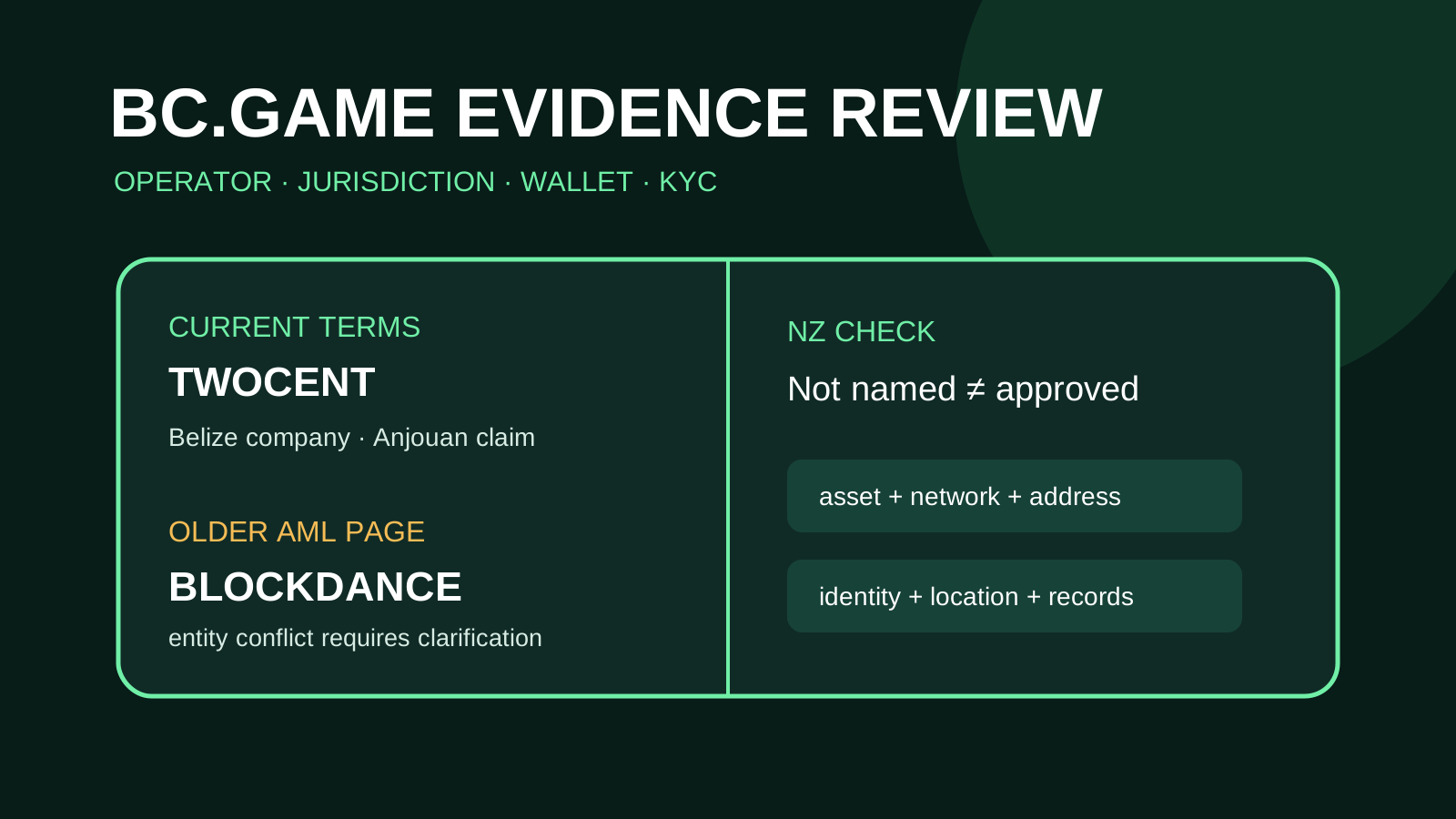
BC.GAME’s current general terms list Aruba, Bonaire, Curaçao, France, the Netherlands, Saba, Statia, St. Martin and the United States as prohibited jurisdictions. New Zealand is not named. However, clause 1.2 also excludes access from any jurisdiction where use is illegal and makes legality the user’s responsibility.
No BC.GAME or New Zealand authority record checked here established a local licence, transition entitlement or operator-specific approval. A reachable site, signup form, NZ IP response or missing country name is not enough to establish eligibility.
We did not create an account, submit KYC, inspect an authenticated New Zealand cashier, deposit, play, contact support or withdraw. We therefore make no claim about account acceptance, actual asset/network availability, speed, limits or dispute quality.
The conclusion is unconfirmed eligibility with an additional operator-document conflict. Readers should obtain written clarification of both NZ permission and the current contracting entity before transferring funds.
- Current operator
- Twocent Technology Ltd
- Official domain
- bc.game
- Licence claim
- Anjouan
- NZ eligibility
- Unconfirmed
Material document conflict
Twocent Technology versus BlockDance B.V.
The current General Terms identify Twocent Technology Limited, company number 41939, with a Belize address at Sea Urchin Street #2, San Pedro, Ambergris Caye. The official 2026 site footer repeats Twocent and claims Anjouan licence ALSI-202410011-FI1.
The checked AML policy instead opens by saying BC.GAME is operated by BlockDance B.V. That record appears older and conflicts with the current contracting disclosure. Its AML controls may remain informative, but its entity line should not silently replace the newer terms.
An operator review must surface this conflict. Before funding, ask BC.GAME which entity contracts with a New Zealand user, whether the AML page remains operative, and which company controls customer balances and complaints. Save the written answer.
The terms then choose Curaçao law and courts for disputes despite identifying a Belize company and an Anjouan licence. This cross-jurisdiction structure is another reason not to summarise the operator merely as “licensed offshore”. Each role and governing clause matters.
Terms checked 6 October 2026
Named prohibited jurisdictions and broader legality clause
Clause 5.2 bars persons located in or resident in the named prohibited jurisdictions and applies the restriction to visitors physically there. It also treats attempts to manipulate location information or provide false residence details as a breach.
New Zealand’s absence from that short list is relevant but incomplete. Clause 1.2 says BC.GAME cannot verify legality in every jurisdiction and requires the user to ensure access is lawful. Clause 4 also requires the user to be legally allowed to participate under applicable law.
Do not use a VPN or inaccurate address to test access. Circumvention would not create permission and could provide grounds for closure or payment restriction. A successful first transaction also would not prevent later location verification.
Country terms can change without individual notice under clause 10. Re-open the live record at the point of use, note its date or lack of one, and compare the text rather than relying on a search snippet.
Separate national evidence
An Anjouan claim is not a New Zealand licence
The site’s New Zealand legal-status guide owns the dated national framework. This operator review does not infer a local entitlement from a foreign licence or global website reachability.
No evidence reviewed established that Twocent Technology Limited or BlockDance B.V. had a New Zealand-specific approval. The appropriate wording is therefore “not established”, not “licensed for NZ”.
Before registration, check DIA’s current player guidance and ask BC.GAME to confirm in writing that a person physically located in New Zealand may use its casino products on that date. Clarify whether sports, casino, Originals and wallet services have different restrictions.
If operator support and national information conflict, do not deposit until the issue is resolved. This page is an evidence review, not individual legal advice.
Verification powers
Personal use, accurate details and KYC
The terms restrict service to personal use and prohibit multiple accounts. Users must act on their own behalf, provide true and complete information and avoid third-party payment methods.
Clause 6 allows BC.GAME to request identity and location documents at any time. Service and payment may be restricted until verification is considered sufficient. Clause 4.9 separately permits verification when transactions appear suspicious or fraudulent.
This means crypto play is not anonymous by contract. A user should be ready to prove identity, residence, age, payment ownership and potentially source of funds. The public terms do not provide a universal KYC-free threshold.
Account security should include a unique password, two-factor authentication where available and careful representative verification. Never send a seed phrase, private key or authentication code to someone claiming to be support.
Control changes on deposit
Casino balances are custodial account claims
Sending crypto to an address displayed in the BC.GAME wallet transfers control away from the user’s self-custody keys. The resulting casino balance is governed by platform terms and account controls, not held in a wallet where the user alone can sign transactions.
The terms describe Bitcoin and other deposits as virtual funds and warn that crypto value can change dramatically. That language affects the contractual balance model and should be read before treating the account as a savings wallet.
Asset, token contract, network, address and any memo must match the live cashier. A supported asset name does not prove every chain is supported. Wrong-chain transfers can be unrecoverable.
Keep transaction hashes and cashier screenshots. Blockchain confirmation proves delivery to an address, not internal credit, KYC completion or withdrawal approval.
Authenticated evidence required
Wallet features do not establish NZ methods
The current help article describes one Wallet area containing balances, deposits, withdrawals, swaps, Vault Pro, NFTs, transactions, rollover and bet history. It says deposits may use available crypto or fiat methods, but does not provide an authoritative public NZ asset-and-network matrix.
Because we did not authenticate an NZ account, this review does not publish a complete coin list, minimums, maximums, fees or confirmation counts. Those fields must be copied from the live cashier immediately before a transaction.
The Swap feature adds exchange execution and rate risk. Vault Pro and NFT functions are not casino-game features and may have different terms or regulatory scope. The official footer itself says crypto trading is not gambling and is not covered by the gaming licence.
Do not infer NZD support from a currency selector or generic fiat language. Confirm deposits and withdrawals separately: a purchase rail may accept money without offering the same route for cash-out.
AML condition
One-times deposit turnover and payment ownership
The AML page states that all deposits require one-times wagering before a withdrawal request. Its example treats a 100-unit deposit as requiring 100 units of wagers before the resulting balance can be requested.
That control is separate from bonus wagering. A promotion may impose a higher multiplier, game contribution schedule, maximum stake or expiry. The wallet’s Rollover area is described as tracking deposit and bonus requirements.
The AML page’s BlockDance entity line conflicts with current Twocent terms, so ask whether the one-times rule remains current and which contract controls. Until clarified, a prudent reader should assume the restriction may be applied.
Only fund from a wallet or payment method the account holder is authorised to use. Third-party methods are prohibited, and suspicious transactions can trigger verification or retained payments.
No personal speed test
Withdrawal evidence and settlement stages
The wallet guide says users select Withdraw, choose an available method, enter an amount and follow the prompts. It does not establish a universal approval time, fee or limit for an NZ account.
A withdrawal passes at least three distinct stages: operator review, blockchain broadcast and network or receiving-platform settlement. Marketing language such as “fast withdrawals” should not collapse those stages into one guaranteed time.
KYC, account breach review, rollover and fraud checks can delay or prevent payment. Terms reserve broad authority over wagers, errors and suspected manipulation. Read those clauses before depositing, not only after a request is held.
Record asset, network, address, fee, requested amount, submission time, status, transaction hash and final receipt. No such test was performed for this article, so no speed rating or payout claim is made.
Lobby versus exact game
Casino categories, Originals and fairness claims
The public site presents slots, live casino, table games, blackjack, roulette, baccarat, new releases and BC.GAME Originals alongside sports betting. A global lobby card does not prove the same game is enabled for a New Zealand account.
Provider games require their own help checks for title, version, RTP, paytable, stake and maximum win. Originals marketed as provably fair require the exact seed, hash and verification instructions for that game; the label alone is not an independent audit.
The terms permit games or events to be changed or terminated and allow erroneous wagers to be voided. Preserve the rules shown when a real dispute arises.
We do not treat marketing statements about audited RNG, user counts or “trusted” status as independently verified simply because they appear in the footer. Advertising and contractual evidence remain separate.
Mutable conditions
Bonuses, cashback, VIP and advantage-play rules
The public site advertises welcome bonuses, cashback, VIP, referrals, promotions and lotteries. Values and eligibility are mutable, so this review does not freeze a promotional amount or rank offer value.
Clause 13 allows winnings to be confiscated and accounts closed where the operator determines a bonus was used for guaranteed profit. It lists delayed round completion, new deposits while bonus features remain, hedging and low-margin patterns as examples of irregular play.
Before opting in, read minimum deposit, wagering, eligible games, contribution, maximum stake, expiry, withdrawal cap and excluded strategies. Take screenshots of the terms attached to the actual account offer.
A reward is not free cash and should not motivate extra turnover. If the bonus terms are unclear or conflict with the general terms, decline the offer until support clarifies them in writing.
Tools and support
Self-exclusion, help and complaints
The Help Centre describes self-exclusion choices after a 24-hour cooldown and confirmation process, including one day, one week, one month, six months and permanent exclusion. It says activated exclusions are irreversible and cannot be removed.
That help record differs from generic footer wording referring to a minimum six-month exclusion and a seven-day cooling-off period. The account flow should be treated as controlling only after the reader verifies the currently displayed options.
General terms direct complaints to support@bc.game and select Curaçao courts. We did not contact support, so no response-time or resolution claim is made. The foreign dispute route is a practical risk for NZ users.
If gambling is no longer recreational, stop depositing and use the New Zealand contacts on the site’s responsible gambling page. Operator tools should be paired with independent blocking and financial controls.
Evidence summary
Verified, conflicting and untested findings
| Question | Status | Evidence |
|---|---|---|
| Current operator | Documented | Twocent Technology Ltd in terms/footer |
| AML entity | Conflict | Older page names BlockDance B.V. |
| Licence | Operator claim | Anjouan ALSI-202410011-FI1 |
| NZ prohibited | Not named | Current clause 5.2 |
| Affirmative NZ permission | Unverified | Local-law condition remains |
| NZ cashier | Not inspected | No account created |
| Withdrawal/support test | Not performed | No funds or contact used |
Principal risks are the entity conflict, mutable country terms, later KYC, custodial funds, network mistakes, rollover, promotion enforcement, volatile assets and a foreign dispute forum. None is resolved by site reachability.
Before registration
BC.GAME evidence checklist for an NZ reader
- Open the live terms and record the checked date.
- Confirm the current contracting entity and ask about the BlockDance AML conflict.
- Verify the Anjouan licence claim independently.
- Ask for written New Zealand casino eligibility.
- Recheck current DIA player information.
- Assume identity, residence and source documents may be requested.
- Inspect the authenticated asset, network, address, fee and minimum.
- Clarify one-times deposit rollover before funding.
- Read promotion and irregular-play clauses before opting in.
- Open exact game help for RTP and version.
- Enable 2FA and set affordable limits.
- Save terms, chats and transaction evidence.
Practical due diligence
How to verify the account before risking a meaningful balance
Start with a zero-funds evidence pass. Save the current General Terms, AML policy, responsible-gambling instructions and the exact promotion terms you would accept. Record the retrieval date, document title and entity named on each page. If Twocent Technology Limited appears in one record while BlockDance B.V. remains in another, send support a narrow question that can be answered clearly: which company would contract with a person resident and physically present in New Zealand today? Ask whether the older AML document still forms part of that contract and retain the full reply rather than a cropped chat line.
Next, separate registration from eligibility. A country selector, accepted phone number or successful email verification only shows that the interface processed those fields. It does not prove the operator will accept play, complete KYC or approve a withdrawal. Request written confirmation for casino use from New Zealand, including any product-specific restriction. Compare that response with the live prohibited-country clause and current New Zealand guidance. If the answers do not align, do not use technical access as a substitute for permission.
Only after those checks should an authenticated cashier be inspected. Build a transaction sheet for the intended asset: exact token, blockchain network, deposit minimum, withdrawal minimum, operator fee, memo or tag requirement, estimated confirmations and the displayed destination address. Repeat the fields separately for withdrawal because deposit support does not guarantee the same cash-out route. Verify the address on the final confirmation screen, and use a small transfer that you can afford to lose to network error or account restriction. A successful test deposit still does not prove that a later, larger withdrawal will pass review.
Before any gameplay, complete verification if the operator permits proactive KYC, enable two-factor authentication and set loss, deposit and time limits. Read the game’s own help screen rather than relying on a lobby tile. Capture the title, provider, version, RTP setting, stake range, maximum-win rule and bonus conditions. For an Original, record the precise provably-fair verification method and test a disclosed result; do not treat the general label as evidence for every game.
Finally, test withdrawal with the same care used for deposit. Confirm any one-times turnover, bonus wagering and identity review before requesting payment. Save the request ID, status changes and blockchain transaction hash. Keep only the playing balance required for the planned session because funds held in the casino account are custodial and exposed to account, operator and jurisdiction risk. This workflow cannot make an offshore operator safe, but it turns vague confidence into a set of dated facts and explicit unresolved questions.
Questions answered
Frequently asked questions
Does BC.GAME permit New Zealand players?
New Zealand is not named in the checked prohibited list, but the terms require local legality and no affirmative NZ approval or authenticated account test was established. Eligibility remains unconfirmed.
Who operates BC.GAME?
Current general terms and the 2026 footer identify Twocent Technology Limited. A checked AML page still names BlockDance B.V., creating a document conflict that needs clarification.
What licence does BC.GAME claim?
The current terms claim Anjouan licence ALSI-202410011-FI1. This is not a New Zealand licence.
Can BC.GAME request KYC?
Yes. The terms allow identity and location documents at any time and permit service or payment restrictions until verification is sufficient.
Does the sponsored button open BC.GAME?
No. It opens the site’s existing separate CPA destination and is labelled as a separate offer.
Evidence record
Primary sources
Facts and configurations were checked against the following first-party records. A public product page is not proof that a game is available through a New Zealand operator.
- BC.GAME — General Terms and ConditionsChecked 6 October 2026
- BC.GAME — AML policyChecked 6 October 2026
- BC.GAME — official site footerChecked 6 October 2026
- BC.GAME Help — wallet featuresChecked 6 October 2026
- BC.GAME Help — self-exclusionChecked 6 October 2026
- New Zealand DIA — online gambling for playersChecked 6 October 2026