Short answer
Account eligibility is not the same as full catalogue access
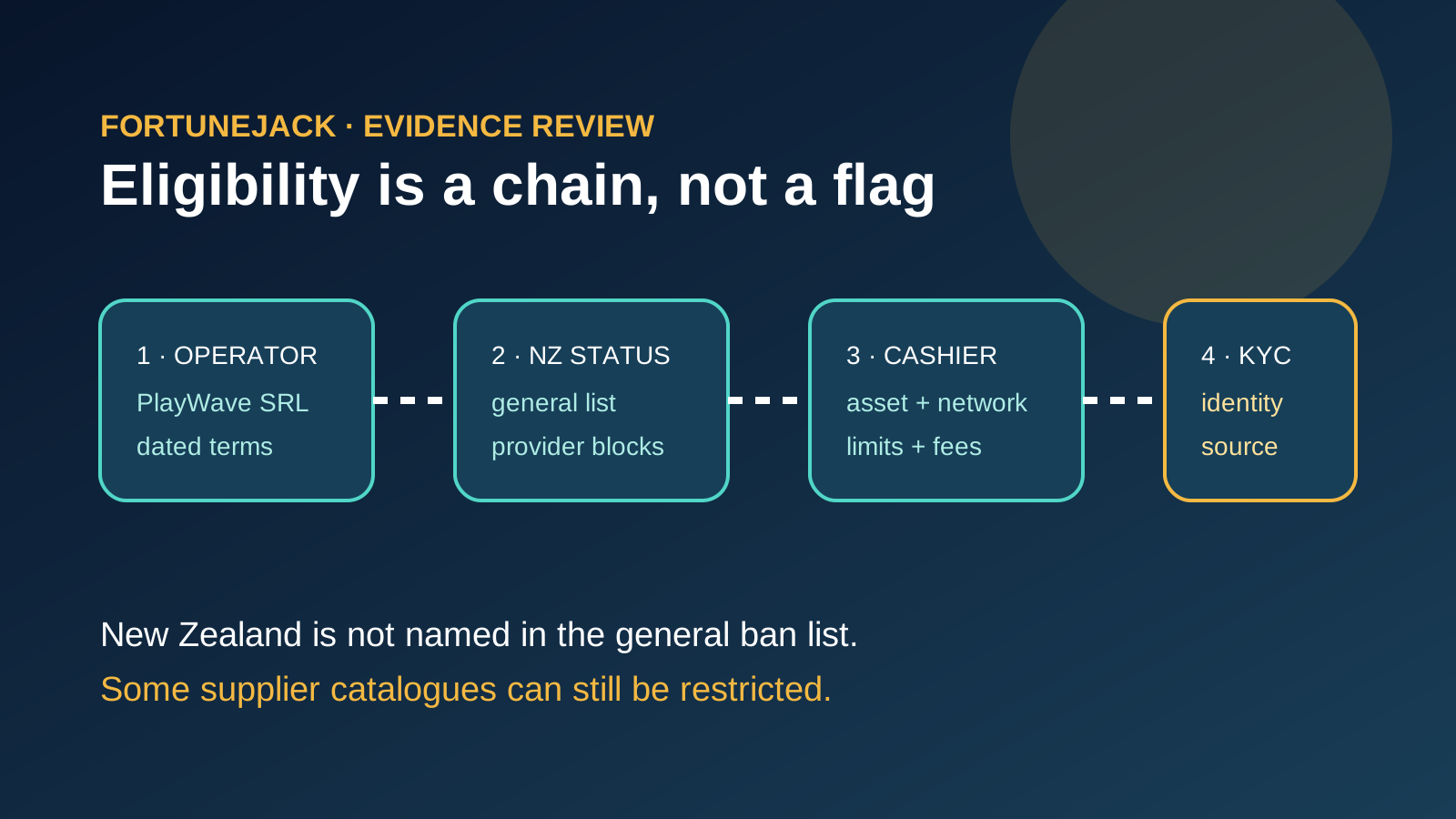
FortuneJack’s general prohibited-territories clause names Australia, Austria, Comoros, France, Germany, the Netherlands, Spain, the United Kingdom, the United States, FATF-blacklisted jurisdictions and places prohibited by the Anjouan authorities. New Zealand is not named in that general list. That is useful evidence, but it is not an affirmative promise that every New Zealand resident can register, pass verification, fund an account, play every game and withdraw.
The same terms say supplier conditions complement the operator contract and publish additional provider-specific territory lists. New Zealand appears in at least one of those supplier restrictions. A user can therefore pass an operator-level country check yet find part of the lobby unavailable. Eligibility needs to be tested at three layers: account, payment route and specific game provider.
We did not create an account, upload identity records, inspect an authenticated NZ cashier, deposit, wager, contact support or withdraw. We cannot confirm the assets, networks, limits, provider catalogue or verification path that one New Zealand account would see today.
The evidence-led verdict is conditional and partially restricted, not “available in NZ”. Ask support whether a resident physically present in New Zealand may register and withdraw, then ask which game suppliers are blocked. Save the response and compare it with registration, live lobby and cashier controls before sending funds.
- Named operator
- PlayWave SRL
- General NZ ban
- Not named
- Provider-level NZ blocks
- Yes
- NZ account test
- Not performed
Current contract
PlayWave SRL is the named counterparty
The terms last updated on 8 August 2025 identify PlayWave SRL, a Costa Rican limited liability company with registration number 3-102-914970. They give a registered address in Santa Ana, San José, Costa Rica. Record those fields together because a brand name alone does not identify the company that holds an account balance or decides a withdrawal.
Current FortuneJack pages state that the company is licensed and regulated by the Government of the Autonomous Island of Anjouan, Union of Comoros. This review reports that first-party claim. It is not an independent validation that a licence is active, covers every product, covers the current domain or provides an effective remedy to a New Zealand resident.
Older licence artefacts can remain indexed after a contract changes. A historical PDF or badge should not override the operator and jurisdiction named in the current terms. Save the dated contract and current validation result together, and investigate if the company, licence number or regulator does not match.
Costa Rican company registration, an Anjouan gaming claim, a third-party payment processor and New Zealand legal status are four separate questions. None substitutes for the others. The practical counterparty check is to match current terms, company record, licence disclosure, domain and payment descriptor on the same date.
Operator-level list
New Zealand’s absence is evidence, not permission
The prohibited list is important because it shows where FortuneJack says its service must not be used. New Zealand is absent from the named countries in the version checked. The clause also includes dynamic categories: FATF-blacklisted jurisdictions and territories prohibited by licensing authorities. Those categories can change without a reader relying on an old review.
Elsewhere, the terms say internet gambling may be illegal or restricted in some jurisdictions and that the company provides no legal assurance. The user is responsible for compliance. This wording prevents a successful page load, country selector or registration form from becoming a contractual guarantee of lawful, durable access.
Residence, citizenship, physical location, payment origin and sanctions screening can produce different results. Ask support a complete question that covers a New Zealand resident physically in New Zealand, casino play, KYC, deposit and withdrawal. A vague “is NZ supported?” answer may not resolve all five points.
Do not conceal location with a VPN or inaccurate details. Even where the current clause does not name New Zealand, inconsistent location evidence can create verification or account-review risk. Use truthful information and pause if controls contradict a support answer.
Catalogue layer
Supplier territory rules can remove games independently
FortuneJack’s terms say game and service supplier conditions complement the main agreement. The detailed prohibited-territories section contains provider-specific lists, and New Zealand is expressly included for at least one supplier, GameArt, in the version checked. This means “the operator did not ban NZ” and “every game is available in NZ” are different propositions.
A provider tile visible on a public lobby does not prove that its games will launch after login from New Zealand. The site may filter at launch, after geolocation, after identity verification or according to a commercial contract. A demo catalogue can also differ from real-money supply.
For any game that matters, capture the title, studio, version, launch result and help screen from the authenticated account. If it is blocked, do not work around the restriction. Choose another documented title or stop using the service.
This review does not try to reproduce every provider list because those lists can change and belong to the live terms. Its durable conclusion is the method: check the operator list first, supplier restrictions second and the exact game launch third.
National context
Offshore access is not New Zealand approval
The site’s New Zealand legal-status guide owns the national framework. This operator review does not turn a foreign contract, licence claim or reachable website into a New Zealand licence or recommendation.
No checked source established a FortuneJack-specific authorisation from a New Zealand regulator. The narrow finding is that New Zealand is absent from one general ban list while present in at least one supplier-specific restriction.
Government information and operator terms can change on different schedules. Recheck the Department of Internal Affairs source and the operator contract at the time of a decision. Obtain qualified advice where legality or a material balance is at issue.
If national information, operator support, registration controls and the cashier disagree, preserve the conflict and stop before funding. Interface availability is the weakest of those signals because it may reflect technical routing rather than a completed eligibility decision.
Registration controls
One personal account and accurate details are required
The terms permit one account for personal entertainment use and prohibit access through another person’s account. They also reserve broad rights where connected people or households appear to operate multiple accounts. Use one accurate identity, a durable email and phone number, and payment instruments or wallets that you can document.
Disposable email addresses and disposable phone numbers are prohibited. The contract states that discovery can lead to blocking, termination or confiscation. This is a material account condition, not merely an interface preference.
The operator can suspend or terminate an account and may investigate registration details, payment sources, transactions and playing patterns. A successful registration is therefore the start of an ongoing relationship, not proof that future withdrawals will be automatic.
Secure the email, use a unique password and enable every available authentication control. Never share one-time codes, wallet seed words or private keys. Keep registration confirmation and subsequent account notices because they establish the timeline if an identity or access dispute occurs.
CDD applies to crypto too
Identity, selfie and source-of-funds evidence may be requested
FortuneJack’s terms apply customer due diligence and KYC to transactions into or out of an account in fiat or cryptocurrency. Possible checks include personal information, certified identity documents, a selfie, occupation, source of funds, source of income, professional background and gaming activity.
The operator may trigger checks for transaction thresholds, high-risk wallets, doubtful documents, unusual patterns, politically exposed persons, suspected fraud or other higher-risk circumstances. It can restrict deposits and withdrawals while checks continue and may request a phone or video interaction.
The terms require requested KYC and CDD documents within 30 calendar days and permit an account lock if the deadline is missed. Prepare current, legible documents before depositing. Make sure names, address, birth date and wallet history tell a consistent story.
KYC is not a one-time badge. Ongoing monitoring means further evidence can be requested after earlier transactions succeeded. Do not deposit an amount whose return depends on verification documents you cannot or will not provide.
Internal balance
A FortuneJack balance is custodial
Sending cryptocurrency to an operator address transfers control away from a self-custody wallet and creates an internal account balance. Access then depends on login security, operator solvency and operation, contract compliance, transaction screening and successful verification.
The terms say the account earns no interest and prohibit transfers between customer accounts. FortuneJack also says it is not an exchange platform and does not perform currency conversion between crypto and fiat. Treat each displayed wallet as a gaming balance, not a savings account or remittance route.
Keep only an affordable session amount on the platform. Record the sending wallet, asset, exact network, address, memo or tag, amount, transaction hash, confirmation count and credited balance. Those fields are more useful than a generic “deposit completed” screenshot.
Crypto market volatility is separate from gambling variance. A balance can lose fiat value while no bet is placed, and a gambling win can coincide with a falling asset price. Compare results in both the account unit and an independent NZ-dollar reference if that distinction matters.
Live configuration
Asset and network must match the current deposit screen
The terms say supported currencies can be added or removed and that minimum deposits appear on the deposit page. They contain specific warnings for some assets: ETH transactions must use the supported Ethereum route and do not support tokens or smart-contract deposits; TRX instructions similarly distinguish native TRX from tokens; Bitcoin withdrawal address support also has stated limitations.
These examples show why an asset ticker is not enough. Record the precise network, address format and any memo before every transfer. Never infer that a token sharing an ecosystem is accepted. Send a small test transaction where the operator permits it and fees make it sensible.
The terms identify EUR as the supported fiat currency and say third-party payment providers process fiat transactions. A payment processor can apply its own exchange rate, eligibility, fees and delays. An NZ card or bank route was not tested and should not be assumed.
Use the authenticated cashier as the current operational source for minimums, maximums, fees and address. Recheck it each time rather than copying an old address or relying on an article’s asset list.
Before withdrawal
Deposits can carry a wagering requirement even without a bonus
The withdrawal clause says a user must be verified and comply with the operator’s wagering requirement. For slots, casino and live games, the terms state that the deposit amount must be wagered up to two times. Sportsbook uses a different rule, while bonus requirements belong to the relevant promotion terms.
This is a contract condition on ordinary deposited funds, not just promotional credit. Before depositing, confirm the exact requirement shown to the account, eligible games, contribution rates and whether a changed rule applies to the incoming transaction.
Do not attempt low-risk or coordinated betting to manufacture turnover. The operator monitors behaviour and can investigate patterns. If the purpose is simply to transfer or convert funds, a gambling account is the wrong tool.
Keep a record of deposits, accepted terms and settled wagers. Do not chase losses merely to finish a turnover target. The safe response to an unaffordable requirement is not more play; it is to avoid funding or seek clarification before the transaction.
No speed promise
Verification, channel rules, fees and instalments can affect cash-out
The terms say the minimum withdrawal appears during the request. For fiat, the contract checked states a €20 minimum and €2,000 maximum per transaction, while the public FAQ may present method-dependent figures. Where public pages differ, the authenticated cashier and current contractual text need reconciliation before reliance.
Withdrawals may have to use the same currency and channel as the deposit. Fiat can require the original payment card. The operator may charge displayed withdrawal fees, and a bank or processor may add its own charges.
FortuneJack reserves the right to pay a withdrawal in instalments and to determine a reasonable schedule case by case. Some requests can take a considerable time. The FAQ’s typical speed language is therefore not a guarantee for a particular KYC state, network or account.
Save request ID, asset, network, address, amount, fee, time, status changes and transaction hash. If support changes a condition, request the clause and preserve the complete conversation rather than relying on a cropped message.
Contract cap
The operator cap is separate from a game’s maximum win
The terms set a maximum amount the company is obliged to pay for a single bet, spin, bonus round or free spin at the crypto or fiat equivalent of €300,000, excluding jackpot winnings. They say a game and stake can display a result above that limit and permit the excess to be removed.
This operator-level clause is not the same as a game’s advertised 10,000× or other mathematical cap. The payable amount can be constrained by both: first by the game’s rules, then by the operator contract. Currency conversion timing can also matter for a crypto-denominated balance.
Before using a stake capable of creating a theoretical result near the contractual ceiling, ask how the equivalent is calculated and when. Save the answer and the current clause. Do not describe a game maximum as fully withdrawable without this comparison.
Jackpots are stated as excluded from this particular cap, but that does not prove a jackpot is available, eligible or governed by no other conditions. Read the exact jackpot and provider rules separately.
Lobby evidence
Game availability and RTP are configuration-specific
A lobby can combine many third-party studios, but the terms allow supplier-specific country restrictions. Confirm each important provider and game from the authenticated NZ account instead of treating a public catalogue count as durable evidence.
For a slot, open its information or paytable and record title, provider, build where shown, RTP, stake interval, volatility label, maximum win and feature-purchase cost. The operator can deploy one of several certified RTP settings. A supplier’s headline RTP does not prove the selected operator configuration.
A demo can explain controls and sequences, but it may use a different wallet, currency, stake range, server, jurisdiction or RTP. Compare its help screen with the real-money client before assuming equality.
This review does not rate the catalogue from an untested public lobby and does not claim any game is available in New Zealand. It gives a repeatable way to establish the exact evidence that matters.
Offer-level contract
Every promotion needs its own current terms
FortuneJack’s public promotion material is marketing until its specific terms are checked. Record eligible country, start and end time, opt-in method, qualifying deposit, minimum odds or game contribution, wagering multiple, maximum stake, expiry, maximum conversion and excluded payment methods.
Do not copy a headline bonus amount into a durable review. Offers can be account-specific, currency-specific or removed. A bonus visible from New Zealand does not prove the user can complete KYC or withdraw its proceeds.
Compare the promotional requirement with the ordinary deposit wagering clause so the two are not confused. Bonus terms may impose a different multiplier and extra restrictions.
If terms are missing, ambiguous or visible only after depositing, decline the offer or obtain written clarification before opting in. Keep the offer page and terms that applied at acceptance.
Evidence trail
Ask narrow questions and preserve complete answers
Before funding, ask support about New Zealand residence and physical location, restricted providers, accepted identity and address documents, the exact crypto asset and network, ordinary deposit wagering, withdrawal channel matching and the single-win cap.
Use one question per issue. Save date, time, agent identity, ticket number and full transcript. A support message may clarify operations, but it cannot silently amend a contradictory written contract.
If a dispute occurs, organise registration confirmation, terms version, KYC submissions, cashier screens, blockchain hashes, bet history, withdrawal requests and support messages chronologically. Never send seed phrases or private keys as “proof”.
The terms and AML policy can change. Recheck them after a long account break and before a material transaction, not only at registration.
What is proved
The strongest evidence is mixed, so the verdict stays conditional
Proved by current first-party documents: PlayWave SRL is named; the terms are dated 8 August 2025; an Anjouan licence is claimed; New Zealand is absent from the general ban list; provider-specific restrictions exist and at least one names New Zealand; KYC and source-of-funds checks can apply to crypto; deposited funds can require wagering; and withdrawals can be limited, delayed or split.
Not proved: successful NZ registration, acceptance of NZ documents, a particular crypto menu, a complete NZ game lobby, withdrawal speed, customer-service quality, independent licence validity or a personal deposit-and-withdrawal result.
The largest practical risks are treating non-listing as approval, ignoring provider restrictions, sending on the wrong network, keeping a large custodial balance, failing KYC, assuming deposited funds are immediately withdrawable and confusing a game cap with the operator’s payment cap.
This evidence balance does not support a “best” rating or an availability claim. It supports a checklist and a conditional verdict that should be re-run when the contract changes.
Before funding
A practical New Zealand verification sequence
- Save the dated terms, operator name, registration and current licence disclosure.
- Ask whether a New Zealand resident physically in New Zealand may register, complete KYC, play casino games and withdraw.
- Ask which providers or games are blocked for New Zealand and test the exact titles that matter.
- Prepare current identity, address and source-of-funds evidence with matching account details.
- Open the authenticated cashier; record asset, network, address format, minimum, maximum and fee.
- Confirm ordinary deposit wagering and any separate bonus requirement before sending funds.
- Send only an affordable amount, preferably a small test where permitted.
- Verify the exact game RTP and rules inside the deployed client.
- Request a small withdrawal early enough to expose verification and channel requirements.
- Keep transaction hashes, bet history, withdrawal status and complete support records.
Stop if country answers, KYC requirements, game launch controls, cashier details or terms conflict. Do not use a VPN, another person’s identity or an unsupported payment route to bypass the conflict.
Bottom line
FortuneJack needs three-layer verification for an NZ user
FortuneJack’s current general terms do not name New Zealand as an operator-level prohibited territory, but that finding is too narrow for a positive availability claim. Supplier lists can block New Zealand, and account, payment and game access may be decided separately.
The contract also makes KYC, source-of-funds review, ordinary deposit wagering, channel matching, fees, instalments and a single-event payment cap relevant before a cash-out. These are material conditions, not footnotes.
Until a New Zealand account, exact cashier route and intended games are verified, the responsible status is conditional and partially restricted. Use the checklist, keep balances modest and retain dated evidence.
The sponsored buttons on this page lead to a different offer. They must not be interpreted as “Play FortuneJack”, and the destination requires its own independent review.
Questions answered
Frequently asked questions
Do FortuneJack’s current terms prohibit New Zealand?
New Zealand is not named in the general operator-level list checked on 7 October 2026. However, the same terms contain supplier-specific blocks and list New Zealand for at least one provider, so game access may be restricted even if registration is possible.
Which company operates FortuneJack?
The terms dated 8 August 2025 identify PlayWave SRL, Costa Rica registration number 3-102-914970.
What licence does FortuneJack claim?
Current first-party pages claim licensing by the Government of the Autonomous Island of Anjouan. This review reports that claim and does not treat it as New Zealand authorisation.
Can FortuneJack request KYC for crypto?
Yes. The terms apply customer due diligence and KYC to fiat and crypto transactions and allow identity, selfie, occupation, source-of-funds and source-of-income requests.
Does the sponsored button open FortuneJack?
No. The existing site CPA route leads to a separate offer, whose operator, eligibility and terms must be checked independently.
Evidence record
Primary sources
Facts and configurations were checked against the following first-party records. A public product page is not proof that a game is available through a New Zealand operator.
- FortuneJack — Terms and ConditionsChecked 7 October 2026
- FortuneJack — FAQChecked 7 October 2026
- FortuneJack — AML PolicyChecked 7 October 2026
- FortuneJack — About UsChecked 7 October 2026
- New Zealand DIA — online gambling for playersChecked 7 October 2026