New Zealand research
“New” usually describes a domain, not a company
Brands and legal entities are different layers. One operator can run several brands, and a white-label arrangement can put a new front end on a platform, a payment stack and a licence that all already exist. The launch is real; the newness is cosmetic.
Rebrands complicate the picture further. A domain change, a name change, or a market exit and re-entry can each produce something presenting as a launch while carrying forward the same ownership and the same operational history — including the parts a reader would most want to know about.
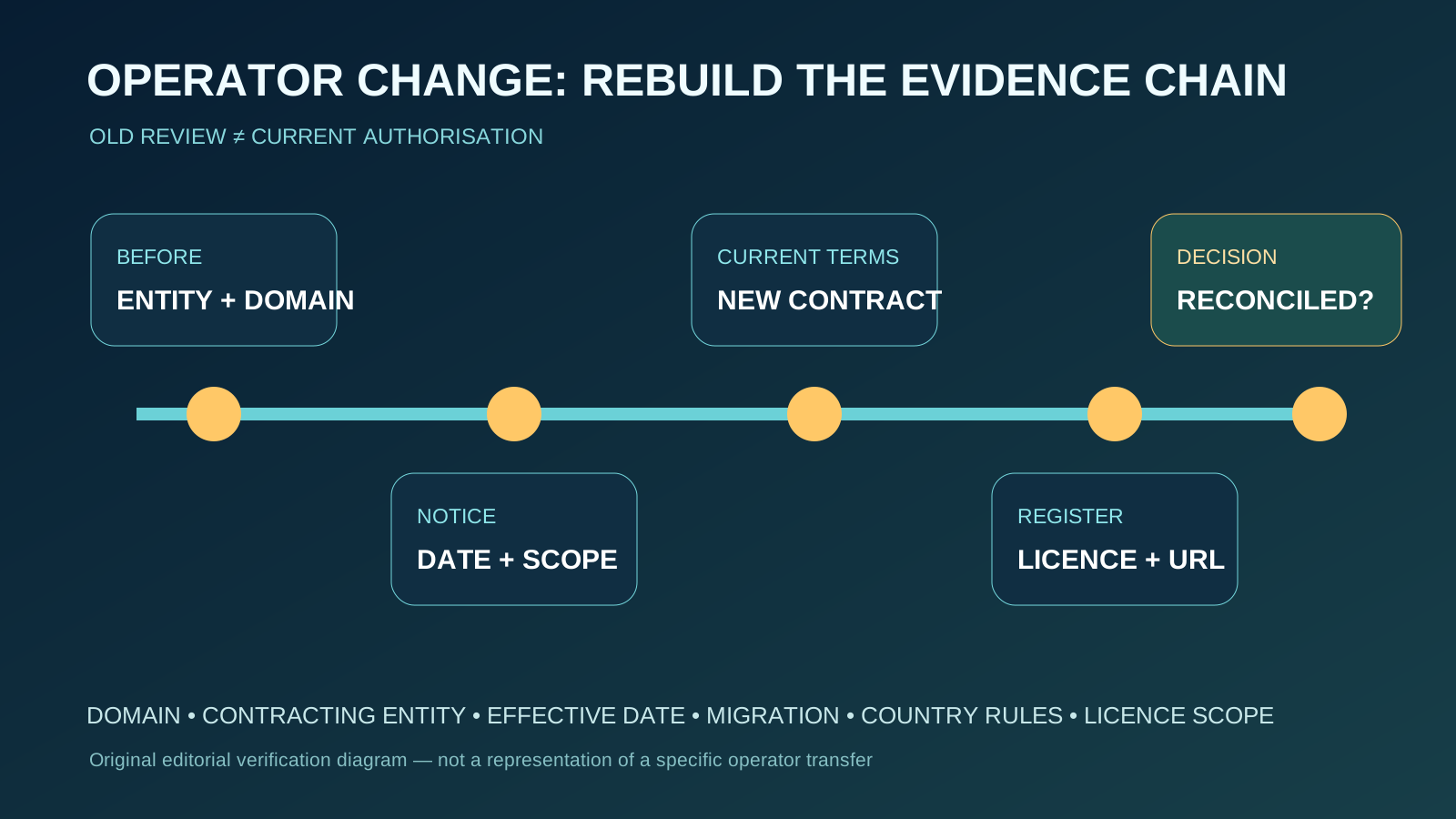
So the first question about a new brand is not when the site appeared but which company stands behind it. Our guide to operator and ownership changes covers the signals worth watching when that layer shifts underneath a familiar interface.
What a launch date can actually be measured from
Several independent artefacts carry dates: domain registration records, the earliest archived capture of the site, the revision date on the terms, a commencement date on a licence record, and the date of a press announcement. They often disagree, and the disagreements are the informative part.
A domain registered years before the brand launched, or terms whose revision history starts long before the marketing campaign, both suggest continuity with something earlier. A licence record naming a company with other brands attached points the same way.
Collect the dates rather than accepting the one in the headline, and write down where each came from. “Launched this year” is a marketing sentence; a set of dated artefacts is a record you can reason about.
The evidence only time produces
Some of the most useful facts about an operator cannot exist yet for a genuinely new one. How it behaves when a large withdrawal is requested. How it handles a verification dispute. Whether limits are applied promptly. How an ownership change is communicated. Whether a licence survives renewal.
Complaint patterns are the clearest case. A single bad account story is weak evidence in either direction; a pattern across time, methods and amounts is strong. A brand with no history has neither, which is an empty record rather than a clean one.
Absence of negative evidence is consequently not positive evidence. The honest reading of a three-month-old brand is that the questions mattering most remain open, and anyone presenting that silence as a recommendation is overreaching.
Why newness reads as a strength in marketing copy
Launch messaging leans on a few reliable notes: the most generous offer the brand will ever run, a modern interface, a long supplier list, and the implication that early users are getting in before the terms tighten. Each note is designed to make a short record feel like an advantage.
Scarcity framing usually joins it. Limited-time launch promotions compress the decision window at exactly the point where available evidence is thinnest, which inverts the order a careful reader would choose.
The counter-move is simply to slow down. Nothing about a new brand becomes unavailable by being checked, and a promotion that cannot survive a day of document reading was not a sufficient reason to deposit.
New brands and the New Zealand transition
Timing interacts with local rules in a specific way here. The transitional pathway the Department of Internal Affairs describes refers to providers that were serving New Zealand before 1 May 2026, with operating restrictions changing on 1 December 2026 and licences expected from early 2027.
A brand launching after those reference points cannot hold the pre-commencement history the interim arrangements describe, whatever its promotional copy implies about local availability. This guide does not treat a localised page or an NZ$ cashier as evidence of a New Zealand position.
Once the public register under the Act carries entries, the check becomes concrete: match the company and platform in the entry to the service in front of you. Until then a new brand’s New Zealand status is unresolved, and our legal-status page carries the dates rather than a verdict.
Terms churn most in the first year
Early documents get revised. Country lists, bonus mechanics, verification thresholds, withdrawal limits and complaint routes are all commonly adjusted once an operator sees real traffic, real payment behaviour and real regulatory attention.
That makes the revision date more important than usual, and it makes saving a copy worthwhile. The version in force when you deposited is the version that governed that deposit, and there is no guarantee it will be retrievable from the site later.
Watch for silent changes in particular. A document updating without a visible revision marker, or a clause narrowing while the summary page stays word-for-word identical, tells you something about how an operator treats its own record.
What a short record does legitimately show
A new site can be checked thoroughly on today’s evidence, and some of that evidence is unusually clean. The company named in the terms, the exact domain, the readability of the contract from a New Zealand view, the supplier list in the lobby and the methods offered in the cashier are all observable now.
Technical and housekeeping basics are observable too: whether the domain resolves consistently, whether the terms and privacy policy name the same data controller, whether account limits and self-exclusion controls can be found and applied rather than merely linked.
A new brand publishing a complete, readable, internally consistent set of documents is giving you more to work with than an older brand whose contract you cannot open. Age is one field among several, not a substitute for the rest.
Hold a new brand to the same standard
Apply the checks you would apply to anything else, and grant no discount for freshness. Company identity across the terms, privacy policy and payment descriptor; country eligibility; account currency; a withdrawal route in your own name; a findable complaint path.
Then add the two checks specific to newness. Date the launch from independent artefacts rather than the announcement, and look for continuity with an earlier brand or platform under the same ownership.
Where a field cannot be resolved, leave it unresolved and let it weigh against the decision. Our methodology page sets out the evidence standard this guide applies, and dated changes are published through the sources and updates record.
New online casinos: reading a short record: common questions
Are new online casinos riskier than established ones?
They are less documented, which is not the same thing. The questions a long record answers — withdrawal behaviour, complaint handling, licence renewal — are simply still open, so the decision rests more heavily on today’s checkable evidence.
How do I find out when a casino actually launched?
Compare independent artefacts: domain registration records, the earliest archived capture, the terms revision history and any licence record date. Where they disagree, the earlier dates usually indicate continuity with something that existed before the brand.
Is a bigger launch bonus a good reason to join a new site?
It is a commercial reason rather than an evidential one. The offer’s value depends on wagering mechanics, bet caps, weightings and exclusions in the campaign terms, and none of that addresses whether an account can be funded and cashed out reliably.
Does a new brand need a New Zealand licence to accept me?
Under the framework this guide tracks, licences are expected from early 2027 and no offshore operator is identified here as New Zealand-licensed. Whether a particular operator will accept a New Zealand resident is a separate, contractual question answered in its terms.
What is the clearest warning sign on a new site?
A company identity that does not match across the terms, the privacy policy and the payment descriptor. Inconsistency at that layer undermines every other claim on the site, including the claims that happen to be accurate.