Short answer
Evidence-led verdict
Freaked out Fish is a Relax Gaming first-party title identified in the checked demo as freakedoutfish. The information panel is marked version 1.1.3 but does not print a help date. The current official product page, Own Games catalogue and playable demo establish public release by the check date, but we did not locate a dated first-party launch announcement. The rules describe a seven-column, seven-row cluster grid with cascades, multiplier zones and retriggerable Free Games. Those identifiers matter because lower-return builds and market-specific clients can share the same artwork.
The checked help states a theoretical RTP of 96.02%, equivalent to a 3.98% theoretical house edge. That is the figure for the client opened during this review, not proof that every operator deploys the same build. Relax's product record lists alternative game IDs, so the percentage inside the exact live client remains the controlling value.
The current v1.1.3 help states a 30,000x maximum. If accumulated Free Games wins reach the limit, the feature ends immediately and unused spins are forfeited. The reference stake range is €0.10 to €30. The risk profile is not stated in the checked first-party help or product record; return and prize information do not predict whether a feature or large award will occur in a session.
This page confirms studio authorship, current help text and public release status. It does not claim that a New Zealand operator offers the title, that a demo is a local real-money product, or that a displayed euro-denominated reference range will appear as NZD. Those questions require a separate operator and live-client check.
- Game ID
- freakedoutfish
- Help checked
- checked 6 October 2026; no help date printed · v1.1.3
- RTP checked
- 96.02%
- Win cap
- 30,000x
Exact first-party build
Release status and the undated v1.1.3 record
Freaked out Fish appears on Relax Gaming's current product site and Own Games page, and the first-party demo is playable. Together those sources establish that it is a released Relax title by 6 October 2026 rather than partner content carried only by the aggregator.
The loaded client identifies itself as “freakedoutfish” and prints version V1.1.3. Unlike the newer help panels checked for several other Relax games, this one does not show a help date. We therefore record the inspection date and version without inventing a publication day.
The product page lists freakedoutfish_94 and a German freakedoutfish_86 build. The suffixes remain identifiers. The actual opened help states 96.02% base RTP and separately states the Ante and purchase returns, which is the evidence needed for percentage claims.
No dated first-party launch post or formal volatility label was located in the checked source set. A current public catalogue proves release status but does not supply the missing date. Likewise, feature complexity is not a licence to manufacture a “high volatility” classification.
Adjacent-symbol evaluation
Five-symbol clusters and cascades
The checked game uses a seven-by-seven grid. A winning cluster contains at least five matching symbols connected horizontally or vertically. Diagonal contact alone does not join two groups, and matching symbols elsewhere on the grid do not merge across a gap.
Winning symbols disappear after evaluation. New symbols fall into the empty positions, creating a cascade that can form another cluster without charging a new base-game stake. The cascade sequence ends when no new winning cluster appears.
Each cascade can interact with multiplier zones already created in that paid round. This makes position history important: two clusters with the same symbol count can settle differently if one overlaps marked cells. The win history and zone state are stronger evidence than a screenshot of the final symbols alone.
Cascades do not make a later win inevitable. Removing symbols changes the current grid under the feature model, but it does not create a debt owed by the random generator. A long cascade is one outcome sequence, not a forecast for the next paid spin.
Position-based multipliers
How Freaky Fish Zones grow to 128x
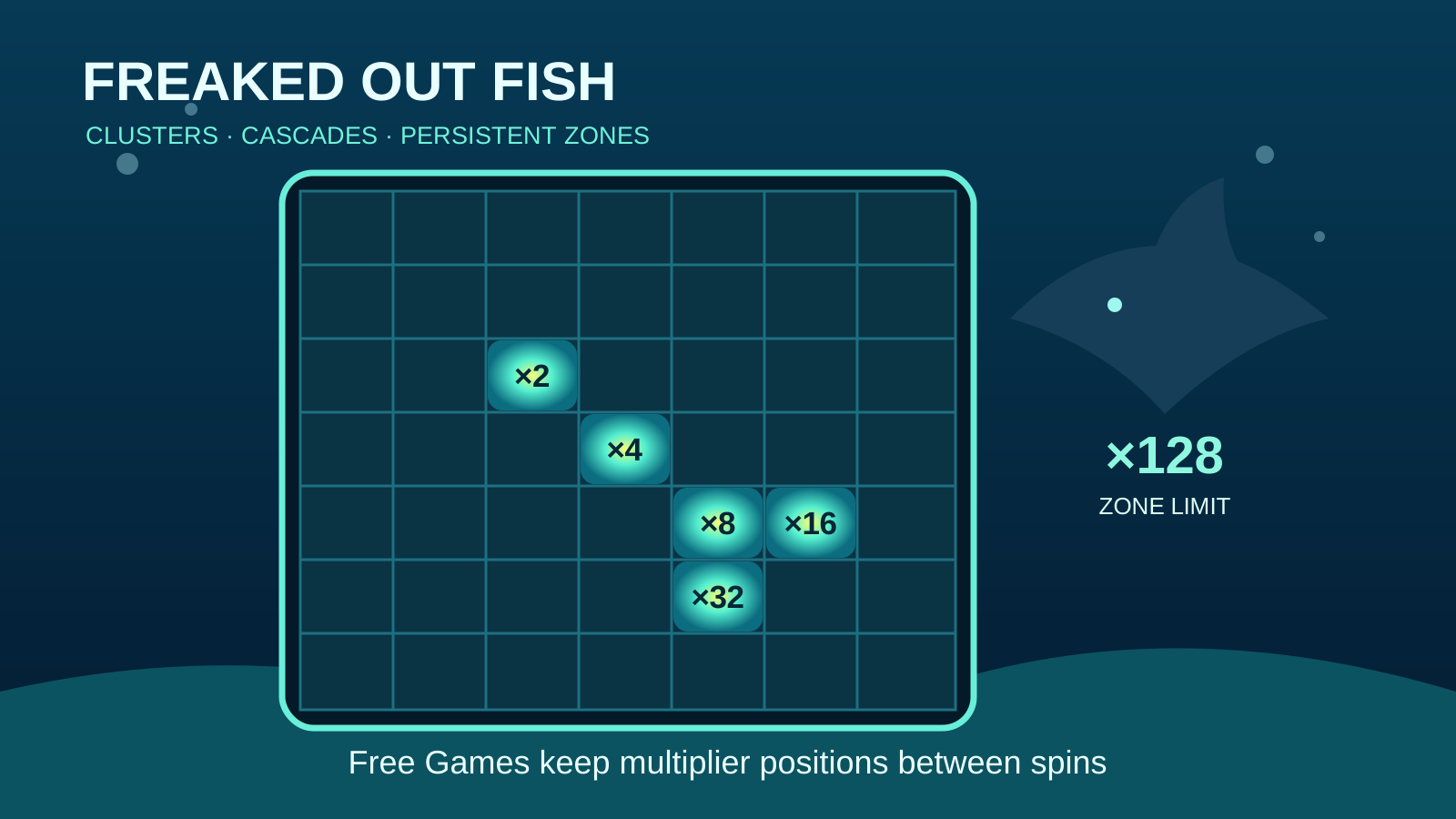
When a winning combination uses a position, it leaves a Freaky Fish Zone there. A second win in the same position adds a 2x multiplier. Every additional winning combination in that position doubles the multiplier until the documented maximum of 128x.
If one cluster overlaps more than one multiplier position, the relevant multipliers are added together before being applied to that win. They are not multiplied by one another. A 4x zone and an 8x zone therefore contribute 12x under the stated addition rule, not 32x.
During the base game, zones survive only through the current paid spin's cascade sequence. They clear after cascades end. During Free Games, they persist between spins until the feature finishes, creating a materially different accumulation window.
A random Zone Upgrade can raise selected zones by one level in either base play or Free Games. Extra Freaky Fish Zones can also place new marked positions without requiring a win on those cells first. Neither event guarantees that a later cluster will cross the upgraded positions.
Grid modifiers
Mega Whale, zone upgrades and extra zones
The Mega Whale selects a random symbol on the reels and changes the surrounding area into a three-by-three winning cluster. The feature can trigger in both the base game and Free Games. Its selection remains random; the animation does not let the player choose the symbol or position.
The Zone Upgrade and Extra Zone features also operate in both modes. An upgrade advances marked cells, while the extra-zone event creates a random number of zones without a preceding cluster. These are different operations and should not be collapsed into one generic “multiplier boost.”
A Mega Whale cluster can enter the cascade process and interact with zones under the normal evaluation rules. The presence of a three-by-three block does not by itself show its value: symbol type, active zone multipliers and subsequent cascades all matter.
The official product copy highlights mega symbols and mystery multipliers, but the live paytable supplies the operational wording used here. Marketing names are useful navigation labels; exact trigger, position and settlement rules must come from the playable help.
Persistent zones
Ten to 30 Free Games and retriggers
Three, four, five, six or seven scatter symbols award 10, 12, 15, 20 or 30 Free Games respectively. The mapping is exact: the number of scatters changes the starting spin count rather than merely increasing an unspecified bonus.
Freaky Fish Zones remain on the grid throughout Free Games. That persistence is the central difference from base play, where the zones clear when the current spin's cascades finish. New wins can therefore develop the same positions across several feature spins.
The feature can retrigger. A retrigger adds spins under the live rules, but the cap still controls total settlement. If accumulated feature wins reach 30,000x bet, the round ends immediately and the help says remaining Free Games are forfeited.
A large starting award or purchase is not a guarantee that zones will overlap clusters. Free spins remove additional wallet debits for the internal feature rounds, but the initiating base stake or full purchase price has already been exposed.
Configuration changes must stay separate
Ante Bet and three Buy Bonus routes
Ante Bet increases the stake by 50%, adds more scatter symbols and makes entry to Free Games more than 150% as likely according to the help. Its theoretical RTP is 96.11%. The Buy Bonus control is disabled while Ante is active, preventing the two optional routes from being stacked.
The first purchase costs 90x bet and supplies three scatters for 10 Free Games at 96.12% RTP. The middle route costs 150x, supplies four or five scatters for 12 or 15 spins and states 96.15%. The highest route costs 550x and supplies six or seven scatters for 20 or 30 spins at 96.12%.
Those routes do not form a simple ladder in which the most expensive always has the highest return. The middle purchase has the highest published RTP of the three, while the 90x and 550x routes share 96.12%. Price, starting spins and long-run return are separate comparison fields.
At any stake, the whole purchase price can return less than it cost. Feature buying can also be unavailable under operator or jurisdiction rules. If a control is absent, this page does not provide a workaround or a second “bonus” URL.
Live-help evidence
RTP, house edge and alternative builds
The information panel in the checked official demo states “the theoretical return to player for this game is 96.02%.” Subtracting that value from 100% gives a theoretical house edge of 3.98%. Both numbers describe the same long-run mathematical relationship from opposite directions; they are not separate charges and they are not a forecast for a deposit.
| Checked mode or route | Theoretical RTP | How to use it |
|---|---|---|
| Base game in official demo | 96.02% | Verified in help: checked 6 October 2026; no help date printed |
| Ante Bet | 96.11% | Costs 50% more and increases scatter presence; Buy Bonus is disabled |
| Buy Bonus · 3 scatters / 10 Free Games | 96.12% | Costs 90x the selected bet |
| Buy Bonus · 4–5 scatters / 12–15 Free Games | 96.15% | Costs 150x the selected bet |
| Buy Bonus · 6–7 scatters / 20–30 Free Games | 96.12% | Costs 550x the selected bet |
A return of 96.02% means that across the model's very large test horizon, average awards correspond to 96.02 units for every 100 units staked. It does not mean a player receives that percentage back after 100 spins. High variation, rare features and capped awards can produce short samples far above or below the designed average.
Alternative game IDs are material even when their exact returns are absent from the public product card. A casino can deploy a lower-RTP build under the same consumer title. We therefore do not label 96.02% “universal” or “guaranteed.” Open the information control in the operator client and look for the percentage after the game has loaded.
Do not infer RTP from a demo balance, one successful bonus, a streaming clip or a site's headline card. A random sample cannot identify the configured model reliably. The useful audit record is the exact title, visible game ID or version, displayed RTP, date and operator client captured together.
Distribution, not prediction
Volatility and maximum-win limits
Neither the current v1.1.3 help nor the official product record checked for this article assigns a formal volatility category. The presence of persistent multipliers, feature purchases and a large cap suggests uneven outcomes, but that observation is not a substitute for a provider label or a measured distribution.
The current v1.1.3 help states a 30,000x maximum. If accumulated Free Games wins reach the limit, the feature ends immediately and unused spins are forfeited. “Times bet” uses the full paid stake for the initiating round, not one coin, one line or the balance. A $1 hypothetical stake makes the scale easy to understand, but it does not assert that NZD play is offered.
A cap is a settlement limit, not a realistic session target. It provides no countdown, hit schedule or evidence that raising the stake improves the chance per dollar. Previous non-winning spins do not move a random future result closer to the cap. Treat every paid round as new exposure.
Practical risk is also shaped by total stake, spin speed, feature purchases, enhanced-spin options and session length. A lower stake repeated rapidly can expose more money than a higher stake used briefly. Decide the total acceptable loss before opening the game, then use account limits and breaks rather than chasing a feature.
Read the charged amount
Bet range, optional costs and affordability
The product record gives a reference minimum of €0.10 and maximum of €30. Those euro-denominated figures identify the provider's reference build. They do not promise equivalent NZD controls, and an operator can apply different denominations or account limits.
Always read the total bet immediately before a paid action. The interface can show denomination, level, lines and total stake separately. Enhanced spins or bonus-reel options may increase the price of a round, while a feature purchase can cost many multiples of the base stake. The amount leaving the balance is the relevant measure.
A useful pre-session calculation is total bet multiplied by the maximum number of rounds you are prepared to buy, assuming the entire amount can be lost. For a feature purchase, treat the whole displayed price as exposed at once. Do not finance a purchase by increasing the base stake after losses.
Promotional funds do not change the slot's RTP. Wagering requirements, game contribution, maximum-bet rules and cash-out limits sit in the operator's terms. Check them independently, because a bonus can make an otherwise permitted game or stake ineligible.
Interface verification
Mobile help and what a demo can prove
The official web demo loaded a responsive game client and exposed the title, help date, version, rules and return information used here. On a phone, locate the menu, information icon, total bet, balance and paytable before considering a paid round. If text is clipped, rotate the device or expand the help rather than relying on a search result.
A demo can demonstrate symbol movement, feature order, mode selection and interface controls with valueless credits. It cannot establish that a real-money operator accepts players in New Zealand, that the operator uses the same game ID, or that its active RTP matches the demo.
Demo results also cannot validate the long-run RTP. Ten, one hundred or even thousands of observed spins are a noisy sample, especially in a volatile game. A large demo win is not a prediction for paid play and a dry demo sequence is not proof that the published mathematics is wrong.
If desktop and mobile help disagree, pause. Record the exact URL or operator, title, mode, help version and percentages. The mismatch can indicate a cached client, a market build or an update. Current deployed help is stronger evidence than an undated review, but conflicting clients still need clarification.
Separate evidence chain
New Zealand access is not inferred from the demo
Relax Gaming's own-games catalogue and public demo show that the studio publishes Freaked out Fish. They do not show that a named operator lawfully offers it to a person in New Zealand. Studio publication, aggregation, operator inventory, territorial access and legal status are separate claims.
Before any real-money use, verify the operator's identity, current New Zealand terms, age and location controls, payments, withdrawals, complaints, account limits and self-exclusion tools. A localised page, NZD wallet or country flag is not on its own regulatory proof.
New Zealand's online-gambling position is time-sensitive. Check the Department of Internal Affairs player guidance and our dated legal-status guide at the point of use. This review is about one game's rules and does not provide legal advice.
Even after an operator check, inspect the live game help. A valid operator relationship does not prove the highest RTP, and the right RTP does not prove operator status. Keeping both questions separate prevents a global demo from becoming an unsupported availability claim.
Source reconciliation
What the checked sources establish
The official product page establishes first-party authorship, public release status, layout, reference bets, headline features and the supported market game IDs. The loaded demo supplies the stronger operational evidence for rules, version, displayed RTP, purchase route and win-cap wording.
The current product and Own Games records establish first-party status. The loaded v1.1.3 help supplies the seven-by-seven cluster model, zone progression, random modifiers, scatter awards, all four RTP configurations, prices and hard 30,000x limit. No help date, dated release announcement or formal volatility label was found, so those gaps remain visible.
Third-party reviews were used to find frequent questions and contradictions, not to override the live help. Competitors often print only the largest cap, omit the selected mode, describe alternative IDs as exact RTPs without a source, or treat global demo access as operator availability.
The evidence was checked on 6 October 2026. The date matters: Relax can update a client or product card, and operators can retain another certified build. Future checks should start with the deployed help and compare its identifier, version and return with this record.
We do not add a hit rate, feature frequency, universal volatility score, New Zealand operator claim or exact alternative RTP unless the checked first-party material supports it. An explicit evidence gap is preferable to a precise-looking number copied from another release.
Two-minute audit
Checklist before relying on this guide
- Match the full title Freaked out Fish and developer Relax Gaming.
- Confirm game ID freakedoutfish, help date checked 6 October 2026; no help date printed and version 1.1.3 where shown.
- Check the layout: a seven-column, seven-row cluster grid with cascades, multiplier zones and retriggerable Free Games.
- Read feature triggers, reset rules and settlement order in the live help.
- Record the active RTP rather than assuming 96.02%.
- Recheck the exact maximum wording: 30,000x.
- Read the displayed total stake after enabling any option.
- Verify operator identity and New Zealand access independently.
- Check promotional terms separately from game mathematics.
- Set money and time limits that remain acceptable if no feature arrives.
If the live help differs, use that deployed build and send the title, game ID, version, date and screenshot through our corrections process. That evidence lets us update one canonical review without creating duplicate RTP or bonus pages.
Exact-title navigation
Related rules and provider guides
Slot RTP and house edge explained — separates a long-run mathematical return from the result of a short session.
Relax Gaming own-games guide — keeps first-party titles separate from games supplied through the aggregation platform.
Compare the active RTP, evaluation model, feature trigger, purchase price, volatility evidence and maximum-win unit—not the loudness of the theme. Those fields show whether two games genuinely create different risk and rules.
Our Relax Gaming guide keeps in-house releases apart from partner content carried by the aggregator. Each game then has one complete canonical URL for rules, RTP, mobile help and demo limits.
Questions answered
Frequently asked questions
What is the Freaked out Fish RTP?
The checked v1.1.3 help states 96.02% for base play, 96.11% for Ante and 96.12%, 96.15% or 96.12% for the three documented purchases.
How do wins form in Freaked out Fish?
Five or more matching symbols must connect horizontally or vertically. Winning symbols disappear and new symbols cascade into the gaps.
What do Freaky Fish Zones do?
A first win marks a position. A second win there starts a 2x multiplier, and later wins double it up to 128x. Multiple zones in one win are added.
How many Free Games can the scatter trigger award?
Three, four, five, six or seven scatters award 10, 12, 15, 20 or 30 Free Games. The feature can retrigger.
What is the Freaked out Fish maximum win?
The checked help limits the game to 30,000x bet and ends the round when Free Games reach that amount.
Evidence record
Primary sources
Facts and configurations were checked against the following first-party records. A public product page is not proof that a game is available through a New Zealand operator.
- Relax Gaming — Freaked out Fish product pageChecked 6 October 2026
- Relax Gaming — official demo and help v1.1.3Checked 6 October 2026
- Relax Gaming — Own GamesChecked 6 October 2026
- New Zealand Department of Internal Affairs — online gambling for playersChecked 6 October 2026