Short answer
Read the evidence label before the verdict
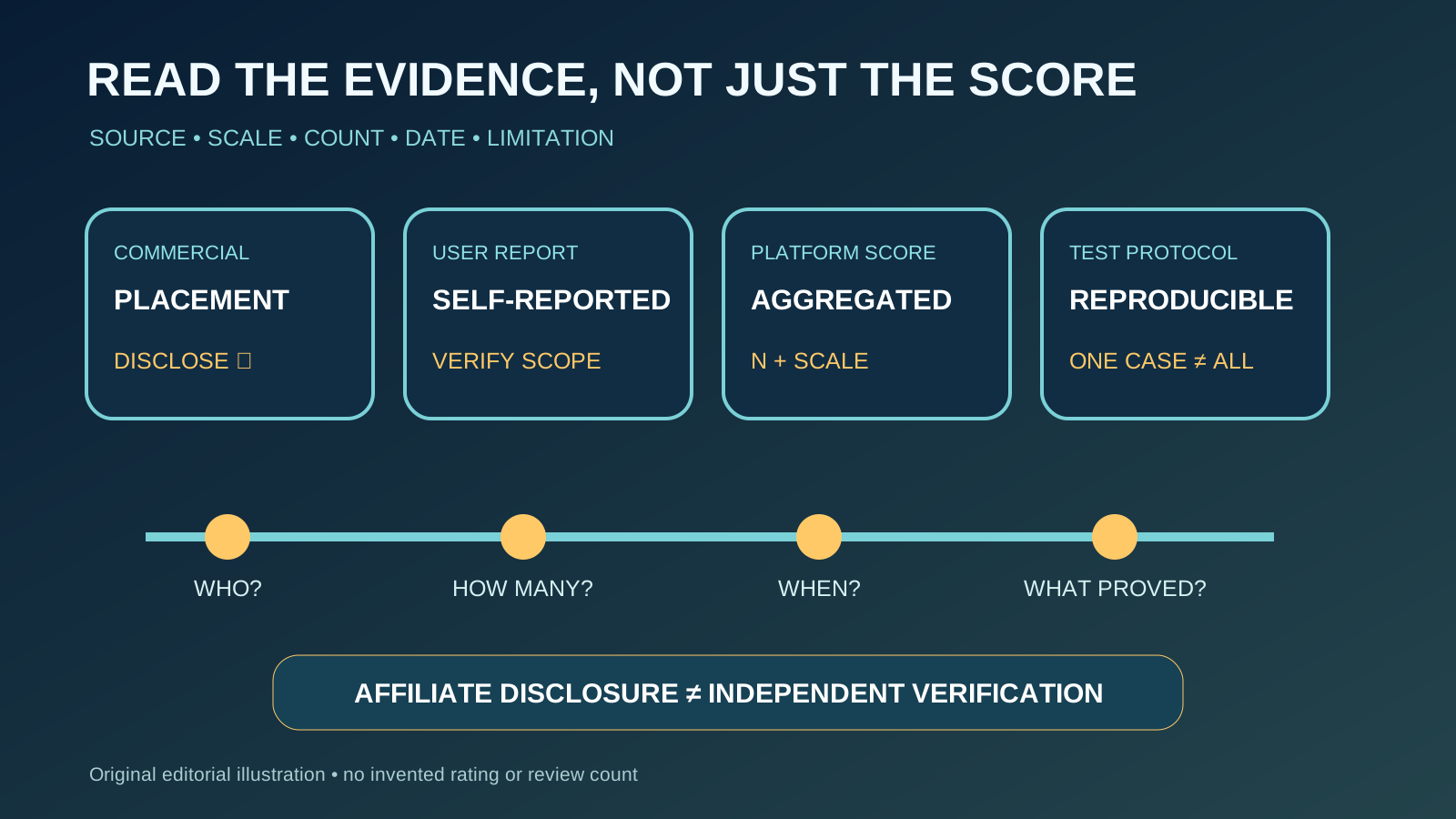
A crypto casino review can contain five very different things: paid or commission-linked placement, an editor’s structured assessment, self-reported player comments, a platform’s aggregate score and an independently documented test. They may appear beside each other, but they do not carry the same weight or answer the same question.
Start with provenance. Identify the publisher, commercial relationship, method, source, scale, observation count and collection date. Then ask what the material can support. A dated screenshot of terms can support what those terms said; it cannot prove a successful withdrawal. A verified transaction can support that one transfer occurred; it cannot prove every user’s future result.
Do not treat “top”, “trusted”, “verified”, “best” or five illustrated stars as data unless the publisher defines the scale and shows the underlying evidence. Decorative confidence is not a measurement system.
This guide provides a general crypto-casino editorial method. It does not create another review of Cloudbet, 22Bet or any other operator, and it does not invent player totals, ratings or personal tests.
Classification
Separate claims by origin and verification level
Commercial placement answers who receives visibility under an advertising or affiliate arrangement. Editorial analysis answers how the publisher interpreted selected evidence. User feedback reports an individual’s account, while a platform score mathematically combines accepted reviews under platform rules.
A verified sample adds a check that the reviewer, transaction or event met stated criteria. Independent testing applies a protocol performed by someone sufficiently separate from the operator and commercial placement. Neither label is meaningful unless its criteria are published.
Primary records include operator terms, regulator entries, company registers, game help and transaction records supplied with suitable privacy controls. Secondary evidence includes journalism, affiliate articles and review-platform summaries. User testimony is direct about the author’s claimed experience but is not automatically authenticated.
Use a clear tag beside each claim: operator-published, regulator-controlled, publisher-tested, user-reported, platform-aggregated or commercially placed. The tag prevents a marketing position from borrowing the credibility of unrelated evidence.
Revenue relationship
Affiliate placement is not an independent performance result
An affiliate publisher may receive a fixed fee, revenue share, cost-per-acquisition payment or another benefit when a reader follows a link or becomes a customer. That relationship can fund useful research, but it creates a material interest in clicks and conversions.
Record whether payment affects inclusion, order, badges, calls to action or editorial wording. A page can have independently researched facts and still give paid partners prominent placement. The two layers should be visible rather than blended into one unexplained rank.
A high position does not prove that the casino has the best withdrawal record, safest custody or broadest NZ eligibility. To support those conclusions, the publisher needs current evidence about those exact fields and a method that compares every candidate consistently.
If the commercial arrangement is unknown, label the ranking’s independence unverified. Do not infer corruption, but do not describe the order as neutral evidence either.
Material connections
A useful disclosure is clear, close and specific
The US Federal Trade Commission’s endorsement guidance emphasises disclosure of material connections that could affect the weight or credibility readers give an endorsement. That is a useful evidence principle even though legal obligations differ across jurisdictions.
New Zealand advertising standards also require advertising to be identifiable. For a casino comparison, a visible explanation near the ranking is more useful than a vague footer statement saying the site “may receive compensation”.
The disclosure should explain the payment model at a practical level and whether commercial relationships affect order. It should remain visible on mobile and should not require a reader to infer that a button or table is sponsored.
Disclosure does not validate the claims. It helps readers interpret incentives. Facts such as the current operator, country restrictions and withdrawal terms still require their own sources.
Scoring model
A ranking needs criteria, weights and reproducible inputs
List every criterion before publishing a score. Examples may include identity evidence, current country wording, licence-register match, custody explanation, account security, game-help access, safer-gambling controls and quality of documented support routes.
Define the scale. A score of 8.4 is meaningless without knowing whether it is out of ten, how decimals are produced and which evidence earns each point. Publish weights and state whether a critical failure caps or blocks the result.
Separate unknown from poor. A missing withdrawal-limit document should not be assigned the same numeric value as a verified harmful term unless the method explicitly explains that choice. “Not verified” is often the honest result.
Apply the same date window and evidence rules to every operator being compared. A current terms check for one brand and a two-year-old affiliate summary for another creates a precise-looking but invalid order.
Self-reported experience
User feedback is a report, not an automatically proven event
A player comment can reveal issues that formal terms omit: a confusing document request, delayed response, account closure or smooth withdrawal. Its value depends on context such as date, jurisdiction, payment method, status and whether evidence supports the event.
One account does not establish frequency. A complaint can be genuine without proving a system-wide practice, while a positive comment cannot show that all withdrawals are fast. Aggregate conclusions need a defined sample.
Do not publish passwords, identity files, full wallet addresses, payment-card data or active support tokens as proof. Useful evidence can redact personal details while preserving date, amount range, network, transaction status and correspondence sequence.
Label quotations as user-reported unless the editorial team independently verified the relevant record. Verification should specify exactly what was checked rather than turning the whole story into a blanket “verified review”.
Verification label
Define what “verified” means for each observation
A platform may verify an email, invitation, purchase, account ownership or transaction. Those checks are not equivalent. “Verified user” can mean only that the person controlled an account, not that every factual claim was audited.
Publish the verification rule: documents accepted, who reviewed them, privacy handling, whether the operator could nominate respondents and how disputes or edited reviews are treated. Avoid requiring excessive personal data merely to create a badge.
For a withdrawal report, an editor might check a redacted account record and public transaction identifier. That can support amount, asset, network and timing for that event, but it may not explain internal review time or prove the same experience for another customer.
Use narrow labels such as “account ownership checked”, “transaction ID checked” or “support transcript reviewed”. Narrow language gives readers more information than a large generic tick.
Aggregate systems
A platform score inherits the platform’s rules
An aggregate score is a transformation of the reviews the platform accepted, retained and weighted. To interpret it, identify the rating scale, total count, date window, rounding, recency weighting and treatment of removed or disputed submissions.
Platforms differ in invitation systems, moderation, identity checks, operator responses and fraud detection. A score from one platform should not be compared directly with another unless the methods are compatible.
The UK Competition and Markets Authority’s guidance addresses fake reviews, concealed incentivised reviews and misleading presentation of review information. Its framework reinforces that an aggregate can mislead when the underlying inputs or display are manipulated.
Record a platform score only as a dated platform observation: “X on scale Y from N displayed reviews on date D,” when those exact values were actually checked. This guide intentionally supplies no invented stars or totals.
Denominator
Always ask “out of how many, collected how?”
A percentage without a denominator hides uncertainty. Nine positive reports out of ten and nine hundred out of a thousand both equal 90%, yet their sampling error, diversity and manipulation risk differ.
Count unique observations after published duplicate rules. Explain whether one account can submit more than once, whether edited reviews replace earlier versions and whether multiple brands share a profile.
State the collection frame: all submissions, invited users, resolved complaints, withdrawals tested by staff or comments selected for publication. A convenience sample should not be presented as representative of all players.
Show missingness. If country, payment route or outcome status is absent for most reports, the dataset cannot support a precise New Zealand withdrawal conclusion even when the total count is large.
Time boundary
Casino evidence ages at different speeds
Operator entities, domains, country lists, bonus conditions, coins, networks, fees, game RTP profiles and support routes can change. Every dynamic claim needs an observation date and ideally a next-review trigger.
User feedback should include the event period rather than only the publication date. A comment posted today can describe a transaction from years ago under another company or cashier.
Scores need snapshot dates and counts because later additions and removals change both numerator and denominator. Do not reproduce a cached search snippet as a current platform score.
When a review is updated, distinguish a source refresh from a cosmetic edit. The modified date should not imply that every operator fact or test was repeated.
Reproducible checks
Independent testing needs a protocol and scope
A useful test defines the account jurisdiction, device, domain, date, deposit route, asset and network, game or cashier action, withdrawal request, verification requests and completion criterion. It records failures and inconclusive results, not only successes.
Independence requires disclosure of funding, affiliate relationships, operator-provided accounts and editorial control. A publisher can perform a real test while earning commission, but should not call it fully independent without explaining the relationship.
One test is a case study, not a population estimate. Repetition across dates, methods and accounts can broaden evidence, but ethical and legal limits apply. Do not create accounts using false residence, bypass country blocks or gamble merely to manufacture content.
For game fairness or RTP, a short playing session is not an audit. Use the site's game-test certificate guide to distinguish laboratory scope, exact versions and integration evidence.
Source example
Cloudbet terms can prove rules, not a review score
On 7 October 2026, Cloudbet’s current terms published country restrictions, account requirements, bonus provisions, closure rules and statements about informational content. Those clauses are primary evidence for what the operator says governs the account on that date.
The terms also say users should verify information against governing rules or support where appropriate. That is consistent with the wider method here: official contractual documents outrank an unsourced review summary for contract questions.
The document does not prove that a reviewer completed a withdrawal, that every customer received the same support outcome or that any external ranking is accurate. It is one evidence layer.
This article does not assign Cloudbet a rating or eligibility verdict. A full operator assessment belongs to its single owner URL and requires current counterparty, country, cashier and account evidence.
High-risk claim
“Fast withdrawals” needs a defined clock and sample
Separate request-to-review, operator approval, broadcast, blockchain confirmation and spendable receipt. A claim measured from approval excludes internal processing; a chain time excludes identity review and queue time.
Record median and range only when the sample supports them. Identify asset, network, amount band, verification state, account country and observation count. One unusually fast transfer should remain one case.
User comments may omit failed eligibility checks, bonus turnover or wrong-network mistakes. Operator marketing may describe an ideal automated path. Independent testing should compare both with the actual timeline.
Never promise a future withdrawal or label a casino “instant” from a button caption. The site's payment evidence guides own detailed timing methods; this page focuses on how review claims should be labelled.
Sampling bias
Who gets invited can shape the result
Voluntary public reviews often overrepresent very satisfied or dissatisfied users. Operator invitations can overrepresent recent, active or successfully completed interactions. Affiliate sites may hear mainly from readers who used their links.
Publish the invitation rule and response rate where known. An “all customers” invitation is more informative than a request sent only after a positive event, but non-response bias can remain.
Do not remove a report solely because it is negative or leave an incentive undisclosed because all reviewers received it. The CMA’s current guidance treats concealed incentivised reviews and misleading review information as material concerns.
Segment only when sample sizes remain meaningful. A tiny NZ subset should be shown as limited observations, not converted into a precise national score.
Publication controls
Moderation should remove abuse without manufacturing positivity
Publish rules for spam, duplicate submissions, hate speech, personal data, unsupported allegations, conflicts of interest and operator responses. Keep an audit trail for edits and removals.
Give reviewers a route to supply evidence privately and correct factual mistakes. Give operators a right to respond, but do not let payment buy removal or suppress a good-faith negative account.
Separate authenticity from outcome. A genuine customer can misunderstand terms; a correct factual point can come from an unverified account. Moderation and fact-checking are related but distinct processes.
Display material incentives and invited-review status near the review. Avoid combining reviews of different legal entities, domains or product versions under one timeless brand profile without a transition note.
Worked comparison
How to read “#1 casino, 4.9 stars, verified payouts”
First, identify whether #1 is sponsored placement or the output of a published comparison model. Find the criteria, weights, candidate set and evidence date. If none exist, treat the position as a promotional label.
Second, inspect the 4.9 score. Find the platform, scale, count, collection window, rounding and moderation method. If the number is copied without those fields, it cannot be reproduced.
Third, unpack “verified payouts”. Ask how many, which assets and networks, what time boundary, which account conditions and who verified the records. A single checked transaction should be described as one checked transaction.
Finally, compare current terms, legal entity, country clause and cashier evidence. A strong review dataset does not override a contractual restriction, and official terms do not validate an affiliate rank.
Two-minute audit
Crypto casino review evidence checklist
- Identify the publisher and author.
- Find the affiliate or sponsorship disclosure.
- Ask whether payment affects inclusion or order.
- Locate the ranking criteria, weights and candidate set.
- Record the rating scale and exact source.
- Record the displayed count and denominator.
- Check the collection period and observation date.
- Distinguish self-reported from independently checked claims.
- Read what a “verified” label actually verifies.
- Inspect invitation, incentive and moderation rules.
- Keep one tested transaction as one case, not a guarantee.
- Recheck current terms, entity, country and cashier facts.
- Do not infer NZ eligibility from a platform score.
- Label unknown and conflicting fields explicitly.
Reusable record
Publish an evidence card beside every material verdict
The card should include claim, evidence type, source owner, URL or record identifier, scale, observation count, collection period, checked date and limitation. For a qualitative conclusion, explain the threshold that produced it.
Include commercial status: no relationship identified, affiliate relationship, fixed sponsorship, operator-provided access or another material connection. Do not make readers hunt through legal boilerplate.
Use correction history. When evidence changes, preserve the prior date and describe the replacement. If an old review refers to another entity or domain, link the site's operator-change checklist.
Where no reproducible evidence exists, publish “not verified” instead of a neutral-looking midpoint score. Honesty about missing data is a useful editorial result.
Evidence boundary
No review system can guarantee the next account outcome
Even a large genuine sample describes observed users under past conditions. Operator policies, fraud controls, networks and individual verification needs can change. A future user may experience a different path.
Review platforms cannot always authenticate identity or cause. Publishers cannot inspect private operator systems. Operators can provide authoritative terms while still omitting operational performance data.
This method improves traceability rather than promising perfect truth. It requires dated claims, transparent commercial relationships, reproducible methods and narrow language.
The guide is editorial methodology, not legal advice, a player rating or an endorsement. Confirm New Zealand rules and the exact operator contract independently before creating an account or transferring value.
Questions answered
Frequently asked questions
Does an affiliate disclosure make a casino ranking independent?
No. It discloses a commercial relationship. Independence and accuracy still depend on the ranking method, evidence, update date and separation between commercial and editorial decisions.
Is a platform star score proof that withdrawals are reliable?
No. A score aggregates the platform’s accepted reviews under its own scale and moderation rules. It does not by itself verify every account, transaction or cause of a complaint.
What should a review count include?
It should identify the denominator, source, collection period, inclusion and removal rules, duplicate handling and whether one person can submit more than one observation.
What can independent testing prove?
Only what its documented protocol actually examined—for example a dated account path, a specific withdrawal or a named game build. One test cannot prove universal performance.
How should an old casino review be used?
Keep stable explanations, but recheck dynamic fields such as company, domain, country rules, cashier, licence status, bonuses and support before treating its conclusion as current.
Evidence record
Primary sources
Facts and configurations were checked against the following first-party records. A public product page is not proof that a game is available through a New Zealand operator.
- Cloudbet — current terms and conditionsChecked 7 October 2026
- FTC — endorsements, influencers and reviews guidanceChecked 7 October 2026
- UK Competition and Markets Authority — fake reviews guidanceChecked 7 October 2026
- UK Competition and Markets Authority — short guide for review publishersChecked 7 October 2026
- New Zealand Advertising Standards Authority — Advertising Standards CodeChecked 7 October 2026