Short answer
A loyalty benefit and a market asset answer different questions
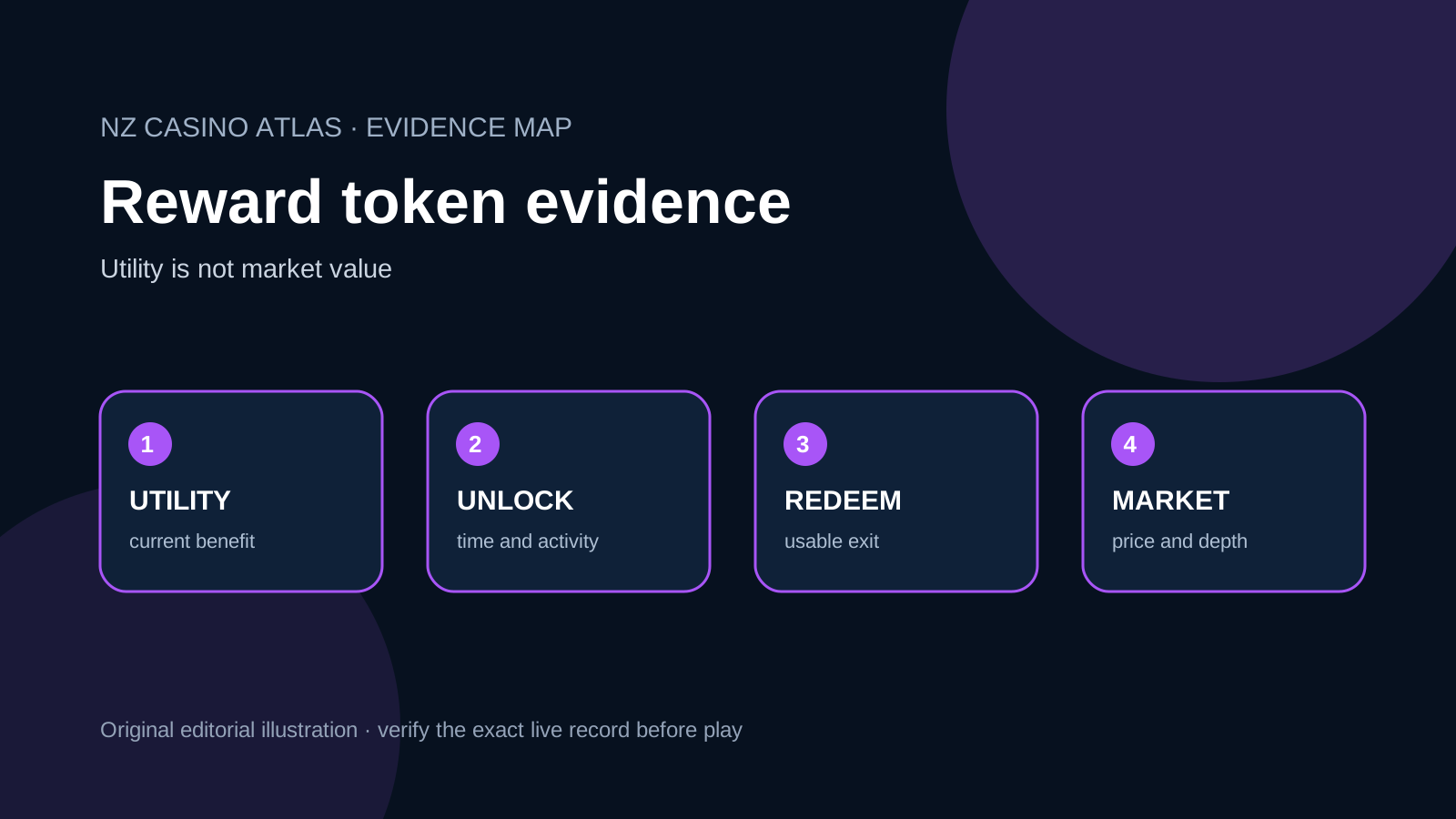
A benefit is useful only under current programme rules: what action earns it, when it unlocks, where it can be used, who is eligible and what can be redeemed. Market value asks whether the token can be transferred and sold, at what price, with what depth, fees and legal restrictions. Neither proves the other.
A token can provide real account utility while falling sharply in price. It can also trade at a high quoted price while an account cannot claim, withdraw or use an allocation. Treat every step—earning, allocation, unlock, claim, withdrawal, swap and sale—as a separate evidence question.
New Zealand’s Financial Markets Authority describes crypto as high-risk and speculative, notes that prices can change quickly and warns that consumer protections may be limited. That boundary applies even when a token is advertised as a casino reward rather than an investment.
This page does not advise buying a token. It supplies a checklist for reading promotional claims without turning loyalty language into a guaranteed-yield or profit claim.
- Utility
- What it does
- Unlock
- When usable
- Redemption
- How value exits
- Market
- What buyers pay
Rights first
Classify points, account credits and transferable tokens separately
Ordinary loyalty points may be non-transferable database entries with no external wallet or market. A bonus balance may be usable only under wagering, expiry and maximum-bet conditions. A crypto token may be transferable on a blockchain, but transferability alone does not create a redemption promise.
Read definitions in the programme terms. Identify the legal issuer, operator, token standard, contract address, network and whether the holder has any claim on revenue, assets, cash or services. A label such as utility token is not enough.
Do not equate token ownership with shares in the casino. Unless enforceable documents grant equity, voting, repayment or revenue rights, those rights should not be inferred from marketing about community participation.
If the token and casino are operated by different entities, note each entity’s responsibility. The casino may distribute rewards while a foundation manages the contract or treasury.
Current programme
Utility exists only through the current issuer and operator terms
Record the date and version of the token terms, programme rules, casino terms and privacy policy. Benefits may depend on account level, country, identity verification, excluded games, minimum activity or a campaign window.
A headline such as better rewards needs a denominator. Ask which reward, compared with what baseline, over what period and whether a cap applies. Save the account screen rather than relying on an old social post.
The issuer may reserve powers to change staking, conversion, bonus multipliers, supported networks or eligibility. A current benefit should not be described as perpetual unless a binding rule makes it so.
Keep brand availability in the dedicated Shuffle review or another operator page. Token utility does not establish that a New Zealand resident may open or use an account.
Acquisition cost
A “free” allocation can require costly wagering or other activity
An airdrop may have no separate purchase price but still require deposits, wagering, verification, staking or continuing account activity. Calculate the total action required and the gambling loss exposure created by that action.
Wager volume is not spend recovered. If a programme unlocks one token after a stated amount of wagering, that ratio says nothing about the user’s game result or the token’s future price.
Do not gamble more to reach an allocation tier. The expected cost of extra wagering can exceed the token value, and both the game outcome and token price remain uncertain.
Record which games contribute, whether voided bets count, the relevant currency conversion, maximum contribution and whether bonus play is excluded. Terms can distinguish allocation from unlocking.
Time and conditions
Allocation, vesting, unlocking and claiming are four different states
An allocated token can appear in a dashboard before it is transferable. Vesting may occur with time, activity or both. Unlocking may make a portion claimable, while claiming moves it into an internal wallet.
Build a dated schedule: total allocation, immediately unlocked percentage, linear or cliff period, activity accelerator, expiry and final claim deadline. Avoid mixing rules from different airdrop campaigns.
If wagering accelerates vesting, quantify the additional turnover and risk without calling it free. A user can lose more through play than the unlocked tokens are worth.
Team, treasury and contributor vesting affect future circulating supply. Their schedules matter to dilution and selling pressure but do not guarantee that holders will sell.
Exit path
Map every step from account reward to spendable or transferable value
A complete path may be allocation, unlock, claim, internal conversion, withdrawal, network confirmation, exchange deposit and sale. Each step can have a minimum, fee, identity check, supported network and pause risk.
Casino use is not cash redemption. A token that can be wagered exposes the holder to another random game outcome. A lottery entry is a promotional utility, not a fixed return.
Check whether conversion occurs at a market rate, an operator-defined rate or a fixed promotional value. Record the timestamp, spread and any conversion cap.
Never test a route by sending a large amount. Use read-only terms and, if already participating, a minimal amount consistent with the user’s own risk decision.
Execution risk
A price ticker is not proof that an allocation can be sold at that price
Liquidity means enough willing buyers and sellers exist at usable prices. A headline last trade or dashboard value can be based on a small transaction and say little about market depth.
Review eligible venues, trading pairs, volume, order-book depth, pool reserves, slippage and withdrawal status. Separate issuer-controlled liquidity from independent markets.
Large holder concentration, locked supply and treasury discretion can affect future supply. Thin markets can move sharply when one holder sells.
The FMA identifies liquidity risk as the possibility that buyers are unavailable when an investor wants to sell. That risk remains even when a token has useful casino features.
Dilution and concentration
Maximum supply does not equal circulating supply
Read allocation percentages for players, team, treasury, contributors, liquidity and future incentives. Then inspect vesting schedules and the effective circulating amount at a stated date.
A fixed maximum can still permit substantial future dilution if many tokens remain locked or controlled by a treasury. Burns reduce supply only when transactions are verifiable and the contract does not allow reissuance.
Market capitalisation is price multiplied by a supply measure. Changing between circulating, total and fully diluted supply can produce very different figures.
On-chain balances verify addresses, not necessarily the beneficial owner or future intent. Label issuer-provided holder categories as claims unless independently substantiated.
Change authority
Identify who can change utility, fees, contract code and treasury use
Read whether the contract is upgradeable, pausable, mintable or controlled by an administrator. Multi-signature control can reduce single-key risk but does not eliminate governance or collusion risk.
Off-chain utility usually depends on the operator’s application. Even an immutable token contract cannot force a casino to maintain a VIP multiplier, lottery or conversion feature.
Treasury policy affects incentives and liquidity. Discretionary allocations may support the programme but can also change circulation and concentration.
Governance votes matter only if their scope and execution are enforceable. A community poll is not equivalent to a legal right.
Wallet boundary
Internal balances and self-custodied tokens carry different risks
An internal token balance depends on the casino’s account ledger, withdrawal controls and solvency. A self-custodied token depends on the user protecting keys and selecting the correct network and contract.
Own Your Online recommends protecting cryptocurrency wallets and recovery information. Never disclose a seed phrase to claim an airdrop, verify an account or connect to an unsolicited support page.
Confirm the official contract address from more than one issuer-controlled source. Tokens with the same ticker can exist on different networks or be fraudulent imitations.
Approvals can grant a contract authority over tokens. Review permissions and avoid signing an unclear transaction merely to inspect rewards.
Independent outcomes
Token price is independent of whether a gambling session wins
A player can win at games while the token falls, lose at games while the token rises, or experience losses in both. These are distinct random and market processes.
Casino revenue, token burns or programme activity may influence expectations, but they do not create a guaranteed yield. Price also reflects liquidity, supply, sentiment, regulation, listings and issuer actions.
A reward should be valued conservatively at the amount that can actually be redeemed after fees and slippage, not at an optimistic future target.
Never present an airdrop as compensation for gambling losses. Chasing volume to recover losses through tokens compounds risk.
Verified example
SHFL shows why programme terms and market value need separate records
Shuffle’s help centre says wagering with SHFL can increase VIP bonuses, provide entry to a token lottery and affect airdrop benefits. These are operator-described utilities, not investment-return promises.
A separate claim guide dated 9 March 2026 says an Airdrop 3 allocation starts with 10% unlocked and normally unlocks one SHFL per US$20 wagered, with a lower activity threshold after specified verification. Those rules belong to that campaign and may change.
The example shows why “earned” is incomplete. A user must distinguish allocation, locked balance, claimable amount, internal wallet, withdrawal and possible market sale. Wager-to-unlock also creates game-loss exposure.
For operator identity, country restrictions and account terms, use the existing Shuffle evidence review. This guide does not duplicate or replace it.
Evidence packet
Save a reproducible record before assigning any value
Capture the legal issuer, operator, exact token name and ticker, contract address, network, programme version and date. Save allocation and vesting documents as well as the account dashboard.
Record market evidence with timestamp, venue, pair, depth, fees and withdrawal status. Do not use a search-result snippet as the only source.
Document conflicts. If a help article describes one unlock rate while the live dashboard shows another, do not average them; identify campaign and ask support for written clarification.
Recheck after a material change. Utility, market support, restrictions and custody routes are time-sensitive.
New Zealand boundary
Token availability does not establish casino eligibility or financial-product status
A transferable token being visible in a wallet or exchange does not prove the issuing casino permits New Zealand residents. Country restrictions and contracting operator belong to the current casino terms.
The FMA says the economic substance and rights of a cryptoasset matter to its treatment. A utility label alone does not settle every regulatory question.
This guide is educational, not financial or legal advice. New Zealand users considering a real financial decision should use current regulator information and qualified advice.
Keep gambling and investment budgets separate. Use the responsible gambling guide if reward chasing changes play behaviour.
Warning signs
Guaranteed yield and pressure to wager are reasons to stop
Red flags include guaranteed returns, an undisclosed issuer, no contract address, no supply schedule, unclear unlock language, an unverified claim site or support asking for private keys.
Also question price claims without market depth, “free” rewards that require large turnover, stale programme pages and benefits that cannot be found in current terms.
A celebrity or affiliate endorsement is not evidence. The FMA warns that influencers may be paid to promote high-risk investments.
If the programme cannot explain redemption, liquidity and issuer powers in plain language, do not assign the token a cash-equivalent value.
Cost comparison
Compare a reward with the cost required to obtain and use it
Start with the activity requirement rather than the dashboard value. Suppose a campaign allocates 100 tokens but makes 90 of them conditional on wagering. Record the amount of eligible turnover, the expected gambling loss implied by the selected games, deposit and withdrawal fees, network fees and the time during which funds remain exposed. None of these inputs guarantees an actual loss, but omitting them makes the reward look free when it is not.
Next value only the amount that is already unlocked and can follow a documented exit path. A locked balance is a contingent claim under programme rules. A claimable internal balance is still not a self-custodied asset. A withdrawn token is not cash until a real market can execute the desired size after fees and slippage. Showing each stage prevents one optimistic price from being applied to the entire allocation.
Use scenarios rather than a single forecast. A conservative scenario can assume no market sale and value only a benefit the user would have used anyway. A liquidity scenario can apply the executable bid after withdrawal and trading costs. A stress scenario can assume that utility changes, the market price falls sharply or withdrawals pause. These are analytical boundaries, not price predictions.
Never subtract an estimated token value from gambling losses to claim a session was profitable. Game settlement, bonus conditions and token-market execution occur under different rules and at different times. A token received after a losing session does not reverse the loss unless it is actually redeemed, and even then the two records should remain separate for budgeting and tax evidence.
Ongoing review
Programme changes need a dated before-and-after record
Token programmes can revise unlock ratios, campaign dates, verification requirements, supported networks, lottery rules, conversion routes or geographic exclusions. Keep a simple change log with the source URL, retrieval date, old wording, new wording and the account population affected. Do not silently update an old allocation with rules from a newer campaign.
Distinguish a change that affects future earning from one that affects already allocated or vested tokens. The relevant terms may reserve different powers for each category. Where the documents are unclear, preserve the dashboard and ask the issuer to identify the controlling clause in writing.
Check whether a help-centre article, token document and casino terms point to the same operator and issuer. Marketing pages can lag behind account controls. If sources conflict, the responsible conclusion is that the current benefit is unresolved—not that the most favourable version automatically applies.
A change log also protects against stale price narratives. Supply, circulating amount, treasury balances, exchange support and liquidity can all change while the token name remains the same. Recheck before publishing a monetary comparison and label every numerical snapshot with its date.
Practical review
Casino reward token checklist
- Name the legal issuer and casino operator.
- Verify the contract address and network.
- Classify points, bonus balances and transferable tokens separately.
- Record current programme terms and date.
- List exact utility and eligibility conditions.
- Calculate wagering or activity required to earn an allocation.
- Separate allocation, vesting, unlocking and claiming.
- Map conversion and withdrawal steps.
- Check fees, minimums, identity requirements and supported networks.
- Review circulating, locked and maximum supply.
- Read team, contributor and treasury vesting.
- Identify upgrade, pause, mint and treasury powers.
- Check independent liquidity and realistic execution.
- Keep token price separate from gambling profit.
- Never disclose keys or chase losses for rewards.
A responsible conclusion may be that the programme has a documented use while a reliable cash value remains unknown.
Questions answered
Frequently asked questions
Is a casino reward token the same as loyalty points?
Not necessarily. Some tokens can be transferred or traded while points may exist only inside an account. Current issuer and operator terms define the rights.
Does earning a token mean gambling was profitable?
No. A token allocation can accompany a net gambling loss, and its market price can move independently of game outcomes.
Does a listed price guarantee liquidity?
No. A quoted price does not guarantee sufficient buyers, depth, withdrawal access or execution after fees and slippage.
Can token utility change?
Yes, where current terms or governance allow the issuer or operator to change rewards, eligibility, staking, conversion or supported networks.
Should a token be bought for a casino benefit?
This guide does not recommend buying or investing. Compare the benefit with cost and risk, and never gamble more to chase an allocation.
Evidence record
Primary sources
Facts and configurations were checked against the following first-party records. A public product page is not proof that a game is available through a New Zealand operator.
- New Zealand FMA — cryptocurrenciesChecked 7 October 2026
- Shuffle Help — SHFL tokenChecked 7 October 2026
- Shuffle Help — claiming airdrop tokensChecked 7 October 2026
- Own Your Online NZ — keeping cryptocurrency secureChecked 7 October 2026