Short answer
What the first-party product record establishes
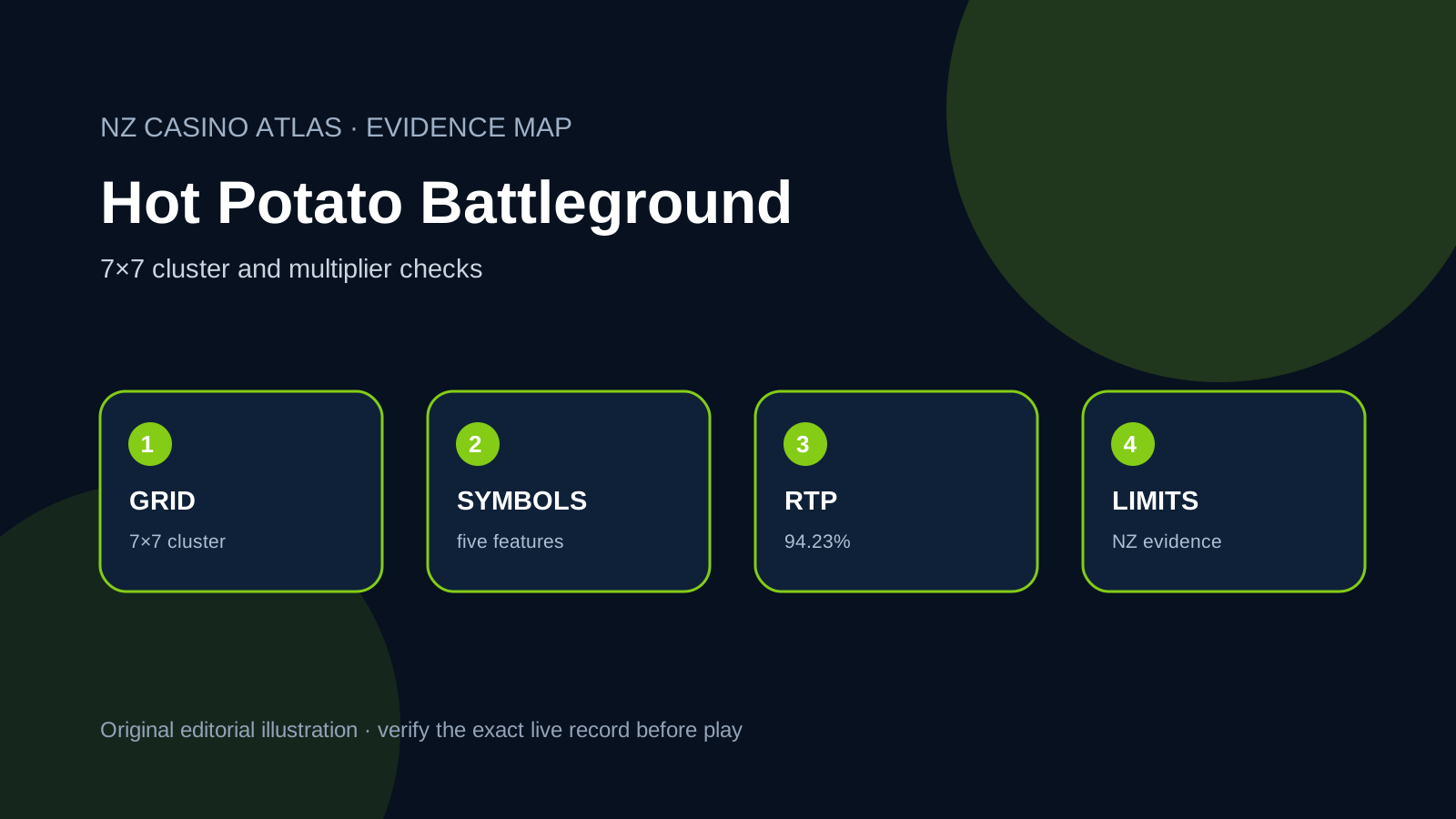
Thunderkick’s exact game page verifies the title, a 7×7 presentation, Cluster Pay requiring five or more symbols, High volatility, RTP 94.23% and maximum exposure of 10,000×. It also names Cell Multiplier Upgrades, five Feature Symbols and Persistent Cell Multipliers in the Bonus Game.
Those facts describe the supplier product. They do not prove that a specific operator offers the game in New Zealand, that every integration uses the same build, or that a reader can legally or contractually open an account.
The public page is a summary rather than a complete rulebook. It does not expose the full symbol-value table, exact orthogonal/diagonal adjacency rule, feature-symbol identities, trigger thresholds, stake range or probabilities. This review therefore marks those items for live-help verification instead of filling them from third-party reviews.
Thunderkick links desktop and mobile demo launchers with a game identifier ending in g110-94. A demo can teach controls and feature order, but only the help in the exact real-money client can prove the active rules and configuration.
- Grid
- 7×7
- Evaluation
- Cluster 5+
- RTP
- 94.23%
- Maximum
- 10,000×
Evaluation method
Five or more matching symbols must form a qualifying cluster
The product panel says “Cluster Pay 5+”. That establishes a minimum count but not the exact adjacency rule. Many cluster games use horizontal and vertical contact, while others add special connections; the deployed paytable must define it.
Record which positions belong to a winning cluster before symbols change. Separate simultaneous clusters of different symbols and note whether overlapping groups merge.
A 7×7 grid contains 49 cells, but board size alone does not state win probability. Symbol weights, transformations, removals and feature symbols all affect the model.
Do not import line, ways or pay-anywhere rules from another Thunderkick title. The Cluster Pay label controls this exact review.
Five named classes, missing public detail
The five Feature Symbols require exact help-screen definitions
Thunderkick states that the game contains five unique Feature Symbols. The public marketing copy does not list their names, values, activation order or whether they pay as ordinary symbols.
When inspecting the live game, record each icon, how it lands or is created, its trigger condition, affected cells and whether multiple feature symbols combine. A visual explosion is not enough to infer a cash award.
Feature animations may resolve before, during or after cluster removal. The settlement order matters when multipliers or persistent states depend on a cell.
Without official public probabilities, the review does not rank the symbols by frequency or value. A demo sample is too small to establish either.
Board state
Cell Multiplier Upgrades attach value to positions, not predictions
The supplier names Cell Multiplier Upgrades, indicating that individual positions can gain multiplier state. The exact starting value, increment rule, cap and qualifying event must be taken from game help.
Record the coordinate and multiplier before and after a settled cluster. Do not assume that every symbol passing through a marked cell receives the multiplier or that values combine by addition rather than multiplication.
A multiplier has value only when the rules apply it to a qualifying award. A large visible number on an inactive cell is potential, not money.
Persistent state can make later feature boards look stronger, but it does not make a win due. Random symbol placement still determines whether useful clusters form.
Persistent feature state
The Bonus Game retains Cell Multipliers under documented conditions
Thunderkick explicitly says the Bonus Game unlocks Persistent Cell Multipliers. “Persistent” should be read as retained for the duration and conditions stated in help, not as permanent account progress.
Before entry, record the trigger, starting spins or lives, initial multiplier map and any carried feature symbols. During the feature, capture which events upgrade cells and whether values reset on retrigger.
The public page does not publish the Bonus Game trigger count, starting duration, retrigger rule or probability. Those details remain unverified until the exact game help is inspected.
The feature can end without using every large multiplier. Persistent values increase opportunity on their cells but do not force symbols to land there.
One public figure
94.23% RTP implies a 5.77% theoretical house edge
The current Thunderkick product page lists RTP 94.23. Subtracting it from 100% gives a theoretical house edge of 5.77% for that documented configuration.
RTP is a long-run mathematical expectation over a very large number of rounds. It is not a minimum return, refund promise or forecast for one session.
The public page shows one number, but the exact deployed help should still be checked. Different builds or market profiles can look identical, and a supplier page can change after publication.
Do not estimate RTP from demo balance changes. A short sample is dominated by variance and cannot verify the mathematical model.
Distribution and ceiling
High volatility and 10,000× maximum describe different things
High volatility is Thunderkick’s qualitative distribution label. It suggests returns may be uneven, but it does not reveal hit rate, bonus frequency or the chance of the maximum.
Maximum exposure of 10,000× is the supplier’s ceiling relative to the relevant stake unit. Confirm in help whether the unit is total bet and how feature purchases, if any, are treated.
The game maximum is separate from operator withdrawal rules, account limits and payment processing. A casino’s contract cannot be inferred from the game page.
Set an affordable loss and time limit before play. Larger stakes and faster rounds increase cash exposure without improving RTP.
Missing public fields
Open the live paytable for symbols, triggers, stake and version
A complete help panel should define cluster adjacency, symbol payouts by cluster size, Wild or substitute behaviour, Feature Symbols, cell upgrades, Bonus entry and maximum-award settlement.
Record the total stake rather than only coin value. Currency and denomination menus can differ by operator and jurisdiction.
No build number or universal stake interval was visible on the checked public page. Release presentation and game ID are not substitutes for a version field.
If the live client conflicts with the product page, save both records, date them and ask the operator which build is deployed. Do not silently select the more favourable value.
Settlement sequence
Reconstruct one round in the order the game resolves it
Begin with the displayed total stake and untouched 7×7 board. Mark every cluster of five or more matching symbols according to the adjacency definition in help. Record its size and symbol award before any animation removes or transforms cells.
Next record which Feature Symbols activate, which cells receive or upgrade multipliers, and whether several effects resolve simultaneously or in a fixed priority. A visually dramatic effect may change board state without directly paying cash.
Continue through every replacement or secondary evaluation until the client declares the round complete. Then reconcile the total award with the account history and new balance. Do not count internal animations as additional paid spins.
This method does not reverse-engineer hidden probabilities. Its purpose is to test whether the documented rules explain a specific observed settlement and to preserve useful evidence if they do not.
Five unknowns to name
Build a feature-symbol table from the deployed help
For each of the five Feature Symbols, note its official name, ordinary pay status, trigger threshold, activation timing, target selection and whether it can appear in base play, the Bonus Game or both.
Record whether the symbols can combine in one round. If one feature upgrades a cell while another moves or replaces a symbol, the order may change the award. Do not infer priority from animation speed.
Check whether any symbol is blocked from substitution or cluster payment. Special symbols often have exceptions that a short product description cannot capture.
When a field is missing, label it unverified rather than “none”. Absence from a marketing page means the page is incomplete, not necessarily that the game lacks the rule.
Avoid double counting
Separate base cluster value, cell value and final award
A cell multiplier may apply to a cluster touching that position, to a symbol occupying it, or under another condition defined in help. Record the base cluster award first and the multiplier contribution separately.
If several multiplier cells participate, verify whether values add, multiply, select the highest or apply independently. Those operations can produce very different results, and the public page does not specify which is used.
Persistent values in the Bonus Game should be mapped spin by spin. A multiplier visible after a round may represent the next state rather than an amount already included in the current win.
Use the round history as the final reconciliation source. If the interface animation and account record differ, save both and contact verified support with the round identifier.
Exact deployment
Match product evidence to the operator’s active configuration
Save the title, Thunderkick name, game ID where visible, rules timestamp, RTP, language, currency and device. These details distinguish the observed client from a supplier page or another operator’s integration.
The official demo URL contains a game identifier associated with the 94 profile, but a URL token alone is not a substitute for an in-game RTP statement. Read the help panel and preserve the displayed figure.
Operator-specific controls can affect available stakes, autoplay, feature access and session tools without changing the artwork. Treat those as deployment fields rather than universal game rules.
Recheck after a substantial interface or rules update. A published review is a dated evidence snapshot, not a guarantee that every future build remains identical.
Session planning
Cluster streaks and persistent multipliers do not justify chasing
A near-complete cluster or high multiplier cell can make another spin feel unusually promising. Unless the rules explicitly carry state into the next paid round, the completed round provides no countdown to a future win.
Even inside a feature with persistent state, better-looking cells do not guarantee that matching symbols will land where needed. Potential and realised value remain different.
Choose an affordable maximum loss and time before play, and count any feature cost in the same budget. Stop when either limit is reached rather than increasing stake to recover a previous result.
If play stops feeling recreational, use the site’s New Zealand responsible-gambling resources and the operator’s time-out or exclusion tools where verified.
Evidence example
How to document one cluster-and-multiplier settlement
Suppose a round begins at a clearly displayed total stake and the starting board contains a group that appears to meet the five-symbol threshold. First use the help definition to decide whether every cell is connected correctly. Photograph or note the coordinates before the symbols disappear.
Next write down the symbol’s paytable value for that exact cluster size. If the cluster touches marked cells, record each cell value separately and wait for the game to show how the values combine. Do not calculate a final award from an assumed additive or multiplicative formula.
If a Feature Symbol activates, note whether it changes the current cluster, creates a new evaluation or prepares a later board. Then follow replacement symbols and new clusters until the round stops. The account-history total should reconcile the sequence.
This worked method is deliberately procedural rather than predictive. It can reveal a misunderstood adjacency rule, timing issue or multiplier operation, but it cannot establish the probability of seeing the same board again.
Known and unknown
Keep the supplier facts separate from unresolved help fields
The first-party page directly supports the 7×7 grid, Cluster Pay 5+, RTP 94.23%, High volatility, 10,000× maximum exposure, five Feature Symbols, Cell Multiplier Upgrades and persistent multipliers in the Bonus Game.
It does not publicly provide the full paytable, adjacency definition, trigger mapping, symbol transformations, feature frequency, stake interval, bonus duration, retrigger rules or build number. Those are not zero and should not be guessed.
Third-party reviews may describe a tested version, but importing their precise values would weaken this page unless the exact build and source can be matched. The present article keeps unresolved fields visible so a later live-help record can update them cleanly.
Readers can report a documented conflict through the site’s corrections process. A useful report includes the title, operator, date, device, game ID, RTP screen, rules page and round identifier where relevant.
Exact title only
Do not borrow rules from another Hot Potato edition
A shared theme, character or series name does not prove that two games use the same grid, cluster threshold, multiplier persistence or RTP. This URL covers only Hot Potato Battleground as documented on Thunderkick’s exact product page.
If a lobby omits the Battleground suffix or shows conflicting artwork, open the help panel and match the full title and game identifier before using this guide. Treat an unresolved mismatch as a different or unverified product.
Learning route
The supplier demo is useful for controls, not availability proof
Thunderkick provides desktop and mobile demo launchers from its product page. Use them to inspect interface layout, information menus and sequence timing when access is permitted.
Demo credit has no cash value, and demo access does not prove the game is enabled at a casino accepting New Zealand residents.
Compare demo and real-money title, provider, game ID, RTP, rules, stake controls and maximum. Similar artwork is insufficient.
On mobile, ensure the information panel and total stake are readable without clipping. Rotate or expand the panel rather than guessing a cropped field.
No availability inference
Supplier publication does not establish New Zealand access
Thunderkick’s global catalogue proves authorship, not operator eligibility. A reachable demo, lobby screenshot or New Zealand flag is not contractual evidence.
Identify the operator, domain and legal company; read restricted-country and age clauses; verify licence claims; and inspect the authenticated cashier before considering payment.
Use the New Zealand legal-status guide for the national context and the Thunderkick provider hub for catalogue navigation.
The supplier’s Great Britain credentials concern its software activity and do not authorise an unrelated casino to serve New Zealand.
Practical audit
Hot Potato Battleground checklist
- Match the full title and Thunderkick developer name.
- Confirm the 7×7 grid.
- Read the exact Cluster Pay adjacency rule.
- Verify the five-symbol minimum and complete paytable.
- Identify all five Feature Symbols.
- Record Cell Multiplier start, upgrades and cap.
- Check Bonus Game trigger and duration.
- Confirm how persistent multipliers reset.
- Read the active RTP rather than relying on artwork.
- Keep 10,000× game maximum separate from cash-out terms.
- Record total stake, currency and version.
- Use demo only to learn controls.
- Verify operator identity and NZ eligibility separately.
- Set money and time limits before paid play.
Questions answered
Frequently asked questions
What RTP does Thunderkick publish for Hot Potato Battleground?
The current official product page lists 94.23%, equivalent to a theoretical house edge of 5.77%.
How large is the grid?
Thunderkick lists seven reels and presents the game as a 7×7 Cluster Pay title.
How many symbols make a cluster?
The public game-details panel states Cluster Pay 5+, but the exact adjacency rule and symbol prizes should be checked in live help.
What is the maximum exposure?
Thunderkick lists 10,000×. This is a game maximum relative to stake, not an operator withdrawal promise.
Does the official demo prove NZ availability?
No. A supplier demo establishes neither operator eligibility nor real-money availability for a New Zealand user.
Evidence record
Primary sources
Facts and configurations were checked against the following first-party records. A public product page is not proof that a game is available through a New Zealand operator.
- Thunderkick — Hot Potato BattlegroundChecked 7 October 2026
- Thunderkick — official games catalogueChecked 7 October 2026
- Thunderkick — studio identityChecked 7 October 2026
- New Zealand DIA — online gambling for playersChecked 7 October 2026