Short answer
What the first-party record establishes
Vegas Fortune is an AvatarUX video slot released on 29 April 2025. AvatarUX's current product record lists alternative RTP settings of 96%, 94%, 90.5%, variance as High, and win potential of 10,000× total bet. Those fields describe the supplier product, not a promise that every casino uses the highest return or that the game is currently available to a person in New Zealand. The unit matters when comparing stakes.
This review keeps three evidence levels separate. The public product page proves the title, developer, release date and advertised mechanics. The supplier's linked demo is useful for inspecting presentation and help when it loads in the reader's territory. Only the help panel inside the exact real-money client can prove the operator's configured RTP, currency, stake controls and supported build.
AvatarUX does not expose a public version number, complete symbol paytable or universal stake range on the checked product page. We therefore do not invent those fields or borrow them from an affiliate review. If they matter to a decision, open the deployed game's information panel before staking and record the version, total bet, RTP and payout table shown there.
- Developer
- AvatarUX
- Release
- 29 April 2025
- RTP options
- 96% · 94% · 90.5%
- Win potential
- 10,000× total bet
Stack compression
Infinity Stacks merge matching symbols downward
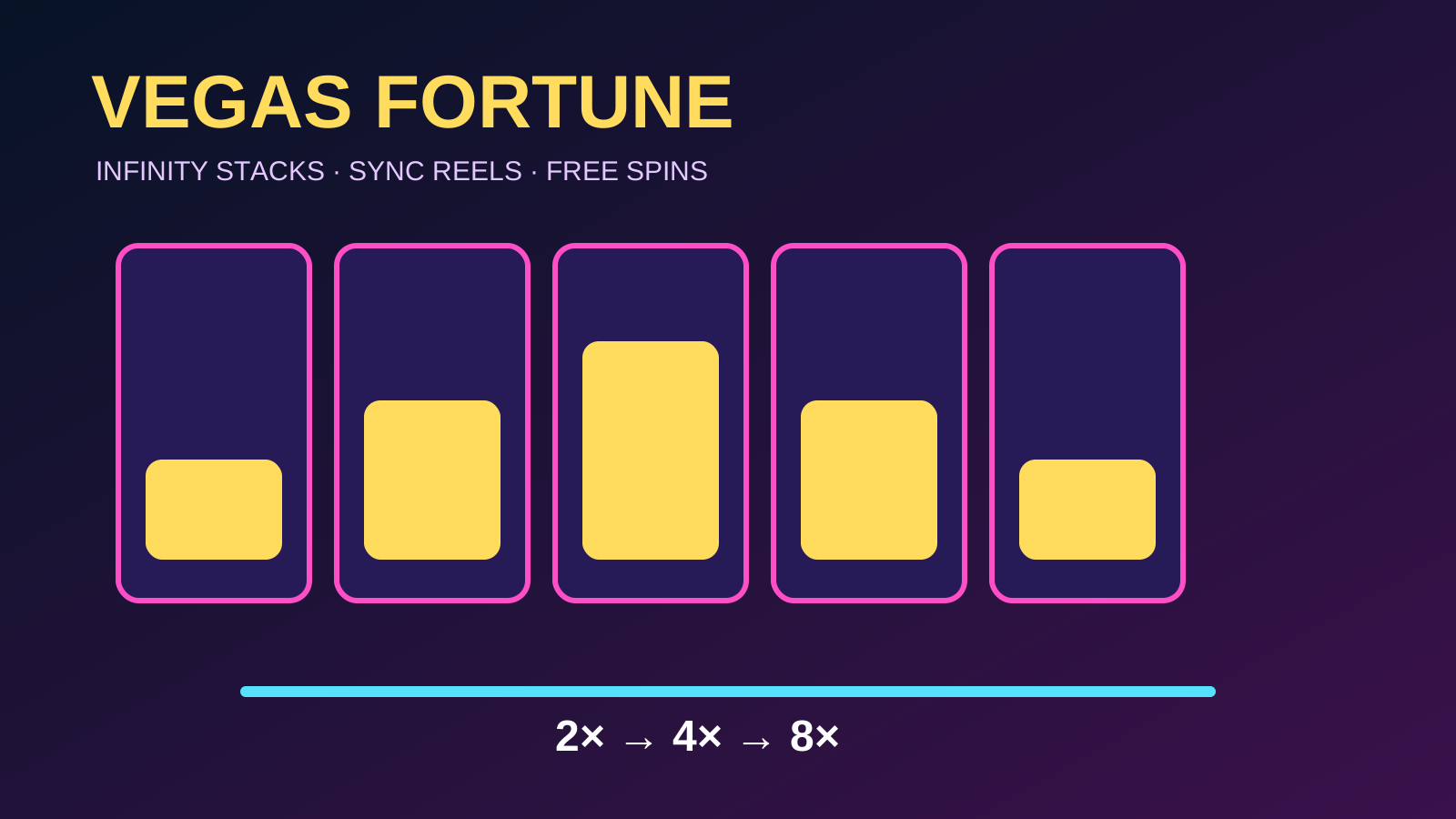
Matching symbol stacks can combine into a lower position. Random multiplier symbols begin at 2× or more and can grow when involved in a qualifying merge. The important sequence is selection, downward merge, win evaluation and any subsequent stack event.
A larger displayed multiplier is conditional: it still needs the documented winning structure. The page does not publish multiplier weights or the average number of merges, so neither can be inferred from a short demo.
Nudging doubles
Giant Stacks enter from the top or bottom
Double-sized symbols can nudge into view and merge with matching nearby symbols. This is a symbol-placement event, not a guaranteed win. Record whether a Giant Stack changes one reel or several and when settlement occurs.
The exact grid and ways count are absent from the public product summary. Use the live help to establish the board and matching direction before interpreting an animation.
Adjacent alignment
Sync Reels align two or more neighbouring reels
Two or more adjacent reels can synchronise to show matching symbol layouts. Synchronisation can improve coverage, but it does not guarantee that the resulting layout connects under the active ways rule.
Free Spins increase the role of Sync Reels and add random or sticky multipliers, cascading stacks and a global multiplier. These modifiers belong to the bonus state rather than every paid spin.
Scatter entry
Three or more Scatters trigger Free Spins
The number of Scatters controls the initial award, and three or more Scatters during the feature can retrigger. The public page does not expose the complete scatter-to-spins mapping, so this guide does not invent it.
Capture initial spins, sticky values, global multiplier changes, retriggers and the final settled amount. A 10,000× ceiling is not a statement about the likelihood of any bonus path.
Live-help audit
Verify each stack and multiplier state in order
Save the pre-spin board, the symbols selected to merge, their destination, multiplier before and after, any Sync Reel event and the credited win. In Free Spins, also record the global multiplier and whether local values are sticky.
Confirm the active RTP inside the deployed help. Identical graphics can sit on any of the three supplier-supported configurations.
Alternative configurations
RTP evidence and theoretical house edge
The supplier publishes more than one return setting for this title. They are alternative mathematical configurations, not simultaneous returns and not a range that fluctuates during a session. A platform normally selects a supported configuration for its deployment. The graphics and feature names may look identical across settings, which is why a screenshot of the title screen is not sufficient evidence.
| Published option | Theoretical RTP | Theoretical house edge |
|---|---|---|
| 1 | 96% | 4% |
| 2 | 94% | 6% |
| 3 | 90.5% | 9.50% |
Theoretical house edge is calculated as 100% minus RTP. At the highest published setting, the edge is 4%; at the lowest, it is 9.50%. That difference can be material over large turnover, but neither figure forecasts one session. RTP is a long-run design measure across a very large number of random rounds, not a minimum refund or a schedule of wins.
The product page does not map those percentages to named market IDs or operator brands. It would therefore be misleading to call 96% the “standard New Zealand RTP”. New Zealand availability is not established, and even an operator serving an NZ visitor could deploy another supported setting. The active value must be read from the exact client.
Do not infer RTP from demo balance changes, a short sequence of spins or a streamer result. A brief sample can sit far above or below the theoretical average. The supplier demo can explain control placement and mechanics; it is not an audit tool for a percentage that requires enormous sample sizes and knowledge of the complete model.
Record the full title, displayed percentage and date together. If the live help shows a value outside the three published options, stop and ask the operator for clarification. It may be a different version, a stale help file or a product update. Combining conflicting records silently would make the guide less reliable.
Missing public fields
Paytable, stake range and version checks
A complete paytable should show which symbol combinations pay, the direction or evaluation method, whether Wilds substitute, and how feature symbols behave. AvatarUX's public marketing record summarises the main mechanic but does not publish the full symbol-value table. This page therefore explains the documented feature logic without pretending to reproduce every prize cell.
Before real-money play, open the information menu and inspect the paytable in the same client that will accept the stake. Match the full title and AvatarUX name, then check the grid or pay method, Wild behaviour, scatter conditions, feature entry, maximum award wording and any purchase or enhanced-bet cost. A similarly named Pots of Power title is not interchangeable.
The public page also omits a universal minimum and maximum stake. Operator currency, denomination menus, market controls and platform integrations can change what appears. The only safe number is the total bet displayed immediately before the round. Coin value, level and number of lines can be separate controls, so confirm the amount actually deducted from the balance.
No public build or version identifier was visible in the checked product record. “Released on 29 April 2025” is not a version number. A later mathematical or interface revision could retain the same title. Where the client exposes a version, game ID or rules timestamp, save it with the RTP. Where it does not, record the operator, URL, date and screenshots of the help fields.
These omissions are evidence limits, not proof that the fields do not exist inside the game. Our method is deliberately asymmetric: a first-party value can be published when present, while an absent value stays unfilled until a verifiable source appears. That prevents an old review or another title's help from being promoted into a current fact.
Distribution, not prediction
Variance, maximum win and session risk
The supplier labels variance as High. Variance describes how the return is distributed, not how often a specific feature must occur. It does not create a countdown, and it cannot tell a reader that a bonus is “due” after a run of ordinary spins. Each paid random round must be considered without a recovery promise.
The product page advertises win potential of 10,000× total bet. “Total bet” means the complete price of the initiating paid round. It is different from an operator withdrawal limit, account balance limit or jackpot pool. A maximum-win field describes the game model; contractual cash-out rules belong to the operator and need a separate terms check.
A published cap is not a likely target. It does not state the probability of reaching the cap, the typical bonus return or a safe session length. Without an official probability, this guide will not estimate one. Marketing animations, progress effects and near misses must not be treated as evidence that the largest award is approaching.
Risk grows with stake and round count. A simple pre-session control is to decide the maximum amount and time that can be lost without affecting essentials, then stop when either limit is reached. Faster play does not improve RTP. Buying or enhancing features, where offered, changes immediate exposure and may use a separately published return.
No game feature reverses the basic uncertainty of random play. A multiplier can enlarge a qualifying win but also appear on a round without a useful combination. A larger board or stronger modifier can improve potential without guaranteeing a positive result. Rules describe possibilities; they do not turn possibility into expectation for a short session.
Official learning tool
Demo, mobile and help-screen limits
AvatarUX links an official “Try demo” launcher from the product page. That makes the supplier demo a legitimate learning route for interface and feature presentation when territorial and technical access permit it. It is not an endorsement of a casino, not proof of legal real-money access in New Zealand and not evidence that an operator uses the same configuration.
The checked demo endpoint is supplier-hosted. Readers should expect demo credit to have no cash value. A demo win cannot be withdrawn, and a memorable sequence cannot predict paid outcomes. If the launcher fails or redirects, use the product page rather than an unofficial mirror.
On mobile, verify that the help button, total stake, balance, paytable and RTP remain readable before interacting. Small screens may hide secondary panels behind an information icon or scrollable overlay. A cropped value is not a confirmed value. Rotate the device or expand the panel, and do not rely on search snippets when the client supplies a current field.
Compare demo and real-money modes field by field: title, provider, version where visible, RTP, stake controls, feature prices, win cap and rules. Similar artwork alone is insufficient. If a demo exposes one RTP while the operator client exposes another, describe them as different configurations rather than accusing either of being incorrect.
Help text is strongest when it belongs to the exact deployed client, but it still needs context. Operator eligibility, identity verification, payment ownership, bonus terms and withdrawal policy sit outside the game's help. Conversely, operator terms cannot replace missing game rules. Reliable evaluation keeps those two evidence chains connected but separate.
No availability inference
What this does not prove for New Zealand
An official global product page proves that AvatarUX publishes the game. It does not prove that a named casino accepts New Zealand residents, that an account is permitted under current terms, or that the title is enabled in an NZ-facing lobby. A flag, NZD selector or reachable demo is not a substitute for contractual eligibility.
Before considering an operator, identify the contracting company and domain, read current restricted-country clauses, verify age and location rules, inspect the authenticated cashier, and confirm complaints and safer-gambling routes. Use the site's dated New Zealand online-casino legal-status guide for the national context. This game review is not legal advice.
Payment availability also needs account-level proof. A public cryptocurrency or card logo does not establish deposits, withdrawals, NZD support, fees or limits for one person. Never send funds merely because a game appears in a lobby. Verify the operator and account first, then verify the game configuration inside that same environment.
Supplier licensing statements are not operator licences. AvatarUX's footer identifies software-supplier credentials for Epic88 entities in Sweden, Romania and Malta. Those records can help identify the developer, but they do not authorise a separate casino to serve New Zealand or resolve a player's dispute with that casino.
Reconciled record
Evidence notes and unresolved fields
The supplier page verifies a ways game, Infinity Stacks, Giant Stacks, Sync Reels, random multipliers, Scatter-triggered Free Spins, three RTP profiles, High variance and 10,000× potential. It does not expose the exact grid, ways count, stake range, Scatter-to-spins table, probabilities, complete paytable or public build number.
The first-party product page and its linked demo were checked on 6 October 2026. The published date makes this a snapshot, not a permanent guarantee. Supplier fields, demo routes and supported mathematical profiles can change. A later reader should prioritise a newer first-party record and report a conflict through our corrections process.
Third-party pages were not used to fill the missing version, stake range or full paytable. Those sites can be useful for discovering a question, but copying a precise number without a traceable current source creates false confidence. The editorial methodology explains why we preserve an explicit “not publicly exposed” result.
A useful recheck preserves both positive and negative findings. Record which fields were visible, which menu was opened, the language and device, and which fields were absent after a reasonable inspection. An absent public value is not automatically zero or unavailable inside the game; it simply remains unverified for this article. If a later supplier page or deployed help adds the field, update the value with its source and date instead of silently replacing the earlier evidence note.
Release status also matters. This review covers the product record as currently released, not a “coming soon” card or an assumed future build. If the catalogue changes the label, the source date and live help need to be rechecked before the article claims a new status.
Practical audit
Checklist before choosing whether to play
- Match the full title Vegas Fortune and developer AvatarUX.
- Confirm the game is released, not an upcoming catalogue card.
- Open the exact real-money help; do not rely only on the product page.
- Record the active RTP instead of assuming the highest published option.
- Read the complete paytable, evaluation method and Wild substitutions.
- Check the displayed total stake, currency and any enhanced-feature price.
- Keep 10,000× total bet game potential separate from operator cash-out rules.
- Use demo mode only to learn controls and feature order.
- Verify operator identity and current New Zealand eligibility independently.
- Set affordable money and time limits before the first paid round.
Questions answered
Frequently asked questions
What RTP options does AvatarUX publish?
96%, 94% and 90.5%.
What is Infinity Stacks?
Matching stacks merge downward; qualifying multiplier symbols can grow as they merge.
How are Free Spins triggered?
The public description says three or more Scatter symbols trigger the feature.
What is the published win potential?
10,000× total bet.
Is Vegas Fortune confirmed for NZ?
No. The supplier record does not establish operator eligibility or NZ availability.
Evidence record
Primary sources
Facts and configurations were checked against the following first-party records. A public product page is not proof that a game is available through a New Zealand operator.
- AvatarUX — Vegas FortuneChecked 7 October 2026
- AvatarUX — Vegas Fortune releaseChecked 7 October 2026
- AvatarUX — games catalogueChecked 7 October 2026
- New Zealand DIA — online gambling for playersChecked 7 October 2026