New Zealand research
“Best” is a verdict, and a verdict needs a scope
Best at what? A player who wants low-variance table games, one who wants a particular supplier’s slots, one who needs a specific payment method in both directions and one who cares mainly about dispute routes are asking four unrelated questions. A single ordered list answers none of them precisely.
Best for whom matters just as much. Country eligibility, currency, available methods and offer qualification all depend on the account holder, and an operator can treat two New Zealand residents differently on the basis of verification status or account history.
Write the scope down before reading any list. Two or three must-haves, stated plainly, will disqualify most of a top ten faster than any score column, and they stay stable while the rankings churn around them.
The fields a comparison page can genuinely check
Some things are observable from outside and can be dated. The exact domain in the address bar. The legal company named in the terms, the privacy policy and the footer. Whether the current terms are readable at all from a New Zealand view. The revision date on that document. The presence or absence of an entry in an official register.
Published catalogues are checkable too, as published claims: which suppliers a lobby lists, which methods a page advertises, which locales exist. These are first-party statements about a page at a moment in time, which is a real finding as long as it is labelled as one.
Each of those fields carries a source and a date in our own work. The methodology page sets out the standard we hold ourselves to, and corrections are published rather than quietly absorbed, so a reader can see when a verdict moved and on what evidence.
The fields that stay unverifiable from outside
An account’s deposit and withdrawal limits, its fee treatment, the documents verification will request and the order in which cash-outs are processed are all account-level facts. They differ by currency, method, history and risk assessment, and no public page can stand in for them.
Service quality is similarly out of reach. Support response times, how a complaint actually escalates, whether a limit request is applied promptly and how an ownership change is communicated are experiences rather than published fields. Aggregated user reviews describe other people’s accounts, self-selected by whoever chose to write.
We therefore avoid publishing a withdrawal speed, a fee figure or a document deadline for a brand we have not held an account with. Where such a number belongs, the honest version names the place to read it: the cashier, the current terms, or a written answer from support.
Why a ranked list reads more precise than its evidence
Ordering implies measurement. A list running from one to ten suggests a shared scale applied to comparable data, and a score such as 9.2 suggests two decimal places of confidence. In practice the inputs are often the same public pages any reader could open, weighted by a judgement that is rarely published.
Commercial arrangements add a second and quieter ordering pressure. A list can be accurate about its individual facts and still be arranged by something other than those facts. The disclosure explaining this is usually short; the table that benefits from it is usually long.
A useful test: for any brand in a top position, ask which specific, dated, checkable fact put it there. If the answer is a sentence of adjectives, the position is an opinion wearing a number.
Star ratings and review counts are not measurements
A five-star display and a review total are interface elements. They summarise something, but the page rarely states which population was sampled, over what period, under what moderation, or whether the count folds in ratings imported from elsewhere.
Where this guide shows a promotional placement with figures attached, those figures belong to the placement rather than to an audit we performed. Commercial units are labelled as commercial and kept separate from the editorial findings on the same page.
Treat every number in a comparison as carrying a provenance question. Who produced it, when, and from what? A page that cannot answer those three is showing decoration.
Licence status is the field most lists skip
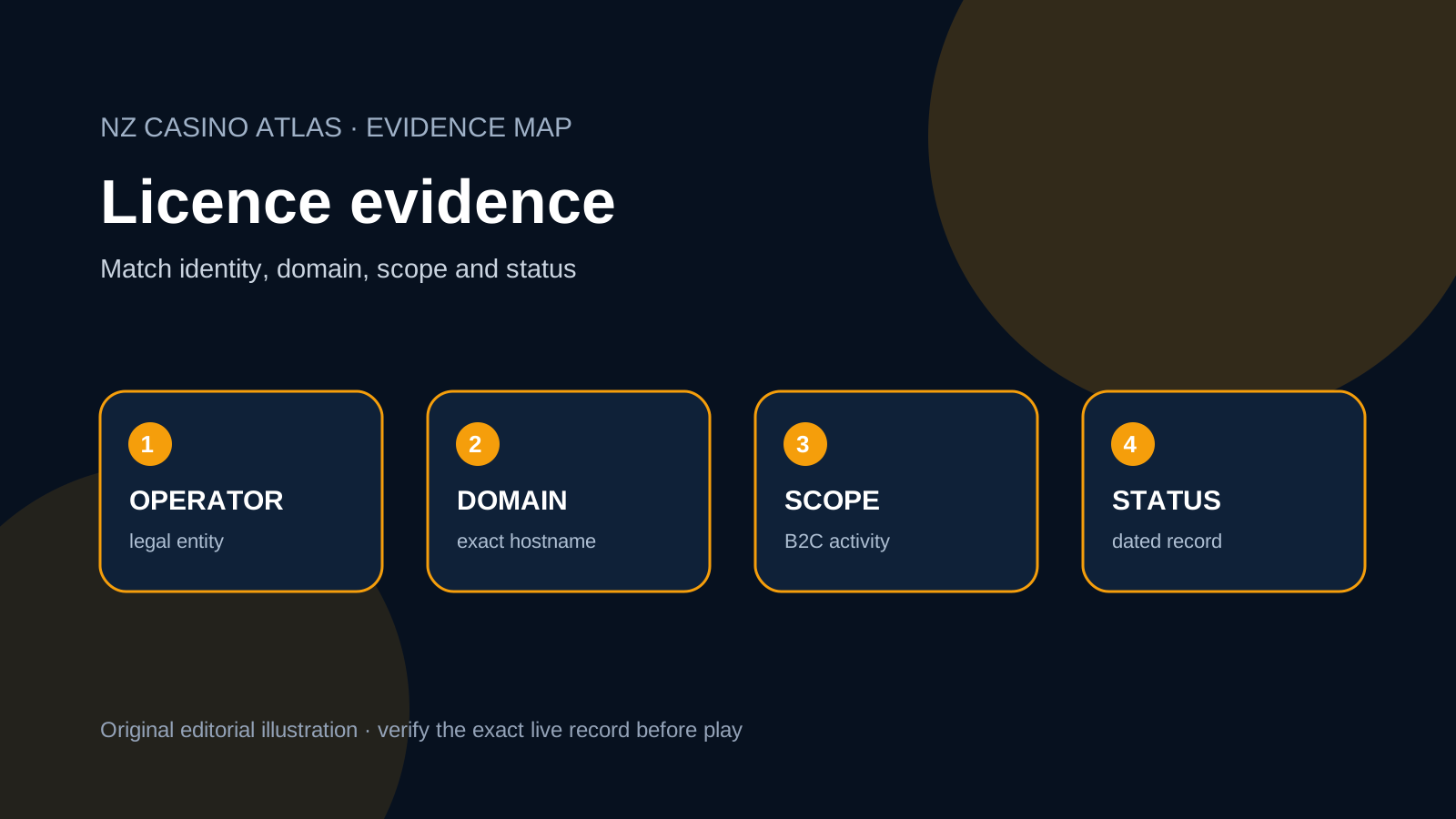
The most consequential field is also the hardest to make attractive: which authority, if any, currently authorises this operator to supply online casino gambling to a New Zealand resident. A badge in a footer does not answer that question.
New Zealand’s own position is in transition, and our dated legal-status page tracks the stages rather than compressing them into a single sentence. Until an official register entry can be matched to a specific company and platform, this guide describes no operator as New Zealand-licensed.
An overseas licence is a genuine fact about a different system. It may say a great deal about an operator’s obligations in that jurisdiction; it says nothing about New Zealand status, and it does not become a New Zealand licence by being displayed to a New Zealand visitor.
Build the shortlist yourself, then test it
Start from your own constraints: the payment route you will actually use in both directions, the suppliers or game types you want, the currency you want the balance held in, and whether you need a readable complaint path. Four lines is enough to work with.
Then test each candidate against those lines using documents rather than marketing. Open the terms and search them for country, currency, verification and withdrawal. Note the revision date. Save a copy, because the version that governed your deposit is the version you will want to quote later.
Anything failing a must-have is out, however it is ranked elsewhere, and anything you cannot verify stays unresolved rather than being promoted to a yes. An unresolved field is a legitimate reason to stop looking at a brand.
What would change a verdict here
A positive change needs new primary evidence: a readable current contract naming the contracting company, an eligibility clause covering New Zealand residents, and an official record matching the exact platform. A marketing refresh does not move a verdict.
Negative changes count equally. A company substitution, a terms revision narrowing withdrawal rights, a register event such as suspension or surrender, or an access route that stops resolving are all findings worth publishing with a date attached.
If you hold evidence contradicting something on this site, send the exact official URL and the date you saw it through our corrections route. Pages are updated in place rather than split into new URLs, so the record stays in one findable location.
Best online casino in New Zealand: the limits: common questions
Which is the best online casino in New Zealand?
This guide publishes no single answer, because the decisive fields are account-level and the New Zealand licensing position is still in transition. What we can offer is the checkable evidence per brand and a method for applying your own criteria to it.
Why do New Zealand lists disagree with each other?
Different weightings, different commercial arrangements and different check dates. Two lists built from the same public pages can order them differently without either being wrong about the underlying facts.
Are the star ratings on this site audited by you?
No. Figures shown inside a commercial placement belong to that placement and are labelled as such. Editorial findings on the same page carry their own sources and check dates.
Does a long row of payment logos indicate a good casino?
It indicates a catalogue. The methods actually offered to you depend on country, currency, verification status and account history, which only an authenticated cashier reveals.
What single check yields the most information?
Reading the current terms end to end with the revision date noted. One document names the counterparty, the eligibility rules and the withdrawal conditions, and no comparison table reproduces it in full.